Harsh realities and systemic challenges facing the homeless discussed at meeting following death of East Toronto woman
By MATTHEW STEPHENS
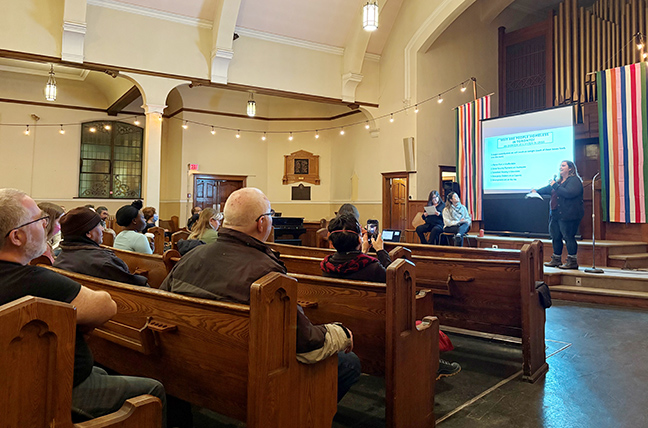
Community members filled the pews of Glen Rhodes United Church (1470 Gerrard St E.), to honour the life of Mary (Rita), and address the pressing homelessness crisis in Toronto.
“This meeting came out of a tragedy. A tragedy that has happened over and over again,” said East End United Church Lead Minister Rev. Bri-anne Swan said as she opened the community meeting at Glen Rhodes on the evening of Monday, Feb. 3.
Back in December, Rita died while sleeping in a makeshift shelter in the parking lot of a Shoppers Drug Mart just east of Coxwell and north of Danforth avenues. Although no official cause of death has been released, it’s believed she may have frozen to death.
She often volunteered her time to help at the Glen Rhodes food bank and became well known within the community as a compassionate individual who will be missed dearly.
“She would come and offer what she could to the community,” said Swan. “The volunteers miss her, and the community misses her.”
Death within the homeless community is not an uncommon occurrence. From January to June 2024, Toronto Public Health (TPH) reported 135 deaths in the unhoused population.
“How many of you have a garage?” shouted one member of the community during the meeting’s Question and Answer panel. “For those of you who do, your car has better shelter and accommodation than people living on the streets.”
The community meeting underscored TPH’s data of disproportionately high mortality rates amongst the unhoused community, with life expectancy now standing at 50 years for males and 36 years for females.
“When I noticed the heartbreak of so many that was being expressed, it was very clear that something needed to happen, and we just happened to be fortunate enough to have the space and the connections with the various outreach workers,” said Swan, emphasizing that lasting change often begins at the grassroots level.
Rita’s passing inspired the public meeting, which focused on addressing systemic issues that force people into the shelter system and subsequentially onto city streets.
“We were invited to talk about what the system is like. To open up for people the common misconceptions around people ‘Not choosing to do certain things,’ as opposed to the reality of the system being so overloaded and in crisis that people don’t have the options that we think they do,” said United Church of Canada community organizer Angie Hocking in an interview after the meeting.
Hocking joined community organizers and members of the Toronto Underhoused Homeless Union for a visual presentation and Q&A panel at the meeting to discuss the harsh realities and systemic issues afflicting unhoused individuals. The community meeting sought to inform residents and break down the barriers between those experiencing homelessness and the general public.
“The regular person doesn’t even know how somebody accesses shelter, or what that means to access shelter, or where the shelters are,” said Hocking. “There’s just shocking basic information. So, raising awareness of that I think is the first step because it really puts things in perspective.”
Toronto-Danforth Member of Parliament Julie Dabrusin attended the meeting to show her support for the unhoused community. She praised the meeting’s organizers for highlighting some of the key issues contributing to the city’s ongoing homelessness crisis.
“I thought it was really good to bring the community together and to hear directly from people who are working to support people who are experiencing homelessness, and also from people who have that experience directly,” said Dabrusin in an interview with Beach Metro Community News the day after the meeting.
“They pointed to a lot of the problems that exist, and it’s good for the community to come together to try and better understand what the challenges are for housing in our city and in accessing benefits,” she said.
Issues detailed in the presentation included data and statistics highlighting the city’s overwhelmed shelter system, unaffordable market rent, oppressive landlord practices, inadequate Ontario Works (OW) and Ontario Disability Support Programs (ODSP), and long wait lists for subsidised housing.
According to Toronto’s Shelter System Flow Data, there were 11,144 people actively homeless within the last three months – a number which has already exceeded the city’s 2024 Capital and Operating Budget plan to increase the number of beds in the shelter system to 10,600.
The city’s budget notes say, “Even with a proposed increased service level of 10,600 beds per night, the gap between shelter service levels and unmet shelter demand is expected to continue to widen in 2024.”
In a report from CBC last year, the city sheltered 9,969 people and turned away approximately 178 visitors daily due to capacity constraints between the months of January and April.
To combat skyrocketing rent prices and alleviate the pressure faced by at-risk individuals, the city of Toronto intends to implement increased access to Rent-Geared-to-Income (RGI) subsidized housing in Toronto. Unfortunately, wait times for access these services can range between eight to 15 years depending on the unit size.
During Monday’s meeting, public speakers addressed the widely known, rule of thumb “30 per cent of income” concept for paying rent through both personal means and subsidized housing. However, they believe this rule has become unrealistic in today’s economic climate.
In Ontario, minimum wage workers take home an annual salary of $35,984. According to the City of Toronto’s website, average market rent for a one-bedroom apartment is around $20,496 annually – which means minimum wage worker would be paying more than half of their annual income to afford a one-bedroom apartment in the city; assuming they’re able to find a place at the average cost. Even a hostel/dwelling room priced at an average market rent of $13,404 would still see a minimum wage worker paying more than 37 per cent of their wages to afford a home.
For those receiving Ontario Works (OW) or Ontario Disability Support Program (ODSP) payments, the gap between income and rent is even wider.
Dabrusin didn’t have an opportunity to speak at Monday’s meeting, but in her interview with Beach Metro Community News she called on all levels of government to step up on the homelessness issue. She also mentioned ways the federal government has been doing its part to support the homeless community.
“As a federal MP, I would have liked to have a conversation that touched on some of the federal programs that have been created over the past several years, and what people would want to see as changes or increases in those existing programs,” said Dabrusin.
She also praised efforts led by Indigenous organization Na-Me-Res, which has been collaborating with the federal, provincial, and municipal governments to build 20 affordable housing units for Indigenous people in East Toronto.
Dabrusin also mentioned the Rapid Housing Initiative: a federal program that has supported the city and the Indigenous and non-profit sectors to create new affordable supportive housing. Most recently, the initiative has been working to build affordable housing for East Toronto seniors.
“On the Danforth there’s housing being built for seniors experiencing homelessness through the rapid housing program, and there’s more affordable rentals that’s being built down at Queen and Coxwell,” said Dabrusin. “Those are examples of where you can actually see physical buildings going up, and there’s been funding provided by the federal government to the city to help with providing support for people experiencing homelessness and living in encampments.”
When asked about the best ways to support the homeless community, Dabrusin said “the construction of permanent, affordable, and supportive housing,” should be the top priority for all levels of government in Canada.