
East Toronto residents say community concerns are being ignored by city and province in rush to approve new developments
By MATTHEW STEPHENS
What do Main Street, Woodbine Avenue and Newbold Avenue in East Toronto have in common?
Some Beaches-East York residents say ongoing development proposals for sites on these streets underscore a pattern of disregard for community feedback at the provincial and municipal government levels.
“After the ravine condo debacle and Murphy’s Law and so many others… Residents have lost their voice,” said resident Melanie Zettler in a recent email to Beach Metro Community News.
The highly controversial proposal for a 10-storey building at the Murphy’s Law site (1684-1702 Queen St. E) received a final stamp of approval from city council late last month, while the fate of a 13-storey building proposal just north of the Glen Stewart Ravine at 847-855 Kingston Road awaits final approval from the Ontario Land Tribunal (OLT) after an agreement was reached between the developer and the city.
Among several proposals in recent years, concerns regarding height, density, and lack of affordable housing have been prominent among many local residents.
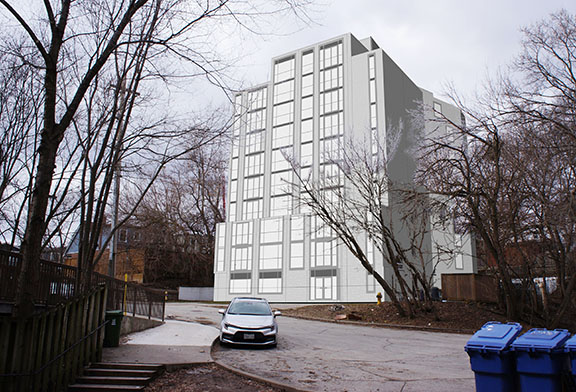
Last month’s public meeting to discuss a 10-storey proposal at 4 Newbold Ave. (in the Coxwell Avenue and Gerrard Street East area) faced backlash from the community and Beaches-East York Councillor Brad Bradford, who said it was inconsistent with the neighbourhood context, according to resident and meeting attendee Dean Miller.
“Councillor Bradford spoke first about the proposal being clearly inconsistent with the neighbourhood (height, massing, density); serious potential parking and traffic problems, and that he does not allow new on-street parking for new development; and about surrounding habitat,” said Miller.
He said other residents opposed the proposal for a lack of parking, “family-oriented” units, and “architectural character.”
In a recent statement to Beach Metro Community News, Bradford said the proposed development at 4 Newbold did not fit with the context of the surrounding area, and that not including parking on site conflicted with his mandate for no on-street permit parking.
“From discussions with residents and city staff, it was clear this proposal did not make sense in that context, and I encouraged the applicant to listen to the feedback and revise the proposal,” said Bradford. “To be clear, no new developments in our ward are eligible for on-street permit parking. The applicant is therefore required to build enough on-site parking to meet future demand.”
A proposal for an 11-storey building at 143-147 Main St., just south of Gerrard Street East, is also raising community concern given its height in relation to the surrounding neighbourhood. A virtual community meeting on that proposal was held in February and residents were told the area has been designated by the city and Ontario Ministry of Municipal Affairs and Housing as one of Toronto’s Protected Major Transit Station Areas (PMTSAs), identified to support future growth and density.
Across the board, many residents say updated provincial legislation and municipal policies have created a sense of hopelessness when trying to oppose proposals that comply with the governments’ vision for new development in Toronto.
“419-425 Woodbine Ave. (just south of Kingston Road) is yet another example of overdevelopment that completely shuts out residents’ concerns. We’ve seen it at the Glen Stewart Ravine, at Murphy’s Law, at 6 Dawes Rd.; the problem is city-wide,” said resident Adam Smith in an email to Beach Metro Community News.
“The province has changed the rules in every way necessary to shut out residents in the push for more development and density.”
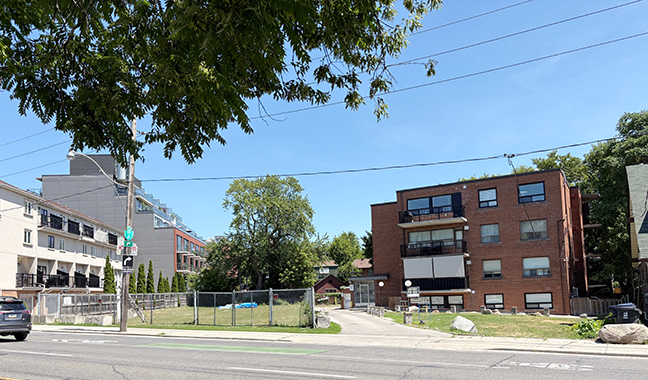
The site of 419-425 Woodbine Ave. is currently subject to an 11-storey mixed use building proposal with 123 residential units and 11 rental replacement units, while buildings consisting of 29, 39, and 37-storeys at 6 Dawes Road have been approved.
One resident complained that the application process for the Woodbine proposal has been a “closed door” engagement between city staff and the developer, providing little opportunity for community feedback.
“I think the 419-425 Woodbine is another example of not only a lack of public input, its indicative of the closed door policy the city has implemented whereby staff work for months or years on a proposal with a developer, to go around the legal bylaws and guidelines and then ask for public input once it’s already been negotiated,” said Elizabeth McGregor, a local resident for more than 35 years.
A community consultation for the Murphy’s Law proposal highlighted developers’ involvement in government policy changes.
During the community consultation meeting to discuss the Murphy’s Law application, planning consultants at Bousfields said studies to update the city’s 2024 Mid-Rise Guidelines to allow more height had been going on as early as 2016.
“Yes, the new Mid-Rise Guidelines were approved in 2024, but the study for the new Mid-Rise Guidelines had been going on for more than three years before that. In fact, it had been studied since 2016 with an update before that, and there were evolving thoughts on rear transition, height of buildings, things like that,” said David Morse, a consultant for Bousfields Inc. at an October 2025 public meeting.
Several provincial bills passed in recent years have also helped to fast-track development proposals and increase housing options for Ontarians, including the More Homes for Everyone Act, 2022 (Bill 109), More Homes Built Faster Act, 2022 (Bill 23), and the latest Fighting Delays, Building Faster Act, 2025 (Bill 60).
Under current legislative policies, developers can receive expanded as-of-right permissions, lowered development charges, and can even seek refunds for application fees or appeal to the Ontario Land Tribunal if timelines are missed.
Despite the province’s power to increase density and fast track taller buildings, Beaches-East York MPP Mary-Margaret McMahon said municipalities ultimately need to step up and internalize community feedback before proposals reach the provincial level.
“You need to strike a balance and be willing to work with the community,” McMahon (who is a Liberal MPP) told Beach Metro Community News in a recent interview. “Primarily, that is led by the city councillor. The councillor can engage the community as little or as much as they want.”
She said Toronto’s transition to virtual consultation meetings post-pandemic has also limited opportunities for public input.
“The city only mandates that there’s one meeting in the community, which used to be in person, and I think we should go back to in person,” said McMahon. “That was a COVID issue (the virtual meetings), but thankfully we’re out of COVID, so I think that should go back to in person.”
For McMahon, one virtual consultation meeting and a statutory meeting at Toronto and East York Community Council is “not enough” for residents to provide their feedback on new developments.
“You’re never going to please everyone, but the community needs to feel like they have some skin in the game,” added McMahon.
At the municipal level, city policy also plays a role in speeding up the approval process, by delegating minor decisions to staff; providing class exemptions from Site Plan Control Applications; and issuing a Pre-Application Consultation Process checklist to prevent late-stage delays.
Bradford said provincial policy has required Toronto to delegate site plan applications to city staff.
“Other provincial policy changes have required the city to delegate approval on site plan applications to staff, which is where technical details around issues like landscaping and external materials are addressed,” said Bradford.
However, Smith said this conjunction of provincial and municipal guidelines have created a system where the city blames the Ontario government for development approvals.
“City staff hide behind the provincial policies, approving developments that five years ago would not have been approved and actively dismissing any and all residents’ concerns. Then council hides behind the staff recommendations and rubber stamps the application without scrutiny.” said Smith.
“(Premier Doug) Ford has imposed mid-rise guidelines that supersede urban design guidelines and do not put any true limits on development, and he has made it so residents and conservation authorities have zero voice at the OLT.”
Last month’s approval of the Murphy’s Law application by Toronto Council showed councillors are concerned about their decisions being challenged at the OLT.
During the March 26 council meeting, Parkdale-High Park Councillor Gord Perks said council’s failure to approve the Murphy’s Law application would result in a hearing at the OLT, where the developer would win.
“What Councillor Bradford is moving will send us to the Ontario Land Tribunal (OLT), where we will lose,” said Perks. “We have a staff report that recommends accepting this application. And you all know what happens when we turn down staff recommendations.”
Bradford said that in recent years the provincial government has implemented several changes that “limit opportunities for resident input, restricted appeals, and sped up timelines.”
“I have heard from more residents who are concerned that their voices aren’t being heard,” said Bradford. “I’ve always been clear that we need to build more housing – but how we do it matters, and we need a process that makes sure we can reach the best outcome for the community.”
And without a means to contest the provincial government, Zettler said both residents and municipalities will continue to have limited power to oppose changes in their neighbourhood.
“What kind of city do we want? Do we want to live in a city where people who don’t even live here get to dramatically impact the lives of the actual residents?” said Zettler. “Shouldn’t tax-paying, small-business-supporting, family-raising community members who chose this neighbourhood (or any other specific Toronto neighborhood) have a say when it comes to things like density, aesthetic, vibe, traffic safety, infrastructure etc..? Well, that’s not the case anymore.”
Comments (0)
There are no comments on this article.