Caricature artist Patrick James works tirelessly to keep tradition alive on streets of Toronto
By MATTHEW STEPHENS
In an earlier time, street vendors and artists served as a critical, yet overlooked, part of Toronto’s culture. Fast forward to 2025: finding caricature artists working on city streets has been whittled down to a distant memory.
For more than 30 years, street portrait/caricature artist Patrick James has been desperately fighting to keep that memory alive.
However, in recent years, James believes working as a street artist in Toronto has become a profession riddled with outdated permit systems, sluggish progression, concerns of public safety, and failed promises from city and federal officials.
“So basically, you have Toronto with it’s slow way of doing things,” said James, who is an East Toronto resident. “All of Ontario is kind of like this with the system. They’re really slow at doing things compared to other cities.”
Up until 2017, the cost for a caricature artist permit was around $500, along with a $2-million liability insurance fee annually. Following two-years of negotiation between James, former Beaches-East York Councillor Mary-Margaret McMahon (now the area’s MPP), and the now-retired Deputy City Manager Tracey Cook, a new permit system was established; one that lowered those excessive fees down to $50 the following year – on par with the permit costs for buskers in the city.
Regardless of his efforts to lower fees and create a stable system, without critically essential changes to Chapter 740, or stricter regulation systems, James said he believes street artists operating in the city continue to face an uphill battle.
“Chapter 740 hasn’t been updated for decades. So, as a result, a lot of the issues in downtown Toronto related to permits for street artists is deteriorating every season,” said James. “Nobody is upkeeping the standard to safeguard the income of all these permit holders with proper policies that protect them from people who aren’t licensed, or the people who have licenses, but go around the rules.”
In addition to the city’s past high permit fees, street artists were also only permitted to work in certain locations determined by the city, to prevent pedestrian congestion in high-traffic areas. As part of James’s efforts to push the LS25.4 amendments to Chapter 740 on Street Vending, that too was changed, allowing caricature artists to operate wherever they see fit.
However, the fight is not over yet, and according to James, the persistent “archaic” systems have forced many street operators to throw in the towel and miss out on their assured and much needed seasonal incomes.
He is now hoping for Code Chapter 740 to be reevaluated and “fine-tuned” by Toronto’s Municipal Licensing & Standards to ensure that caricature and portrait artists will continue to thrive and operate under proper regulations. James is prepared to take any action necessary to push for changes in the system – even legal action.
“I intend to imminently use a possible court action to compel City Hall’s licensing division to finally carry out its 10-year-old moratorium, which would involve overhauling its hideously outdated street entertainers/street vendors licensing system,” he said.
James began his career working in portraiture before committing to a full-time career in street artistry in the early 1990s. During that time, he operated alongside many other artists in Toronto at Yonge and Dundas Square.
By the early 2000s, after 10 years of working out of the notoriously tourist-heavy location, he and the other street artists were removed from the area due to the city’s concern that the redevelopment of Yonge Street near the Eaton Centre would cause a congesting influx of tourists and pedestrian traffic.
The city’s regulations prompted James to venture to Montreal, and later Kingston, Ontario, where he said he experienced updated permit systems that he believed to be effective in providing street artists with sustainable annual incomes.
“Many operators have given up on what was once assured seasonal incomes. For the street portrait artists, only one or two are left out of the initial 30 plus from 30 years ago,” said James. “Compare this to Old Montreal with its effective updated permit system in which 20 similar artists are consistently thriving on annual seasonal incomes.”
Upon his return to Toronto in 2014, James said he noticed the glaring disparities cultivated by the city’s ineffective regulations had a debilitating impact on the world of caricature artistry. He now fights tirelessly to see those regulations change , but so far to no avail.
“Each year, the licensing division bosses, and policy staff have promised they were going to fulfil their promises ‘this coming Fall’ and always thereafter, they break that promise,” said James.
As a potential response to his ongoing concerns of working in the inner city, James has devised a proposal for a new system to be implemented that would create a “safe haven” for hand-picked artists to operate annually at the Harbourfront Centre (235 Queens Quay W.).
“I’ve been trying to rectify the current situation – which is that it’s not workable there. That’s why people don’t take advantage of these cheaper permit fees; it’s chaos down there,” said James. “Who wants to work in that kind of setup?”
In addition to creating a safe hub for caricature artists to operate, James’s initiative aims to revive public interest in public caricature art, revitalize Harbourfront’s reputation, and utilize the space to turn the location into a popular tourist attraction.
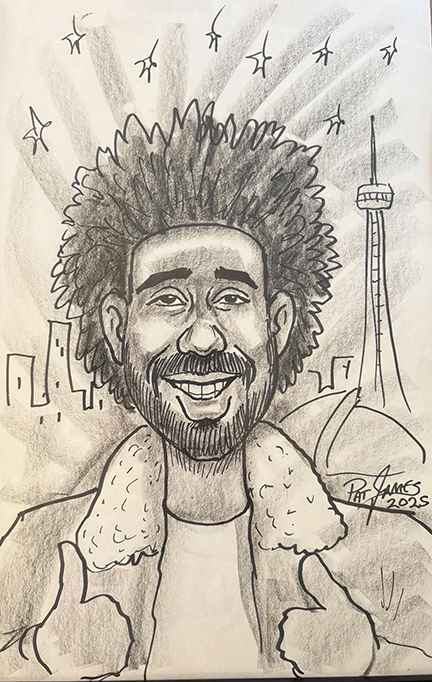
In October of last year, James said he visited the office of Beaches-East York MP Nathaniel Erskine-Smith for help in achieving his plan for Harbourfront but so far no further progress has been made.
According to James, a similar action to safeguard street artistry was taken within the private confines of the Distillery District in Toronto. He believes these private spaces are just some of the very few safe and affordable locations to operate as a caricature artist.
“Outside of those private property areas, homelessness and hazardous conditions plague all public spaces downtown where street entertainers would normally operate,” said James.
James continues to hope that one day city and federal officials will help to conceptualize his vision to keep caricature artistry alive in the City of Toronto.