Ontario’s new zoning policy shutters safe drug consumption sites, sparking debate on public safety and addiction support
By AMARACHI AMADIKE
On Tuesday, August 20, Ontario announced a new policy banning safe injection sites from operating within 200 metres of schools or childcare facilities.
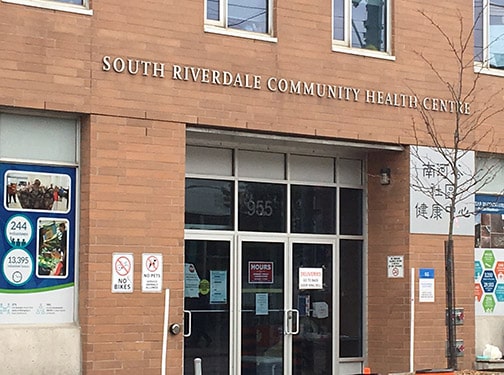
The announcement means that 10 facilities in Ontario — including South Riverdale Community Health Clinic (SRCHC) near Queen Street East and Carlaw Avenue, the facility which prompted the provincial government’s review of all its safe drug consumption sites — will shut down.
“Our Board and senior staff will be carefully reviewing the Minister of Health’s announcement this afternoon and the implications for consumption and treatment services (CTS) in the province,” said SRCHC Director of Community Engagement and Communications, Gabriella Skubincan in an email statement to Beach Metro Community News.
With more than 500 fatalities from opioid toxicity in Toronto last year, and more than 2,600 opioid-related deaths across all of Ontario, advocates believe that providing drug users who are on a path to sobriety with a controlled environment will be beneficial to their well-being.
But critics point to reports of increased violence in neighbourhoods that host such facilities.
Following the death of Leslieville resident Karolina Huebner-Makurat, the 44-year-old mother of two who was killed by a stray bullet in a daytime shooting near Queen and Carlaw streets last July, the intersection where SRCHC is located, the location was put under the microscope as community members called for a halt to its safe consumption services.
Before the incident, residents urged officials to help control the rising violence, which they attributed to SRCHC’s safe consumption site.
Neighbours shared stories of alleged violent threats directed at them from SRCHC clients as well as complaints of streets that were littered with used needles and drug paraphernalia.
There was further outrage that the Ontario government approved the safe consumption site despite its proximity to Morse Street Junior Public School.
Although SRCHC tried to change the public perception of their services through a number of open houses, Ontario succumbed to the demands of safe consumption site critics.
However, SRCHC officials say that “safe consumption is a very small part” of their operation and they will continue to provide other essential services to the community.
“Our focus is on ensuring we have a plan in place for providing continued compassionate care to the clients we serve, support for our dedicated staff and dialogue with our neighbours,” said Skubincan.
With 10 of the 17 provincially regulated consumption and treatment services (CTS) set to be affected by Ontario’s new zoning restrictions, there will now be a shortage of services for those battling addiction.
However, Ontario pledged $378 million for Homelessness and Addiction Recovery Treatment (HART) Hubs to fill the void created by Tuesday’s announcement.
Clare Hacksel, a Leslieville resident and federal NDP candidate for Toronto-Danforth, told Beach Metro Community News that investing in replacement safe consumption facilities is vital in Ontario’s battle against drug addiction.
“When I watched the announcement, what I found troubling was that I don’t know what evidence that Doug Ford and Minister (Sylvia) Jones put forward to say that this move will mean fewer needles in the alley where my kid plays, or the school yard where he goes to school every day,” said Hacksel.
Hacksel says that the announcement felt like a closure rather than a reevaluation of the sites’ locations, leaving cities like Toronto ill equipped to provide support for people suffering from addiction.
Facilities like SRCHC, although generating a slew of criticism, often utilize their expertise to reverse many overdoses which, consequently, eases pressures in Toronto emergency rooms.
According to SRCHC, there were 355 non-fatal overdose calls attended by Toronto Paramedic Services for suspected opioid overdose this past June. The health clinic’s safe consumption wing, keepSIX, “reversed 74 overdoses and 517 overdoses at Moss Park.”
With keepSIX welcoming more than 8,700 patients with an average of 733 monthly visits between April 1, 2023, and March 31, 2024, Leslieville residents battling addiction have lost a vital resource.
“People who live in this community access the centre to manage the illness that they have,” said Hacksel. “That (illness) doesn’t go away just cause you close (the site). Could you move it an extra 100 metres to get it outside that 200-metre bubble? I think that’s worth exploring.”
Hacksel believes that this loss, once implemented, will be felt by the neighbourhood which she says is filled with people who are supportive of having a safe consumption site.
“I’ve canvassed more than 1,000 doors in our neighbourhood this summer,” said Hacksel. “I’ve heard people say they have concerns about this particular site.”
“And I’d ask if they want to see no harm reduction programs, or have more of a conversation about (SRCHC) services. Very consistently, my neighbours would tell me that they’re uncomfortable with the current location, and management, but they don’t want to see services just gone.”
Along with SRCHC, there will be four other supervised drug consumption sites shutting down in Toronto. These include Parkdale Queen West Community Health Centre; Regent Park Community Health Centre; Toronto Public Health at 277 Victoria St.; and Kensington Market Overdose Prevention Site.
According to the provincial government, these sites will stop operating no later than March 31, 2025.
“The Province just posted the reports from Unity Health who they appointed to evaluate the sites and nowhere in those reports do they say (to close the sites),” said Hacksel. “They (suggest) more security — extended hours.”
Although acknowledging that current safe consumption site locations “potentially” need to be reevaluated, the Toronto-Danforth NDP candidate highlights a lack of evidence that “[her] kid’s school yard is safer on April 1” because of the new restrictions.
Rather, she urges Ontario’s government to focus on “four pillars” which include strategies to get people into treatment in order to ensure users don’t rely on detoxing within the jail system; prevention strategies such as affordable housing to curb homelessness, ensuring people don’t fall into old habits after detoxing; well operated harm reduction facilities that are safe for both the people inside and outside the sites; and enforcement in the form of figuring out why so many drugs are making it over Canada’s borders.
But perhaps most importantly, Hacksel implores that community members come together and view those struggling with addiction as one of their own who simply need help.
“Thousands of people are dying,” she said. “This is not a joke. You live in a city where people are different from you. People have made different choices than you. People live in different housing situations and struggle with different problems. That’s the beauty of living in a community. We are not all the same, but that doesn’t mean that we cannot support each other.”