
Community Council approves plan for 40-storey residential building on Eastdale Avenue
By MATTHEW STEPHENS
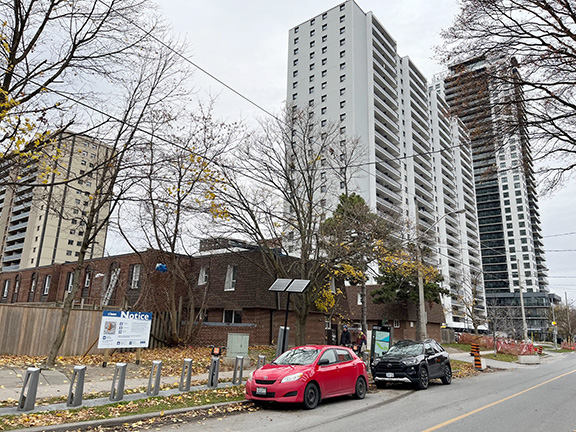
Tensions were high as a number of local residents called on Toronto and East York Community Council to defer a decision on a 40-storey residential building at 90 Eastdale Ave. and 2 Secord Ave.
“That was a lovely little neighbourhood. And we’re not against development, but it has to make sense.” said local resident Harry Leonard in his deputation to councillors at a Public Meeting on the proposal on Tuesday, Jan. 14, during Community Council’s meeting at Toronto City Hall.
Leonard also expressed his concerns about population density, transit and traffic congestion, and the wellbeing of students attending Secord Public School, in his deputation.
Among the residents to make a deputation at the meeting was former Beaches-East York Councillor Janet Davis, who took to the stand to highlight residents’ overarching concern of population density in the area.
“Just over these last six years, the number of units on this site have doubled,” said Davis “I’ve come to raise questions about when is density enough? Particularly when the community benefits that accompany it are insufficient.”
Davis was the councillor for Ward 31 (Beaches-East York) from 2003 to 2018. She did not run in the 2018 municipal election, which saw the number of wards in the city cut in half due to a decision by Ontario Premier Doug Ford. When Davis was a councillor, she represented the portion of the ward north of Danforth Avenue and east of Coxwell Avenue in East York.
The plans for Eastdale between Secord and Lumsden avenue, including another building (35 storeys) already constructed just to the north of the site discussed on Tuesday, was originally put before the city during Davis’ time as councillor. Lack of community benefits, including a community centre for the increased population in the surrounding Main Street/Dawes Road and Danforth Avenue area, were among the main concerns she expressed in her deputation.
While those concerns were discussed by councillors at the meeting, they chose not to defer the proposal and instead approved it for final consideration at next month’s full Toronto Council meeting.
Beaches–East York Councillor Brad Bradford said the application had already been deferred once before by Community Council, and deferring it again would present the risk of the proposal being appealed by the developers to the Ontario Land Tribunal (OLT). The applicant for the project is DBS Developments Limited C/O 90 Eastdale inc.
“We can’t speak to what risks might emerge; however, the applicant has passed the time at which it has appeal rights to the Ontario Land Tribunal,” said Director of Community Planning Carly Bowman, when asked by Bradford what the implications of deferring a decision might be.
Coming into a development project which started before his time, Bradford said it has been a long process getting to the approval stage given a number of factors including the replacement of existing rental townhouse units which will be demolished for the new building and that the building to the north has previously been approved.
“It’s a big site and there have been multiple phases. The original application on Phase One was approved before I was here, and the community has been very patient during that time,” said Bradford. “In my case, I was able to work with city staff to push and get some additional benefits for the community, and for me, top of mind – housing affordability is number one. That’s what I’m working for and that’s what I’m securing in these applications.”
As part of Tuesday’s meeting, there was also a Rental Housing Demolition and Conversion Application portion for the site discussed. There are 31 existing townhouse residential rental units on the site that will have to be demolished for the new 40-storey building that will contain 535 residential rental units. However, 35 rental replacement units will be provided by the developer as part of this project
Renters in some of the townhouses expressed concerns about how the conversion process would work for them, what kind of new units would they be getting, and how long would it take.
Jenny Laden said there is a lack of sufficient compensation when comparing her current home to the one she’ll receive following the redevelopment.
“In total, I have a three-floor townhouse with ample living and storage space,” said Laden. “What we are being offered as fair compensation for the space that is being demolished is not equal to what we have and are paying for now.”
According to Laden and other residents, the proposal doesn’t account for private outdoor living space; only offering shared outdoor spaces when the redevelopment is complete.
“We’re being told that the new units we’re being offered will be the same amount of living space as our current units. This is true as far as the inside dimensions, but the private space we currently have with our front and backyard is not taken into account,” resident Eliza Kirby Laden told the councillors. “When we move into our new unit, we’ll be paying the same amount for less.”
As part of the rental replacement plan for the proposal, the 31 townhouse residents are expected to be provided with an acceptable Tenant Relocation and Assistance Plan (TRAP) to ensure a smooth transition and “lessen hardship” for their transition to the new units.
As part of the redevelopment proposal, the replacement rental dwelling units are expected to collectively contain a total gross floor area of at least 3,953 square metres, and be comprised of two studio units, two one-bedroom units, 27 three-bedroom units and four four-bedroom units.
The redevelopment plan also ensures the 35 replacement rental dwelling units will have access to all indoor and outdoor amenities at no extra charge, as well as other benefits like ensuite laundry, central air conditioning, 21 rentable storage lockers, and 16 vehicle parking spaces.
Proprietors of the new building are expected to provide at least two studio, two one-bedroom, 13 three-bedroom at affordable rents, four four-bedroom units at mid-range (affordable) rents, and one three-bedroom unit at mid-range (moderate) rents; all for a period of at least 10 years following the date of first occupancy of each unit. According to the City of Toronto, rental costs for the remaining 13 three-bedroom replacement rental dwelling units will be “unrestricted”.
However, after years of construction to renovate the current buildings at 94 and 100 Eastdale Ave., and another projected three years of development for the new building, residents with disabilities such as Brian Moore said they have been facing accessibility difficulties amongst the ongoing construction surrounding the building site.
“This amendment is proposing another probably three years of construction,” said Moore. “In the previous constructions that are just getting close to finished, there were many accessibility issues created by the construction. For several months, the only path in and out of our complex was through the driveway where the construction vehicles came in and out.”
If not for his controlled rent, Moore said he would have already moved from the unit he lives in.
To combat construction traffic and access concerns, Bradford said he has worked to establish a motion in the application which intends to address construction staff and alleviate the anticipated increase in traffic in the area.
“It is a super congested area. It’s difficult to get back there, so this is to address that and manage some of the impact associated with the traffic infiltration. I’ve asked transportation staff to pursue site access via Dawes Road, and our staff here in transportation have reviewed and are going to work on that,” said Bradford.
In her deputation, Davis acknowledged the proposal’s plan for the new property owners to secure the surrounding buildings as rental properties for the next 20 years as one benefit of the redevelopment.
However, she believes that more support for community services would help to alleviate increased population growth in the surrounding area.
“It is a transportation hub; the density is huge. There has been no plan developed; we don’t know what community services are going to be available. The existing community centre at Main Square is being demolished; we have no idea if and where it’s being replaced,” Davis told councillors. “In the heart of this high-needs community is a school that’s designed and ready to be rebuilt.”
In her deputation, she urged city council to utilize the projected increase in population and accompanying financial revenue to support and relocate the local community centre at Main and Danforth, and to renovate Secord Public School – a school she said is at the top of the TDSB (Toronto District School Board) list for redevelopment.
“In the heart of this high-needs community is a school that’s designed and ready to be rebuilt,” said Davis. “There is an opportunity here to take what community benefits and money comes from all of this density and build a joint facility.”
In an interview with Beach Metro Community News immediately after Tuesday’s meeting, Davis said there are not enough community services being planned for the area to serve what will be its growing population.
“My concern about seeing the mass density that is coming to Main and Danforth and Dawes, in what is called a transit hub area, is that there simply are not the kinds of services being put in place or even planned that will accommodate that level of growth,” she said
Bradford said establishing community centres is a costly process not sufficiently covered in the Community Benefits Charge (CBC) paid by developers.
“I’d love to have community centre money; I’d love to build a community centre at Secord. You know what a new 65,000-square-foot community centre costs today? It costs $100 million bucks. You know what the CBC is…on an application like this? A fraction of that,” he said in the meeting.
In response to some deputants’ concerns over a lack of transparency regarding the Eastdale proposal, Bradford pointed out he had held several community consultation meetings regarding the redevelopment with residents and tenants (both virtual and in-person) between the months of May and October.
“We actually had a tenant meeting about the rental replacement and the relocation back in October at 2 Secord to make sure that the tenants were aware of their rights. And all of the remaining tenants accepted the replacement units within those buildings,” said Bradford.
During past meetings in recent months, Bradford said the attending tenants and city staff found the proposal’s rental agreements to be “satisfactory.”
When discussing the affordability crisis and establishing rent-controlled properties within the new development, as part of the application, Bradford said he had secured “net new” affordable rental units for the next 99 years – which is “well above any statutory requirements and well above the CBC (Community Benefits Charge) requirement.”
In an interview with Beach Metro Community News immediately after Tuesday’s meeting, Bradford said the “planning regime and legislative world” we are now in makes securing community benefits more difficult.
“But through a lot of dialogue, consultation and hard work, we were able to do more, and I think that’s a net benefit for the community,” he said.
“It’s an apartment infill site, and you’re seeing that across the city and these sites that were planned and conceived in the 1960s and 1970s – large sites, lots of space in between those original apartment towers. And now as we go, we don’t have a lot of additional land in Toronto, but we’re trying to create more housing supply.”