On The Wild Side: Sighting of short-billed dowitchers a highlight of the summer
By ANN BROKELMAN
The summer has come and, as always, in a blink of an eye it’s on its way out.
I can’t really complain, though, as this has been a lovely season for me, full of many exciting views of hawks, birds, foxes, and grandchildren. But the top highlights revolved around shorebirds.
Even after all my years of birdwatching, photography, and interest in nature, I’m still ‘discovering’ new wildlife neighbours.
I’d heard the name ‘dowitcher’ before, but for some reason it never stuck in my memory or caught my eye on a checklist of local birds, as something to see along the shores of Lake Ontario. I’ve also probably seen them dozens of times but at a far distance.
I’d gone down to the lake with some friends, Peg, and Shona, and were enjoying the swans, ducks, cormorants, and other waterfowl.
After a time, we noticed three birds, standing together and feeding along the shore, and I assumed they were sandpipers. Something about them seemed a bit off, however, so Shona took a picture on her phones and did a quick reverse-image search.
After a few seconds, the internet came through with an ID: short-billed dowitchers! Amazing how, only a few years ago, to have made a similar identification we would have had to have brought a sizeable picture book with us and hoped it contained a useful image to compare with what was in front of us.
As per my standard routine when finding a new animal, I went home and did some research that I’d like to share with you now.
The short-billed dowitcher, Limnodromus griseus, is a medium-sized, stocky bird with long bills. Well, they have long bills compared to other shore birds of similar sizes. I’m sure if you asked a long-billed dowitcher it would tell you the short-billed dowitcher has a rather…deficient…bill.
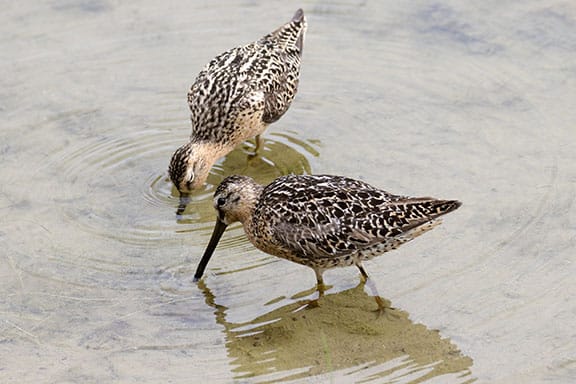
When hungry, the dowitchers will put enough of their head underwater to submerge their eyes and then walk along the shore poking and probing the ground for food.
While we watched the three along the lake for a while, and they were certainly eating something, we could never see exactly what they were pulling out of the water. According to All About Birds, they eat insects, larvae, crustaceans, marine worms, seeds of grasses, pondweeds, and bulrushes.
Short-billed dowitchers are ground nesters and typically have three-to-four eggs per clutch. Both male and female parents take turns incubating the eggs over a stretch of about 21 days.
Unlike most birds I’m familiar with, after the eggs hatch, the young will immediately leave the nest and look for their own food. The male parent will stay with the young, doing most of the work of protecting them, but neither parent will feed the chicks. They are also able to swim almost immediately and won’t shy away from the water.
I spoke with a few birder friends, who told me that the dowitchers have already started their migration south.
The ones around here will end up somewhere between Virginia and Florida, while the ones that nest in Alaska and British Columbia will spend their winters in California.
To see a new bird after all these years is always exciting, but to share the experience with my friends at the lake made it even better.
In recent weeks I’ve also seen many killdeer, and their babies, spotted sandpipers, least sandpipers, and even a Wilson’s Phalarope.
Get outside soon, and you can also enjoy the start of the migration of songbirds, hawks, and monarchs and other butterflies.
If you need help with an ID, just send me an email to abrokelman@gmail.com with the best pictures you can take. I’ll do my best to get back to you quickly!
Enjoy the rest of your summer, which officially ends on Sept. 22.