
Class action lawsuit by victims of Danforth Shooting against Smith & Wesson enters next phase
By ALAN SHACKLETON
More than eight years after the Danforth Shooting took the lives of two people and wounded 13 others, the lawsuit against the maker of the gun used by the shooter is entering its next phase.
In the Nov. 17 edition of Beach Metro Community News (Page 28) there is an ad from the law firms handling the class action lawsuit against American gun maker Smith & Wesson Corp. The ad is to ascertain those who will be part of the lawsuit that was first filed in December of 2019 on behalf of victims and families impacted by the shooting.
The class action lawsuit by representative plaintiffs Samantha Price, Skye McLeod, Kenneth Price, Claire Smith, Patrick McLeod and Jane McLeod against defendant Smith & Wesson Corp. is suing for $50 million in general damages and $100 million in punitive damages.
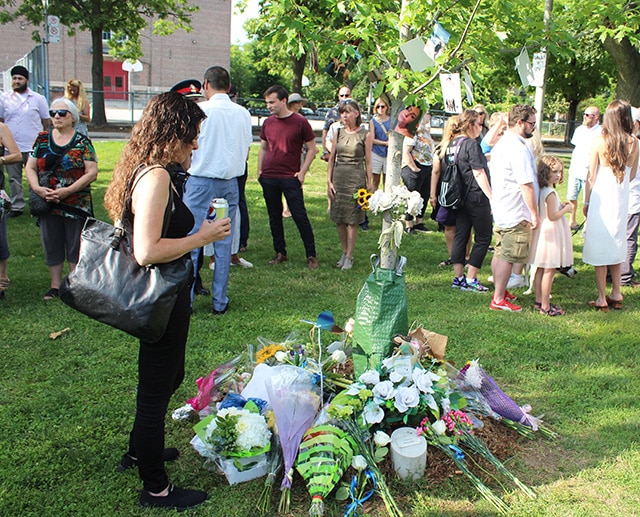
The Danforth Shooting took place on the night of Sunday, July 22, 2018, in the area of Danforth and Logan avenues. East Toronto resident Reese Fallon, 18, and Julianna Kozis, 10, of Markham, were killed in the shooting and 13 other people were injured. The shooter also took his own life that night.
Fallon had graduated from Malvern Collegiate in June of 2018 and was looking forward to studying nursing that coming fall at McMaster University in Hamilton. She was out with a group of friends on the night of the shooting and they were in the Alexander the Great Parkette at Logan and Danforth when the gunman began firing randomly at people on the street and inside businesses.
Fallon’s friend Samantha Price was wounded in the shooting. Skye McLeod, another friend who was out with Fallon that night, fell to the ground when the shots were fired and was then pulled into an area restaurant where she hid with other terrified patrons and those trying to escape the shooter.
Ken Price, Samantha’s father, has said the main goal of the class-action lawsuit is to force legislative changes that make safety features such as existing smart gun technology, which locks the trigger and prevents the use of a handgun by anyone other than its legal owner, mandatory.
“We decided to use the courts to shape public policy,” said Price of the lawsuit. “We did what we are doing to force changes in the law and through court decisions.”
The lawsuit claims Smith & Wesson did not build smart gun technology into the Military and Police 40 semi-automatic handgun that was used in the Danforth Shooting. According to the lawsuit, smart gun technology would have prevented the gun from being used by anyone other than the legal owner. The gun used in the Danforth Shooting had originally been legally sold in Canada, but was then stolen from a gun dealer in Saskatchewan in 2015. The allegations in the lawsuit have not been proven in a court of law.
Law firms Gowling WLG (Canada LLP), of Toronto, and Michel Drapeau Law Office, Nepean, are handling the lawsuit on behalf of the plaintiffs. According to the ad in today’s paper, the members of the “class” being represented in the lawsuit are “persons shot and injured or killed”, “other injured persons”, and “family members”. Excluded from the “class” are the shooter and his estate.
The ad in today’s paper includes a Class Action Opt-Out Coupon for those who could be considered part of the class but do not wish to participate in it.
It has been a long road since December of 2019 to see the lawsuit reach the stage it is now at, said Price.
He said the entire process has been an education in how Canadian courts function. Price said that while it has taken years to reach the certification point, he said that is actually a good thing as it shows how thoroughly the matter has been considered by the highest courts in Canada.
“There should be a high bar for certification, it should not be trivial. It should be a challenge to get certified,” he said.
One of the final legal decisions allowing the lawsuit to move forward came in June of this year when the Supreme Court of Canada said that it would not hear an appeal trying to stop certification.
In June of 2025, the lawsuit was certified by the Ontario Court of Appeal. The lawsuit had earlier been denied certification by a lower court judge, but the appeal to the province’s top court saw that decision overturned. This June, the Supreme Court of Canada said it would not hear the appeal of the Ontario Court of Appeal’s ruling.
In the United States (under the Protection of Lawful Commerce in Arms Act of 2005), gun manufacturers and legal sellers of weapons are protected by law from being sued or held liable when their products are used in crimes.
While the lawsuit is still possibly years away from going to a trial, and none of the allegations are proven in court, Price said the certification process has had “to prove” arguments that could be heard in a Canadian court are valid enough to be presented.
“This could still be a while though… It could be 2027 or 2028,” said Price.