
On The Wild Side: Tracking Monarch butterflies on their journey from Rosetta McClain Gardens to Mexico
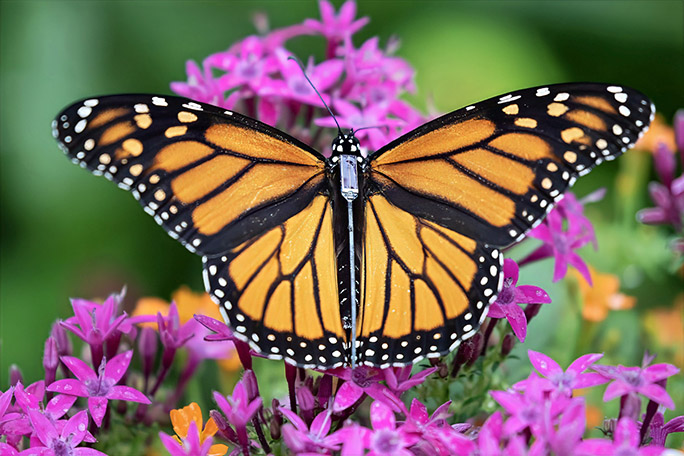
By ANN and ERIK BROKELMAN
Even after all my years of watching and counting Monarch butterflies (Danaus plexippus) at Rosetta McClain Gardens in southwest Scarborough, I still find myself learning new things about them.
While, since COVID, I’ve become a bit of a pro at helping raise them from the egg, to caterpillar, to chrysalis, to adult stages, (and I’ve helped many others learn to do the same), I’ve recently become interested in their migration behaviour and how we track them.
Their journey to Mexico is a marvel, and if you’ve never seen the images of them, in the millions, congregating in places like the El Rosario or Sierra Chincua sanctuaries, you need to search for images asap!
I was recently given the opportunity to observe a Monarch with a special tracking transmitter that allows me to follow its journey across the continent. I don’t know if my little traveler, named RMT26002, will make the full journey to Mexico, but I am completely hooked on following him (using the Project Monarch app free on my phone).
As of writing this article, this incredible little butterfly has traveled 1,150 kilometres in just 11 days. By the time this article reaches you, I hope he will be well past the 1,500-kilometre mark!
To tell you a bit more about this whole experience, I have to go back and introduce you to Betty McCulloch, of the Scarborough Rosetta Gardens Monarch Taggers (a wonderful local group of citizen scientists). I’ve known her for years and she’s taught me so much about different butterflies.
Betty was contacted by Dr. Greg Mitchell and Ana Diaz Bohorquez, from Environment and Climate Change Canada (ECCC), about a special tracking project. When they arrived at Rosetta McClain Gardens on Sept. 1, they showed the Monarch Taggers, how to safely attach a new type of transmitter.
The device, actually called a BluMorpho tag, weighs just 0.06 grams. It is completely solar-powered, without any battery at all, and is designed to track a butterfly’s daily flight using solar radio transmitter technology. The BluMorpho has been in use since 2023-2024 after a successful pilot program.
I was lucky enough to join Betty and the others for all of this and I actually managed to catch the very first Monarch of the day! I was also able to watch front-row seat to watch Greg and Ana demonstrate the proper technique of safely handling the butterflies and attaching the transmitter.
If you’re curious, the key steps included: measuring the wings, identifying whether the Monarch was male or female, weighing it, and checking for Ophryocystis elektroscirrha (a common parasite). Once those checks were done, the transmitter was gently secured using ordinary eyelash glue.
After the tag was attached, the butterfly was placed in a large mesh container for about five minutes, where it could be observed while it tested its wings. This was followed by Dr. Greg passing me the butterfly, me wishing it a safe flight, and the monarch taking off to continue its journey of more than 4,000 kilometres.
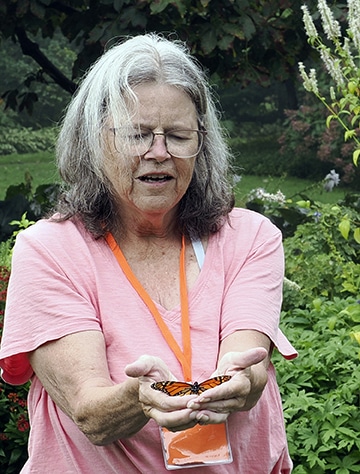
If I’m making the process sound simple, trust me when I say that it involved many precise, somewhat nerve-wracking, steps. These little creatures are so delicate that it would be easy to do them irreparable harm. Luckily, Ana and Greg patiently guided us through the entire process as we successfully tagged 33, out of 33, Monarchs over two days. .
If you’re interested in learning more or wondering how you can follow along with this at home, it’s so simple! All you need to do is download the Project Monarch app on your smartphone. And don’t worry about costs, because it is completely free.
Once you open the app, head over to the data tab where you can look up specific butterflies to see their real-time migration details. If you want to follow the exact Monarchs the Rosetta McClain Gardens team tagged, search for tags RMT26002 through RMT26033.
If you need a hand getting set up, please contact me at abrokelman@gmail.com and I would be more than happy to guide you through it so you can watch these little travellers make their way south. Let’s cheer them on together!



Wow! What a story! I downloaded Project Monarch, and am now following the monarchs’ progress to Mexico!
Carol
This was so exciting to be part of.
Ann
Rmt26032 monarch butterfly
Has made it to Mexico
Two Monarchs with transmitter have gone in two different directions.
One heading to Mexico and 1 towards Florida .
How exciting .
I can’t wait to find out where they are. 10 are still transmitting their location.
Another monarch butterfly with transmitter RMT26029 Raymee has travelled almost 2000 km and getting close to Texas . Incredible journey. There are still many other monarch on their way to Mexico.
If anyone would like more help downloading the Project Monarch app or how to find the Rosetta monarch transmitters let me know.
abrokelman@gmail.com
Very true Barbara
It is amazing
0.06 grams does not sound like much but it is actually over ten percent of their total weight…which is like strapping fifteen pounds to my back before I set out to walk hundreds of kilometres…I think I would much prefer if you didn’t, thanks…it also negates the science behind the project to some extent…and why 33? sounds like overkill…our amusement isn’t the point of ecology and science and caring about the natural world: maybe just leave them alone
Thank you for your comments Jane.
So amazing. Thanks for the information about the app. Downloading it now!
Shona I find it amazing seeing the different routes that the monarchs have taken. I just assumed that they would head the same way, imagine crossing Lake Erie in 3 hours.
Amazing. For years we have tagged monarchs with a small sticker on a hind wing, hoping they will be spotted travelling through the United States or Mexico. But this new BluMorpho device allows us to follow the journey on the Project Monarch app. We know they can cross Lake Erie in 3 hours, and some days they travel up to 100km a day, while other days they rest. It also depends on the weather in that area.