New East Toronto pickleball courts now open and proving extremely popular with players
By ALAN SHACKLETON
The dinks, chicken wings, volleys and more are running full speed at Toronto’s newest outdoor public pickleball court near Woodbine Park.
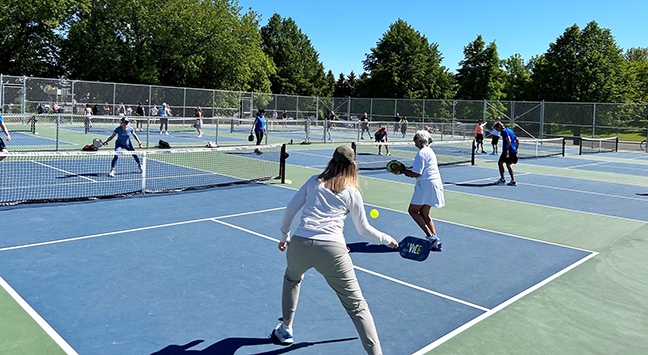
Located on the west side of Embaadiimok Avenue, between Eastern Avenue and Lake Shore Boulevard East, the courts which are being referred to as the New Woodbine Courts opened up for play on Monday, June 1, and are already seeing huge numbers of enthusiastic players. An official opening date has to be set, but as of now the courts are open for players from 8 a.m. to 9 p.m.
The facility, which features 11 courts including three larger-sized wheelchair-accessible courts. came to reality thanks to the hard work of the East Toronto Pickleball Association (ETPA), local politicians and the City of Toronto.
“We are very excited and happy that after four years of working hard and collaboration with the city that we finally have these courts open,” said Davi Ramjug, president of the ETPA.
“This is an historic moment for pickleball in the City of Toronto. We’re proud of this. We finally have this facility with 11 dedicated pickleball courts, and it is tournament ready.”
She said the need for pickleball courts across the city was acute, especially for good outdoor ones in public spaces.
“We used to play on outdoor hockey rinks in the summer,” pointed out Ramjug.
And with its growing popularity even more public pickleball courts are going to be needed across the entire city, she said.
“It’s popular because of the ease of the game. Anyone can pick up a paddle and you’re out there having fun hitting the ball around,” said Ramjug.
She said the sport appeals to wide range of age groups and should not under any circumstances be considered an activity taken up mostly by retirees.
“It’s for all ages and all skill levels,” said Ramjug. “You can have four people of different ages all playing together.”
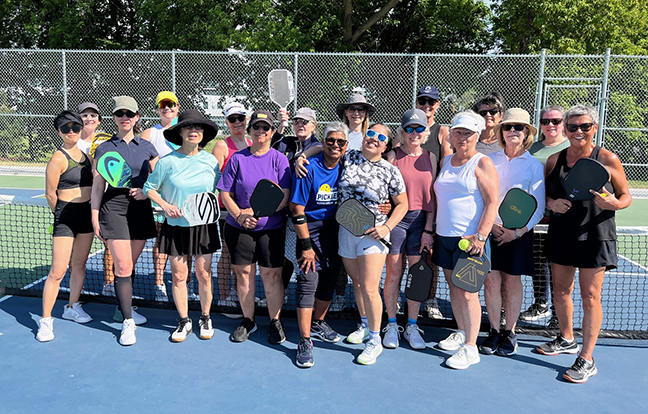
And that was certainly in evidence when Beach Metro Community News visited on the morning of June 5. Along with a skills clinic being run by ETPA pro Natalie Araya, there were numerous groups of teens, young adults and even a family with young children out on the courts playing on what happened to be a school PA Day.
Ramjug said the game also has many positive social benefits and an inclusive mindset that welcomes players.
“It’s one of the few sports with such a big social element. You can come as an individual player and then you’re playing with three or four strangers you don’t know at all but by the end you are all laughing together and making plans to meet again,” she said. “It’s great exercise and it’s fun to play.”
The ETPA is still waiting for the city’s signage to be installed that will help explain how the booking and permitting of the courts work as there has been some confusion as to what courts are available for play at what times.
“The public has been understanding but it would be nice for the signage to be up,” said Ramjug.
Basically, how it works is four courts are permitted to the ETPA or the Toronto Gay Pickleball Assocation (TGPA) or other community groups who have made online court bookings, two courts can be booked online for use, and the other five courts are available for free public drop-ins.
When not booked for permits, the other six courts can also be available for free public use. There is a cost to making an online court booking permit, and more information can be found at the City of Toronto’s where the facility is referred as the Main Sewage Treatment Playground at https://www.toronto.ca/explore-enjoy/parks-recreation/places-spaces/parks-and-recreation-facilities/location/?id=2283&title=Main-Sewage-Treatment-Playground
The ETPA is the city’s largest non-profit community pickleball association and is at its membership capacity with more than 700 members. For more on the ETPA, please go to https://etpa.ca/
Along with providing playing opportunities and advocating for facilities, the ETPA also offers a number of programs to teach the sport to members. When Beach Metro visited, pro player Araya was leading a Learn to Play session for the ETPA.
From Mississauga, Araya started her racquet sports career with tennis and was a tennis pro before starting to compete as a professional pickleball player and also a coach of the sport.
She said pickleball can be played and enjoyed at a number of skill levels.
And at the highest professional levels it is extremely competitive. Araya plays in the Canadian National Pickleball League and has been doing so for the past three years. “That’s the highest level of Canadian pickleball competition,” she explained.
Araya is also planning on taking part in some APP (Association of Pickleball Players) Tour events in the United States this year. Those competitions have large prize money available for competitors, prestigious corporate sponsors, and spectators purchase tickets to watch the matches.
“Five years ago I got into the game and I’m now playing competitively and in pro tournaments,” she said.
SOME POPULAR PICKLEBALL TERMS
Along with its huge popularity, pickleball also has a language that is unique to the sport with a variety of terms. Here is a few (but nowhere near all) of the popular pickleball terminology:
Ace – A serve not returned by the opponent.
Chicken wing – When a shot is hit into a player’s body and they are forced into an awkward elbow-bent position to return the ball.
Dink – A soft low shot from within or just behind the non-volley zone that lands in the opponent’s non-volley zone.
Kitchen – An affectionate term used for the non-volley zone.
No man’s land – The area in the middle of the court four or five feet away from the “kitchen” line. Ideally players don’t want to be standing there as balls can easily be hit to their feet.
Non-volley zone – A seven-foot area adjacent to the net within which the ball cannot be volleyed.
Poach – Used in doubles play when a player crosses into their partner’s area to play a ball.
Volley – To hit the ball before it bounces.