
In My Opinion: Journalism, Artificial Intelligence and the fundamental humanity of local news
By MATTHEW STEPHENS
For years we’ve been hearing about the benefits – and detriments – of Artificial Intelligence (AI) and its use in our daily lives. Be it questioning an AI-generated video on social media, or seeking assistance from an automated chatbot – it’s safe to say we’ve entered a new era of technological skepticism.
Not unlike the introduction of the internet in the early 90s, our inherent curiosity with AI has also permeated into the workforce. Many booming industries are now investigating what this new tech could bring to the table – and take away from it in the process.
With the ability to simulate vast intelligence and creativity at the speed of a supercomputer, we’re facing the reality that AI could soon replace many jobs that once required the efforts of a feeble mortal.
As a result, many industries – including my own – have seen the scales tip in favour of AI’s increasing power and unrelenting capability.
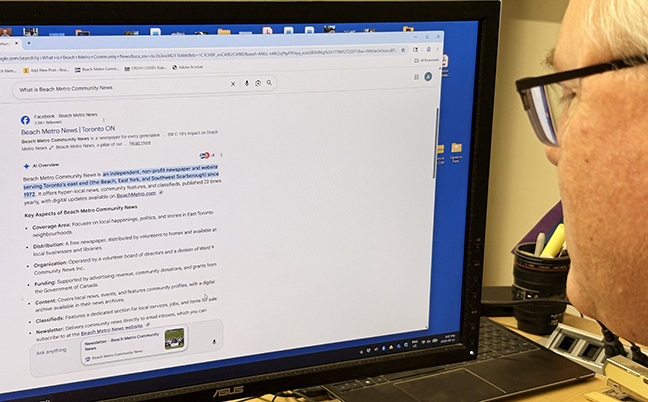
To illustrate this point as it relates to journalism, let me turn your attention to search engines. Now, those on the less “tech-savvy” side might be thinking, “how do search engines relate to AI?” Well, if you’ve looked up anything online within the last two years, there’s a good chance you’ve unknowingly experienced generative AI pulling the strings behind your search.
Generative AI is a form of artificial intelligence designed to create content, including text, images, code, music, and video. It creates content based on learning patterns from a vast, existing database of information. In recent years, some of the world’s largest search engine sites (Google, Microsoft Bing …) have been introducing generative AI responses to keep up with the newer, flashier AI-native search engines such as Perplexity AI and ChatGPT.
While I’m not opposed to technological advancements, these fancy new tools seem to have been designed to keep eyes and clicks on search engines for as long as possible, without properly crediting the work they use to power them.
With AI responses, information is gathered from multiple web sources and synthesized into one clear, concise summarization – and it all happens right on the search engine’s website, using information stripped right off the back of human labour.
A newfound alliance between AI and search engines might be beneficial for the corporate powerhouses running them, but for news outlets the outcome is less advantageous.
As a relatively new journalist navigating these circumstances, I often find myself asking, “how are readers expected to engage with our content directly when they’re being encouraged to allow AI to do the heavy lifting for them?”
It feels like search engines are using AI to ensure users never visit the very same sites they generate responses from – a vicious cycle that for better or worse, won’t last forever.
While it may seem harmless, or even efficient for the average user, this strategy to replace human work with generative AI is particularly harmful amongst news sites, where revenue can be directly tied to clicks and web traffic.
And that’s just scratching the surface of AI’s impact on what is already a particularly fragile industry. Misinformation, algorithmic biases, and an erosion of trust and authenticity all pose serious implications if AI is not used properly in the world of news.
It’s not all bleak and dystopian, however. AI has potential to serve the news industry with its vast databases of information, and ability to lighten our workload as journalists.
Evidence shows that, as a general tool, AI is currently shifting the balance of workflow in the fields for which it applies.
A 2024 report published on McKinsey Global Institute said current generative AI tools have the potential to automate tasks that take up 70 per cent of an employee’s time during the workday. In a separate report from 2025, the Institute said three times more employees are using generative AI for a third or more of their daily work.
While these stats may not apply to more labour-intensive jobs, they show AI’s use in the field of news reporting could be shifting from adversary to ally – with the tool now being encouraged for several applications, including data analysis, fact checking, and editing.
As a local reporter often tasked with delving into city documents, zoning applications, and corporate reports, I can attest that AI’s ability to simplify information and edit work has made my life noticeably easier, despite the looming idea that it could one day be my sole competitor.
However, I think that AI’s calamitous powers will be least effective against local news, where human connection serves as the beating heart of any community-based publication.
When I think about the stories I’ve covered as a reporter for Beach Metro Community News – and my connection to the community as a local resident – I can confidently say it would be difficult for artificial intelligence to fabricate the essence of what makes a local, human story.
AI simply can’t embrace the woes of a community opposing changes to the character of a neighbourhood; or empathize with a mother fighting to improve school services for her children. While I’m sure it could write these stories with ease, my thoughts are that it would still be missing… something.
If anything, our ongoing love/hate relationship with AI has taught me that local news boils down to some very simple elements – elements that are too fundamentally human to be replicated.



Comments (0)
There are no comments on this article.