
On The Wild Side: A visit with a White-winged Scoter by Tommy Thompson Park
By ANN AND ERIK BROKELMAN
If I asked you to picture a duck, what would come to your mind? You’d picture a green headed Mallard. Or would you think of a large white duck wearing a blue sailor’s shirt and cap? Do you know the one I mean; the one always hanging out with a particularly famous mouse?
While these are the ones that many people would think of first, you might be amazed at the variety of ducks in Ontario, let alone throughout the world.
In winter, Lake Ontario becomes home to several species of sea ducks that migrate south from the Arctic. These birds spend most of their lives on open water and have incredible shapes, colours, and behaviours that make them quite unique.
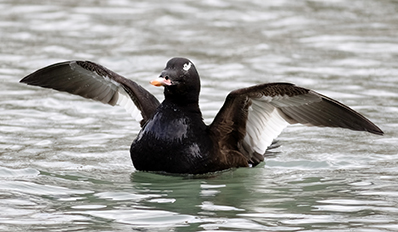
One of the most striking of this past winter’s visitors was the White-winged Scoter. Last month, at the base of Tommy Thompson Park, I was lucky enough to spot one swimming just off the shore.
Scoters are large members of the duck family, measuring about 48 to 58 centimetres long and weighing between 950 and 1,800 grams.
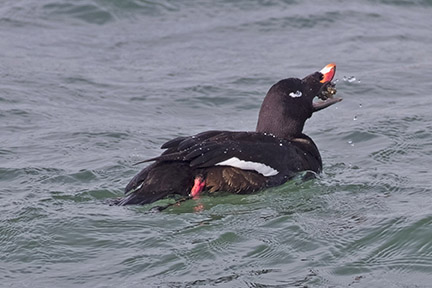
The tip of the bill is orange, and the males also have striking orange-red feet. This robust sea duck has a thick neck, a large head with a sloping forehead, and a sturdy bill. Male scoters have a rounded knob at the base of the bill and glossy black plumage. When I saw the white on his wings and around his eyes it made me realize how special the duck is.
Another interesting detail, which I learned later, is that male scoters take about three years to develop their full adult plumage.
Female and juvenile White-winged Scoters also show the distinctive white wing patches, although their overall colouring is a bit on the dull side: darker brown with lighter bellies. Females often have two faint white facial markings and darker bills, which helps distinguish them from the younger males. These ducks nest far in the north, usually on the ground and are well hidden in vegetation near water.
These ducks seldom come close to shore, so I was quite lucky with the one I saw. When they dive for shellfish you never quite know where they will surface again, or what they will bring up from the depths.
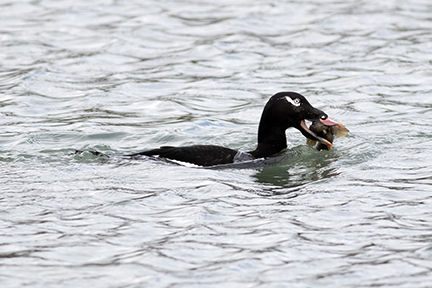
Because they are such large sea ducks, they can stay underwater for quite a long time while searching for food. Their diet varies depending on where they are feeding. In freshwater areas they often eat crayfish and aquatic insects, while in coastal waters they prefer mollusks and other crustaceans.
Tommy Thompson Park also hosting another remarkable sea duck this winter. A mature adult King Eider was spotted in the area. Unfortunately, my knee did not let me walk far enough into the park to see him. I have been fortunate enough to see a young King Eider in the past, but its plumage could not compare to that of a full adult.
If you’ve never seen one before, please take a moment to look up a picture now. I’d love to share one of mine, but I don’t have one! It’s on my list, and hopefully one day I’ll get to share the story of finally capturing one on camera.
If you have the chance, take a walk down by the lake. You still might just spot some of these amazing ducks visiting us from the far north.



Comments (0)
There are no comments on this article.