East Toronto parents express concerns over province’s funding of supportive school programs, plans to take over local boards
By MATTHEW STEPHENS
With the passing of Ontario’s Supporting Children and Students Act (Bill 33), the Provincial Ministry of Education has assumed expanded powers over 4,861 schools and approximately 2.1 million students across the province.
For one East Toronto parent, Bill 33 and a lack of funding means her child with Down syndrome is receiving even less support at school than in the past.
“Trustees have basically had all their authorities stripped from them, and so you can only escalate so far within a system that doesn’t have the resources to give you anything,” said Elizabeth Garkowski, a local parent concerned about the long-term implications of Ontario’s Bill 33 at St. Joseph Catholic School on Leslie Street, where her daughter Grace currently attends.
Under the new legislation, the Ontario Ministry of Education has gained extended powers to intervene in the operation of local school boards for concerning matters such as financial mismanagement, “matters of public interest,” and other aspects of a school board’s operations, including governance, budgets, delivery of education, student well-being, infrastructure, engagement with parents/communities, and more.
Currently, Garkowski said a lack of funding and loss of Educational Assistants (EAs) and supportive programming is impacting her daughter’s “human right” to receive a quality education at St. Joseph.
“At our specific school, we lost I think 42 per cent of our EA support staff from one school year to the next, which translated to three EAs being cut from our staff,” Garkowski told Beach Metro Community News.
“They are amazing educators, but there’s so few of them to go around that they’re basically only able to do crisis management, not really sit down and educate. I just learned this week my daughter’s not even going out for recess with her peers. She’s no longer being integrated with her peers at all. My daughter’s not receiving an education, and it’s her human right.”
Beach Metro Community News reached out to the Toronto Catholic District School Board (TCDSB) for a statement regarding Bill 33 and its impact on St. Joseph school. In response, the TCDSB said “the Board is currently under Ministry Supervision,” and advised reporters to speak with Ontario’s Ministry of Education.
The Ministry has not yet responded to a request for comment from Beach Metro Community News.
Garkowski said St. Joseph is renowned for its specialty programming to accommodate “a higher portion of students with disabilities,” by providing access to specialized programs such as the “multiple exceptionality room.”
With many of these programs serving as a noteworthy pillar for children with special needs, Garkowski said the school can’t afford to sustain any further losses in EA staff.
However, she said funding cuts of approximately $700,000 since 2018 means special programming for children with disabilities at St. Joseph have been lessened or shut down entirely.
“Our school had a lot of specialty programming, the multiple exceptionality room being one of them. We had a learning disabilities classroom that got shut down,” said Garkowski. “To have a cut like that was a significant hit to our school because the population of students with disabilities was not changing.”
As schools’ operating budgets continue to decline, she fears the passing of Bill 33 means her elected school trustee has even less power to advocate on parents’ behalf to increase support at St. Joseph – and worries that the Ministry of Education could soon step in, given the school’s current financial situation.
“Special education is underfunded by approximately $850 million province-wide,” said Garkowski. We’re running a deficit, so I know that the government will point and say, ‘Oh there’s mismanagement here.’ To point to that and tell us that was the problem, when really, we haven’t had the money or been properly funded for years and years – it creates a problem.”
In a public education emergency meeting held back in May, the Toronto District School Board (TDSB) reported that it spends $38.5 million more than it receives from the ministry for students receiving special education.
In previous years, Garkowski said the Toronto Catholic District School Board’s (TCDSB) Special Education Advisory Committee meetings acted as an essential service for parents to “get a sense of what’s going on” regarding decisions and policies being made across the board.
But with the Ministry’s new directive to have school boards block livestreams of their monthly meetings, Garkowski said it’s become even more difficult for parents to make their voices heard.
“It’s another avenue that we had to bring forward complaints that were happening,” said Garkowski.
“As a parent with a child who has a disability, I cannot get up to North York (where the TCDSB offices are located) on a weekday. You really have no way of seeing or learning what’s going on unless you can physically get to that space.”
With nowhere else to turn, Garkowski has now assumed an “advocacy role” by creating petitions, starting interest groups, even conducting a walk-in demonstration with other local parents at St. Joseph back in late November.
“Having this walk in demonstration was a way for us to stand in solidarity and collect signatures on a petition to the government, because that’s really the only option left to us,” said Garkowski.
During the walk-in at St. Joseph, Garkowski presented a petition to revoke Bill 33 and reinstate all suspended trustees, which would allow them to “fulfill their role just as other democratically elected representatives in Ontario do.”
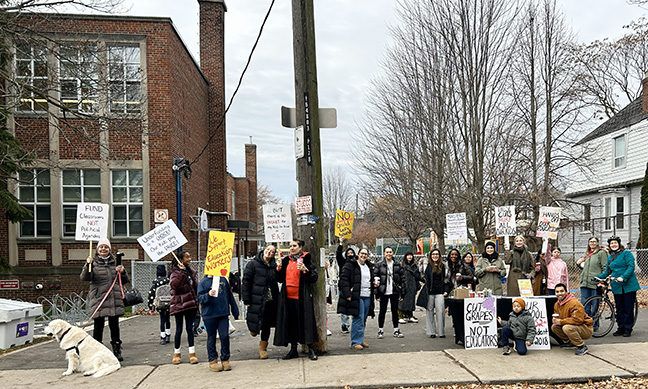
The walk-in demonstration at St. Joseph has gained traction amongst other concerned parents and advocates across the community, who held a similar walk-in demonstration, dubbed the Fund Our Schools Walk-in, on the sidewalk just outside Williamson Road Junior Public School on Friday, Dec. 5.
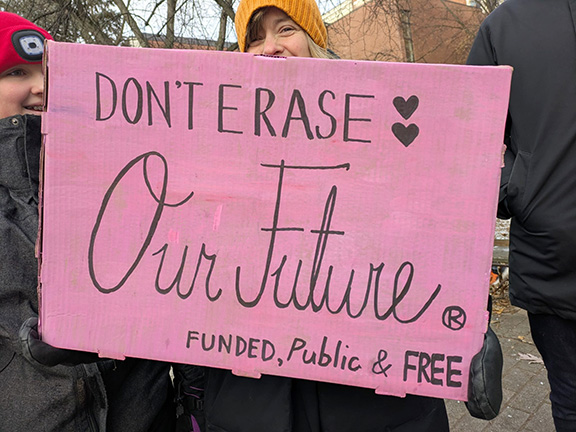
“I think when some school communities start showing up with these demonstrations, it sets the stage for other schools to say ‘hey! We can do that.’ We can join in, we can collectively raise our voice and share our stories – to say to the government that this isn’t OK,” said Garkowski, reflecting on the walk-in movement.
“I think it creates a snowball effect. That is my sincere hope for this movement. That it inspires others and encourages them to participate. To show them that it is not hopeless and every voice matters.”