Beaches-East York councillor critical after ‘watered down’ motion on removing encampments near schools, daycares and playgrounds approved by Toronto Council
EDITOR’S NOTE: This story has been updated and contains additional information from the story originally posted on Nov. 14. Further comments from councillors and city staff during Toronto Council’s debate on the motion have been added.
By MATTHEW STEPHENS
Beaches-East York Councillor Brad Bradford’s motion to have the City of Toronto promptly remove encampments near school zones, daycares, and playgrounds was amended with some noteworthy changes at Toronto Council’s meeting yesterday.
“I’m the father of a two and four-year-old, and I don’t think that parents should have to worry about whether it’s safe or not to take their kids to the park, or to walk to school,” said Bradford at the Nov. 13 city council meeting.
“When I go to the park, I’m worried about my daughter splitting her chin open on the slide. I don’t want to have to worry about her stepping on a needle, or seeing somebody smoking crack, or having a negative interaction with somebody who is having a mental health episode.”
As part of Bradford’s motion, encampments located within 200 metres of a school zone, playground, or daycare facility would be removed within 48 hours of being reported to the city.
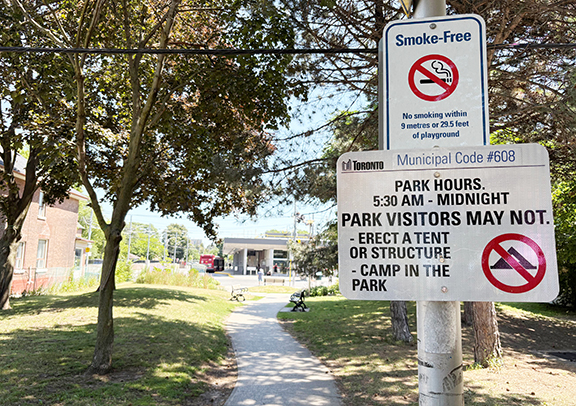
While addressing his fellow councillors, Bradford referred to his ongoing efforts at Stanley G. Grizzle Park (21 Chisholm Ave. just northwest of Main Street and Danforth Avenue), where an encampment has caused significant disturbances in the neighbourhood and negatively impacted the daily operation of the local daycare Muppets Children’s Centre since it was set up in the summer.
“We have an encampment at Stanley Grizzle Park, it’s literally right next door to a daycare, it is right next door to a playground, and that encampment has been there for months,” said Bradford.
“On a daily basis, people see the folks in encampments using crack pipes, using needles, increased garbage, screaming at three in the morning, human waste left in residents’ backyards, and the illicit sale of drugs to minors, porch package theft, and assaults. That happens on a weekly basis in that park.”
At the Nov. 13 council meeting, his motion received a mixed reception amongst other council members.
Some at the meeting expressed concern that clearing out encampments may prove to be difficult in the city’s more densely populated neighbourhoods.
Toronto-Danforth Councillor Paula Fletcher, who was partially in support of Bradford’s motion at the meeting, said the approach to removing encampments should be implemented gradually, addressing encampments within the closest proximity to at-risk areas first.
“The motion says to prioritize 200 metres. I’m thinking about making sure this happens because I agree that it’s a difficult situation to have encampments so close to playgrounds,” said Fletcher at the meeting.
“So, I’m wondering if there’s a way to phase that, so we would start with 50 metres, then 100 metres, then 200 metres. If that would be something that we could expedite and initiate immediately, rather than sit down and prioritize them.”
Fletcher proposed to amend the motion to “initiate” encampment removal within 24 hours rather than 48 to speed up the process.
Bradford questioned the wording in Fletcher’s amendment, believing her proposed changes to the original motion were not clear on how timely encampments would be removed.
“I think Torontonians deserve a clear timeline and accountability from city hall on how we are going to address these encampments… Be very careful about the language of Councillor Fletcher’s motion to poison pill.” said Bradford. “Initiating within 24 hours? They changed the word to ‘initiating’ for a reason. That doesn’t deliver the accountability or the results that parents and families in our communities deserve.”
Gord Tanner, general manager of the city’s Toronto Shelter and Support Services, said the suggestion for a distance-based approach to encampment removal is “operationally feasible.”
According to Tanner, there are currently 355 encampments located in Toronto, 255 of which are situated in 92 city parks, and 199 located within 200 metres of a school, playground, or daycare.
Under Fletcher’s distance-based approach, the city would need to address 18 encampments located within 50 metres of a school, playground, or daycare.
Bradford disapproved of Fletcher’s amendment to only prioritize the 18 encampments situated within 50 metres at-risk areas and suggested that her amendment be increased to 150 metres instead.
“I have an amendment to your amendment,” Bradford told Fletcher. “And that is to increase the distance to beginning with 150 metres, because I’ve heard from residents, I’ve heard from staff that 50 metres and 18 encampments is inadequate in comparison to the order of the magnitude of the problem when it comes to encampments here in the City of Toronto. The reason I brought this motion forward in the first place is that we need to restore safety and accessibility to our public spaces, to our parks, especially around schools, playgrounds, and daycares.”
Bradford reaffirmed that his motion would still entail a precedent of “compassion and coordinated” in the city’s response to homelessness and encampments.
However, with a current shelter system that is “not sufficient to meet anticipated demand,” according to the 2025 Budget Notes for Toronto Shelter and Support Services, Parkdale-High Park Councillor Gord Perks underscored council’s obligation to provide more shelter space before addressing encampment removal.
“We heard very clearly from the city solicitor that we have a legal duty to make sure that if we’re going to move somebody out of an encampment, that we have to have shelter space,” said Perks.
He criticized Bradford of “performativity” due to his lack of support to increase shelter space at city council back in July of this year.
“Isn’t it interesting that the same person who gets up and thumps the table and talks about all the harms that are caused by people who have lost their homes and being in encampments has voted against building shelters, has organized against building shelters,” said Perks.
During the July 24 council meeting, Bradford opposed the introduction of six additional shelters across the city, on the grounds that more planning and community engagement was needed before council approved the decision to place the shelters in neighbourhoods that had concerns about them.
Bradford has also expressed his disapproval of the current system for encampent removal, which was adopted by Toronto Council in June 2024.
“The approach that was adopted by this council is a rights-based approach that puts people experiencing homelessness at the centre of our outreach efforts, with the goal of connecting with them, ultimately bringing them into the shelter system, or into permanent housing,” said Tanner.
He said the current structure of removal has allowed the city to address encampments faster, and that the number of encampments has decreased by 185 since the new outreach model was adopted by council in June 2024.
Tanner said that “every encampment is different” and that currently there are no stipulations to determine how fast an encampment is removed by the city.
Following a contentious discussion, Bradford’s original motion was amended to “prioritize removing encampments located within 200 metres of a school, daycare or playground within 24 hours of being reported, with prioritization based on most significant impact beginning at 50 metres, update the local Councillor within one business day of initiation, and provide regular updates on the status of the location, with coordination between the Fire Chief and Deputy City Manager, Community and Emergency Services, to ensure safety and operational factors are fully considered.”
In a post on X (formerly Twitter) on the morning of Friday, Nov. 14, Bradford said the amended “watered down” motion that council approved was not good enough.
“Yesterday, I moved a reasonable and common-sense motion designed to give playgrounds back to our kids by clearing encampments near schools, parks and daycares,” said Bradford in his X post. “Rather than listening to parents like Rakshitha and Jennifer, Mayor Chow and her allies on council watered down the motion to address only 5% of encampments across the entire city. That’s not good enough for my family or for yours. It’s time to build a safe and clean city where our kids can thrive.”
In his X post, Bradford urged city residents to sign a petition in support of his original motion calling for the encampment exclusion zone around schools, parks and daycares. The petition can be accessed at: https://bey-bradbradford.nationbuilder.com/protect_parks_for_kids_and_families