Beaches-East York Councillor Bradford to present motion for removal of encampments near schools, playgrounds or daycares within 48 hours
By MATTHEW STEPHENS
Beaches-East York Councillor Brad Bradford will be presenting a motion at this week’s Toronto Council meeting to ensure encampments around playgrounds, school zones and daycare facilities are removed in a timely manner.
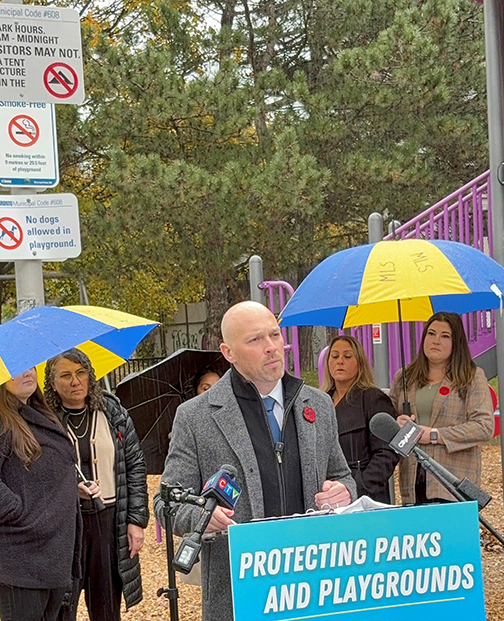
“Toronto’s parks are some of the most important spaces in our city. They’re where families gather, kids come to play, and neighbours and communities connect,” said Bradford at Stanley G. Grizzle Park on the morning of Friday, Nov. 7.
“But when tents or encampments are set up next to daycares or schools, or in/around our playgrounds, these spaces stop being safe for all the people that they’re intended to serve.”
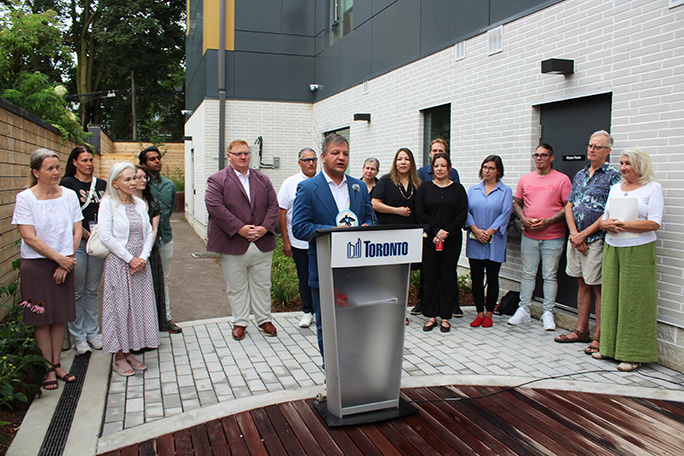
Bradford met with local parents, families, and daycare staff at the park on Main Street just north of Danforth Avenue for a press conference to announce his motion, which he will introduce at the Toronto Council meeting slated for Nov. 12 to 14.
His motion aims to ensure encampments within 200 metres of a school zone, playground, or daycare facility are removed within 48 hours of being reported.
In recent months, Bradford worked with city officials to remove an encampment located at Stanley G. Grizzle Park, which had sparked significant public concern for the safety of children attending Muppets Children’s Centre, a daycare operating directly next to the park.
Back in July, residents and daycare staff reported that the ongoing public drug use within the park and surrounding area had been negatively impacting Muppets’ daily operation.
“We’ve had to stop our neighbourhood walks, which is a core part of our curriculum. Parents are anxious and expressed safety concerns,” said early childhood educator and supervisor at Muppets Childcare Centre Lama Abou-Merhi in a Beach Metro Community News story from this July.
“Our staff are doing everything they can to maintain a nurturing environment, but the situation has taken a toll.”
Despite it’s removal in July, the encampment has since returned to Stanley G. Grizzle Park.
“After repeated escalations from me and my office, the encampment was removed on July 17,” said Bradford. “But despite these efforts, a new encampment was established on Sept. 2 and has been here ever since.”
During Friday’s press conference, Bradford referenced the city’s current encampment protocol, which prioritizes high-volume encampments operating in public spaces.
“Right now, the city’s encampment protocol (EC13.8) that was championed by Mayor Chow, means that despite the negative impacts, tents in these locations are often at the bottom of the city’s priority list, left standing for many weeks or months on-end. And I don’t think that is acceptable.” said Bradford.
In a previous statement to Beach Metro Community News, he specified that the city’s current policy often only prioritizes “large encampments” for removal.
“We’ve seen that policy in action this year at the infamous Dufferin Grove encampment, where the city spent more than a million dollars over seven months and still ended up in a standoff with nine individuals who were demanding 800 square foot apartments before they would leave the park,” said Bradford at the meeting.
With his new motion, Bradford said encampments within the proximity of school zones, daycare centres and playgrounds would take priority over large encampments.
“I don’t support encampments anywhere, but when we have limited resources available, the ones that need to be prioritized are the ones that impact schools, daycares and playgrounds, because those are the spaces that we need to keep safe for our most vulnerable, our children,” said Bradford.
He also mentioned that Chow’s “enhanced outreach model” specified that encampments won’t be cleared “until the individuals are ready to leave,” which often draws out the encampment removal process.
Some of the attendees at Friday’s press conference questioned whether Bradford’s motion for timelier encampment removal could mean more force would be used to remove individuals from the locations.
“That’s not what we want,” said Bradford. “But at the end of the day, these parks have to be safe and accessible for everybody… you never want to see those things go in a direction where any clearing operation is violent, but people are always given a choice to leave. They are given access to shelter, and that would continue to be the approach.”
Bradford assured that the city’s Streets to Homes Street Outreach & Support Program would continue to support those living in encampments on their transition into the shelter system.
However, with a current shelter system that is “not sufficient to meet anticipated demand,” according to the 2025 Budget Notes for Toronto Shelter and Support Services, some remained skeptical that those living in encampments will have a smooth transition into the shelter system.
In response, Bradford suggested that the issues plaguing the city’s overburdened shelter system is a conversation that needs to be held at the federal government level.
“Our shelters are under strain, and when you look at the shelter population, 40 per cent of them sometimes are refugees or asylum seekers,” said Bradford “That’s a conversation that we need to have with the federal government. I hope that Mayor Chow continues to push and advocate for that funding because it’s so important.”
He stressed that a “long-term” solution to the overarching shelter and encampment issue rests on the city to provide more supportive housing for those suffering from mental health and addiction issues.
“I would suggest to the public that we need to focus on supportive housing as the long-term solution,” said Bradford. “We need to focus our efforts on actually delivering that, rather than trying to create more bureaucracy to build more housing, which ultimately is a great way to spend a lot of time and money, but not deliver a lot of results on the housing front.”