City announces Red Tape Hotline for small businesses at Red Tape Brewery in East Toronto
By MATTHEW STEPHENS
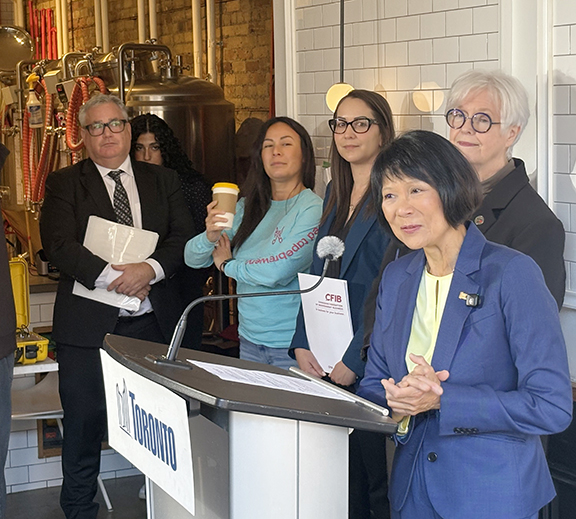
Mayor Olivia Chow joined Angela Drennan, Vice-President of Legislative Affairs at the Canadian Federation of Independent Business, and Budget Chief and Don Valley North Councillor Shelley Carroll at a local East Toronto brewery to unveil the Red Tape Hotline – a new initiative designed to help businesses cut through red tape and municipal barriers.
“Across our city, businesses are facing real challenges,” said Chow during her media release statement inside the Red Tape Brewery at 159 Main St. on Monday, Oct. 27.
“We heard from a café owner, who waited for months for a permit to expand her patio, slowing her ability to hire more staff. We heard from a tech startup struggling to navigate updated bylaws just to get their signage approved…. These are just a few examples of how red tape can slow down businesses, even when they’re trying to grow, innovate, and serve their communities.”
The Red Tape Hotline launched as a pilot project earlier this year to give business owners a direct connection to the city to report permitting delays, outdated bylaws and other “unnecessary” municipal barriers.
“Toronto’s businesses are the backbone of the local economy and neighbourhoods. Operators need the ability to be nimble and respond quickly to changing market trends, but red tape can slow them down,” said a City of Toronto news release.
Carroll said business owners “face enough challenges already” and are fighting an uphill battle against multiple impeding obstacles, including U.S. tariffs, rising costs, and other municipal hurdles.
“The last thing we need is unnecessary municipal hurdles slowing business owners down,” said Carroll. “We don’t want to be the problem. This pilot is our way of listening directly to business owners.”
According to Drennan, the average small business spent approximately 735 hours working through red tape and municipal regulations, which roughly translates to 92 workdays and costs upwards of $10,000 per year.
“When we surveyed our members, 50 per cent said that property and business taxes are the most burdensome regulations, followed by building and renovation permitting, losses due to delays, and navigating business licensing,” said Drennan during the meeting.
For Sarabeth Holden, owner of Red Tape Brewery, opening a brewery under revamped bylaws serves as an example of the work the city has been doing to support small businesses such as hers.
“We were the very first craft brewery in Toronto to open under a bylaw pass that allowed small breweries under a certain volume production to open in commercial residential spaces, and that is thanks to the task force,” said Holden.
For other small businesses looking to help change the system from within, the city is urging business owners to complete the Red Tape Hotline Survey by Sunday, Nov. 30 at www.toronto.ca/redtape.
Feedback received from the survey will help guide the city’s efforts to remove municipal barriers, streamline approvals, and alter regulations to become more modern and responsive.
Survey findings will be compiled into a city staff report, which will include recommendations for administrative and bylaw changes, to be presented to the Economic and Community Development Committee in early 2026.