Closure of some East Toronto school pools possible as TDSB trustees call for more funding from province
By JOSHUA McGINNIS
The Toronto District School Board is considering closing 36 swimming pools, including in the East Toronto community, as it grapples with a projected $58-million deficit for the 2025–26 school year.
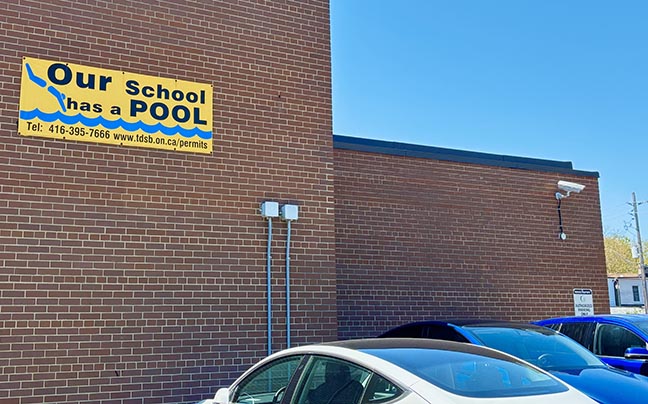
The TDSB currently operates and maintains 66 swimming pools. Of these, 27 are leased to the City of Toronto for after-school community programs, and two are leased to third-party organizations. If budget cuts are approved, 36 school pools will be shut down.
Among those facing possible closure are four pools located in the Beaches-East York and Toronto-Danforth area. They are the Monarch Park Collegiate, Riverdale Collegiate and Malvern Collegiate pools, and the pool at Queen Alexandra Middle School on Broadview Avenue.
The board may also eliminate certain music instructor positions if it cannot secure additional funding.
In a statement to Beach Metro Community News, Beaches-East York TDSB Trustee Michelle Aarts said the provincial government must provide adequate funding for pools and aquatics, emphasizing their importance to residents.
“The TDSB was created when the province amalgamated seven Toronto school boards. Each former board had a different approach to building schools. The former East York and Toronto boards built schools in collaboration with the city and were meant to be community hubs serving students, families and neighbourhoods,” she explained.
“Rather than building on large plots of land, the schools were built with community centres and pools embedded amongst the houses. East York schools generally have very little property; some schools rely on neighbouring city parks for green space. The close partnership with the city is critical for students and also benefits neighbourhoods. We know that students thrive and communities are stronger when we have intergenerational relationships in and around our schools.”
Aarts also said, “The provincial government needs to invest in public education adequately.”
She said provincial education funding is supposed to allow local boards flexibility to meet the needs of their communities.
“However, flexibility assumes there is enough funding to cover the costs of school services. The year-over-year budget struggles actually reflect the severe underfunding that all school boards face.”
Aarts said 42 of Ontario’s 72 school boards are facing deficits, and that education funding has not kept up with inflation.
“The Ontario Public School Boards’ Association estimates that the lack of investment has led to a year-over-year decline in funding since 2019 to the tune of $776 per student. For the TDSB, that is $269 million. For the province, which has about two million K–12 students, that is over $1.5 billion,” she said.
According to Aarts, while the provincial government boasts about its education spending, that funding fails to meet the TDSB’s needs.
“The provincial government likes to brag that they spend more on education every year, but spending more is not the same as spending enough to ensure student success and well-being. What we need is a provincial government that recognizes that students are the future of our communities and economy and invests in them accordingly,” she said.
Sara Ehrhardt, TDSB trustee for Toronto–Danforth, shared similar sentiments on the need for funding and also on the importance of school pools.
“Learning to swim is a life-saving skill. We live next to Lake Ontario, and there are tragic drownings each year. We owe Toronto’s children places and spaces to learn to swim and to build water skills. Pools also are places for joy and fun in our community.”
She said pools should be funded through the education budget since they support both the health curriculum and student well-being while noting that the Ontario government makes the final decision.
Tensions between the TDSB and the provincial government escalated on May 2 when Ontario Education Minister Paul Calandra criticized poor financial management by five school boards, and launched financial probes into the TDSB, Toronto Catholic District School Board and Ottawa–Carleton District School Board.
“Do the right things for teachers, do the right thing for students. If you don’t, I’ll take you over and put the board back on track,” said Calandra. “Some school boards treat hard-earned tax dollars like their own, spending them on luxury hotels, fine dining and first-class travel overseas, and booking extravagant retreats for meetings while accepting test results that in some cases show students struggling.”
In response to the province, TDSB Chair Neethan Shan said the board has made significant budget cuts in recent years but continues facing financial pressures, especially as a large urban board.
Rising costs, underfunded benefits, salary gaps, a freeze on school closures, and a $1,500 per-student funding shortfall (when adjusted for inflation) have made it challenging to meet student needs, he said.
“It is important to note that while trustees will continue reviewing the budget to find savings, we have already cut millions of dollars from the TDSB budget over recent years in the face of significant financial challenges that impact our ability to meet student needs,” said Shan.
This is not the first time the TDSB has been at odds with the provincial government. In 1997, under Premier Mike Harris, the Ontario government introduced Bill 160, which centralized control over funding, policy decisions, and staffing, placing them in the province’s hands.
Bill 160 removed school boards’ ability to raise taxes locally and gave the Ontario government complete control over education funding. It also took control of class sizes, teacher preparation time and out-of-class services such as maintenance, administration, extracurricular and other school programs.
The legislation also allowed the government to appoint provincial supervisors, granting them complete control over board operations. This occurred in 2002, when Education Minister Elizabeth Witmer appointed Paul Christie as TDSB supervisor.
Also, in 2015 the Ontario Liberal government of Premier Kathleen Wynne appointed an “expert panel” to review a number of issues at the TDSB.
On May 7, the TDSB released a statement on behalf of trustees calling for fair education funding. The statement said the TDSB’s budget does not address the needs of its size and magnitude, highlighting a lack of government funding in key areas — a $1,500 per-student funding shortfall when adjusted for inflation, escalating staffing costs that exceed provincial benchmarks, and a growing $4.5-billion maintenance backlog due to a provincial moratorium on school closures.
Aarts spoke on the broader issue of provincial education funding across all of Ontario.
She said since major 2019 budget cuts, it has been increasingly difficult for the TDSB and other boards across the province to survive. “In reality, the situation in the TDSB reflects the state of underfunding across all school boards.”
Aarts noted most school boards are spending more on programs such as special education than the Ministry of Education provides.
No final decisions have been made on the TDSB budget.