Guest Column: The Ephemeral Bloom – Spring in the Beach and the Wisdom of Impermanence
By R. LUGO-NARANJO
I arrived in Toronto at the end of August 2022, just as summer was beginning to exhale its final breath. The light over Lake Ontario was golden and stretched, the streets of the Beach were still unsettled, and the gardens lining the porches were already beginning to fade.
I come from a place where the seasons hardly change, where the year flows in a continuous loop of sun and rain. The idea of watching nature die and be reborn each year seemed more like a myth than a reality.
That first winter — not as harsh as this year’s — was a lesson in stillness.
Snow covered the flowerbeds, silenced the streets, and transformed the landscape into a palette of greys and whites. The trees stood like skeletons against the sky. Time felt slower. But then April arrived, and everything began again.
What surprised me most wasn’t the return of warmth or the thawing of the lake — it was the people. As soon as the frost withdrew, my neighbors emerged as if moving to the rhythm of an invisible clock, armed with shovels, gloves, and wheelbarrows full of hope. Along Glen Manor, Kew Gardens, and Queen Street East, they turned the soil, pruned branches, and knelt to plant tulips, daffodils, and lavender — fully aware that all those flowers would wither by November.
To someone new, this seemed impractical. Why devote time, money, and care to something that will not last? Why work for a beauty destined to disappear?
And yet, over time, I came to understand that this wasn’t just gardening. It was a ritual. It was resistance. And perhaps, more than anything else, it was faith in the ephemeral.
A Neighborhood of Silent Rituals
The Beach is a neighbourhood that breathes in rhythm with the lake and the life of the community. Its winding streets and Craftsman-style homes give off a modest charm. From the Boardwalk to the back lanes of Silver Birch and Wineva avenues, there is a shared awareness that each season demands its own gesture.
Spring’s gesture is the garden.
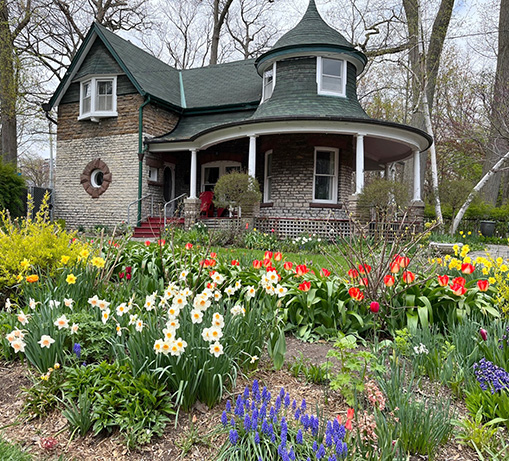
By May, flowerbeds burst into colour. Crimson tulips flank front steps, golden daffodils peek between fences, and delicate pansies overflow from porch pots. These gardens are not simply private spaces — they are unspoken invitations to the neighborhood. A blooming bed in front of a house lifts the entire block. A neglected garden does not go unnoticed. I’ve seen neighbors pause to admire a cluster of lilies, exchange seeds on their doorsteps, or praise each other’s roses with genuine delight.
There is something quietly noble in this shared effort — something that goes beyond aesthetics.
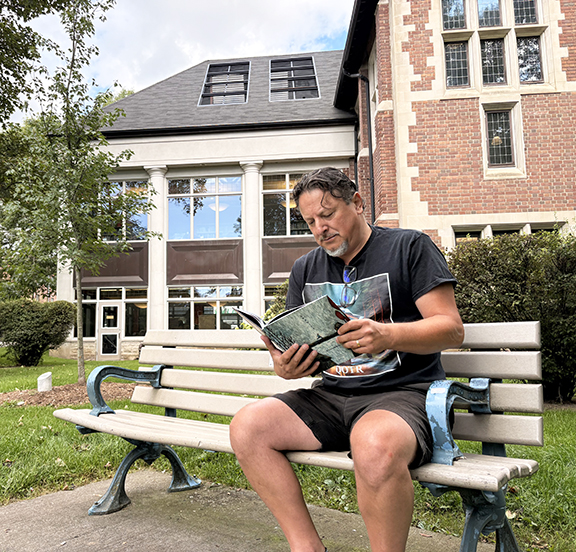
It reminded me of a book I read years ago: The Chrysanthemum and the Sword, by Ruth Benedict, a study of Japanese culture written during the Second World War. In it, Benedict explores how Japan balances two powerful forces: the softness of the chrysanthemum and the severity of the sword. Grace and discipline. Aesthetic refinement beside inevitability.
That image returned to me as I watched a neighbour plant tulip bulbs beside a snow shovel still leaning against the garage wall.
Echoes of Japan in a Canadian spring
Ruth Benedict describes several fundamental values in Japanese life: mono no aware, the sensitivity to the transitory; wa, the pursuit of harmony; and haji, the subtle social pressure of shame. Curiously, all of these values find echoes in the springtime rituals of the Beach.
Mono no aware, in particular, pulses through the neighbourhood from April to May. In Japan, cherry blossoms bloom briefly, and the hanami celebrates this brevity — for their fall is what makes them precious. The same could be said of a tulip on Glen Manor Drive or a daffodil on Lee Avenue. These flowers bloom in defiance of what came before — the dark months of snow — and of what will come after — the inevitable frost. Their value lies in their fleeting nature. The gardeners may not name this philosophy, but they live it.
And they share it. Gardening in the Beach is not just communion with the earth — it is dialogue with the community. A well-kept flowerbed becomes a public declaration. A neglected one creates a crack in the visual harmony of the street. Harmony is not enforced, but it is felt.
There is even a faint presence of haji. Not a strict shame, but a subtle social pressure. One feels the impulse to “keep up,” not out of competition, but out of belonging. A neglected garden may not bring dishonour, but it might draw a knowing glance. And so, people try. Not because they must, but because they care.
Here I found a kind of faith in what will not last — a silent yet colourful expression of Canadian wisdom. A peace with change. A willingness to invest in the fleeting, not because it is useful, but because it reminds us what truly matters.
Canadians, I’ve come to learn, love their gardens not despite the snow, but because of it. They plant knowing they will lose. And they plant knowing they will win. There will always be those ready to reclaim the lost garden from the ice.
My days here pass alongside new uncertainties — the ones I exchanged for the old ones. I want to believe I am learning, among other things, the language, and also a language without words that, when translated through a keyboard, might be summarized like this:
There is beauty in what does not last.
There is strength in planting again.
And there is meaning in the ephemeral — for once it is truly seen, it stays forever.
- R. Lugo-Naranjo recently submitted this essay to Beach Metro Community News. It was originally written in Spanish and then translated to English using AI.