Environmental ‘disaster’ of plastic election signs raised by some local candidates as Toronto’s deadline for disposal approaches
By MATTHEW STEPHENS
As the deadline approaches to dispose of 2026 municipal election signs posted across Toronto, some Beaches-East York candidates are speaking out about the negative environmental impact of using plastic signs for campaigns.
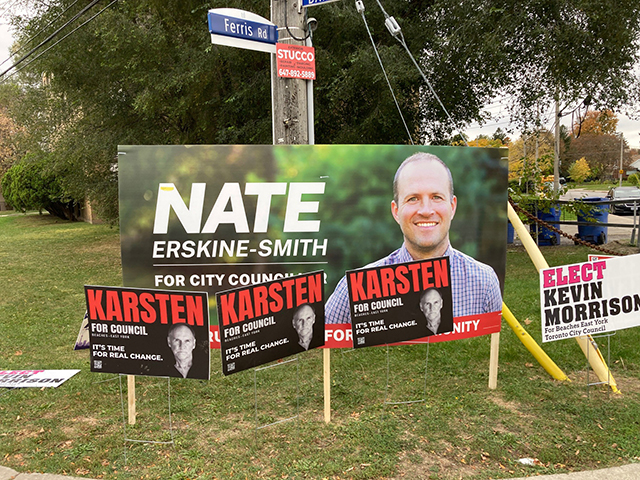
“Plastic election signs are an environmental disaster — garbage on a stick. Even when recycled or reused, many end up in landfills or littering our neighbourhoods,” said Beaches-East York city council candidate Kevin Morrison in an email to Beach Metro Community News.
“Multiply that waste across thousands of candidates provincially and nationally, and the environmental impact is staggering. It’s also a massive double standard when politicians preach a green agenda and then use plastic signage during campaigns.”
After running six municipal campaigns since 2010, Morrison said he found that many plastic signs he’s used in the past have been either “stolen, destroyed or discarded in nearby undergrowth.”
“As a community leader, contributing to this waste troubles me deeply. For decades, I have made signs from reclaimed wood, but that approach isn’t practical on a large scale,” said Morrison.
According to a recent press release from the City of Toronto, election signs are to be discarded at any of the seven City Drop-Off Depots for disposal or recycling no later than Thursday, Nov. 12.
The city said signs are to be properly disassembled and each individual material placed in a specific “dedicated container,” noting that unseparated mixed waste that includes election signs will “be charged the regular fee of $189.86 per metric tonne of material and a flat fee of $19 for the first 100 kg.”
Nadine Kerr, the city’s Director of Transfer Stations & Landfill Operations, said candidates and residents have “historically done their part” to ensure election signs are properly disposed of.
“Many candidates and residents have historically done their part to keep election signs out of landfill,” said Kerr. “The City of Toronto supports these efforts through education and free drop-off services, successfully diverting 17.38 tonnes of election signs following the 2022 municipal election.”
But for Morrison, this year’s municipal election saw him take an eco-friendlier approach to the campaign.
“Instead, I organized a pumpkin giveaway, bringing smiles to families and children while reducing my campaign’s environmental footprint,” he said. “Did pumpkins generate the same name recognition as another wave of signs? Probably not. But while other campaigns were putting up second and third waves of plastic signage, I chose a different approach.”
At the Beaches-East York councillor candidates’ meet-and-greet event on Oct. 7, candidate Mohammad Shabani introduced a “banana campaign,” distributing campaign messages on bananas instead of using traditional flyers.
But Morrison and Shabani weren’t the only Beaches-East York council candidates to come up with a uniquely “organic” way to advocate for their political campaigns. Adam Smith decided to post signs crafted from “reclaimed materials” that his team could retrieve and discard themselves.
“It was the obscene amount of plastic waste from election signs that inspired me to make all of my signs out of reclaimed materials. This meant I had less than 50 signs this election, compared to many hundreds other candidates had,” Smith told Beach Metro Community News.
He argued against the city’s statement regarding eco-friendly sign disposal, noting that “disposing of election signs properly does nothing to mitigate the waste and emissions from their production, distribution, and collection.”
Smith added that many of the other candidates’ signs went against the city’s regulations regarding size and proximity to street curbs.
“When candidates have such an excess of signs, they instruct their teams to put them in many illegal spots, like right on the edge of the road or in parks, or the worst offender for illegal signs this election, the nearly double-the-legal-size signs,” said Smith.
According to the city’s regulations, election signs erected in public spaces were not permitted to be posted within 1.5 metres of the curb or edge of pavement; be no larger than 1.2 square metres in area and higher than two metres above ground level. Also, multiple signs displayed at a location were to be at least one metre apart (unless approved by the property owner/occupant, or the owner/occupant of the adjoining property when placed on public property).
In a press release prior to Monday’s Election Day, the city said election signs that conflicted with the city bylaw could be reported through a service request to 311.
“Election signs are obsolete visual and environmental pollution, and I have called for their banning since my 2018 platform,” said Smith. “I am floored at the waste election signs create.”