Fox Theatre set to screen 4K version of celebrated Canadian documentary Hookers on Davie
By MATTHEW STEPHENS
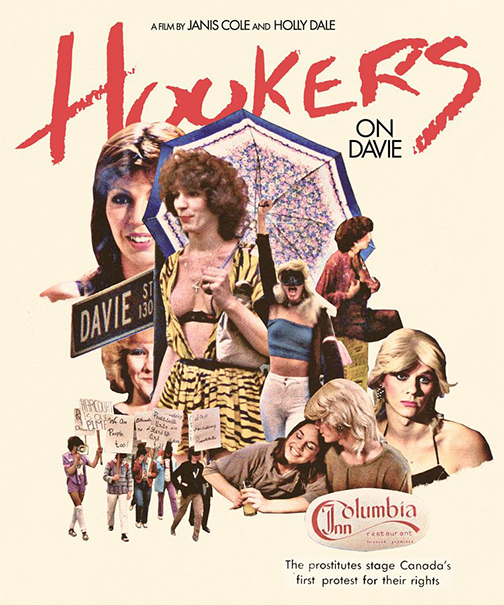
On April 5, 1984, at the Bloor Cinema in Toronto, filmmakers Holly Dale and Janis Cole premiered Hookers on Davie; a documentary film exploring the culture and lifestyle of cisgender and transgender sex workers operating on Vancouver’s Davie Street during a political campaign to “clean up” the British Columbia city’s streets.
For the first time since the film’s initial release more than 40 years ago, a 4K restoration of the celebrated documentary will be shown at the Fox Theatre on Tuesday, April 29, at 6:45 p.m.
“Holly Dale and myself made this film. We shot it in ’83, finished it in ’84 – and Canadian International Pictures has just done a 4K master and made a Blu-ray for the 40th anniversary of it. They’re co-hosting the screening with the Fox cinema.” said Cole, who has lived in the Beach for more than 10 years.
Tickets for the film can be purchased on the Fox Theatre website for $15.24 per admission.
Set in Vancouver, which was once informally known as “The prostitution capital of Canada,” the documentary combines candid interviews with evocative subjects and powerful hidden-camera footage from Davie Street’s neon-clad scenery, to effectively encapsulate the world of street sex workers at the height of the 80s.
“I grew up in Vancouver, so when we looked into the topic to do a film feature documentary on prostitution, we looked at several cities but landed in Vancouver and decided to make the film there,” said Cole in an interview with Beach Metro Community News.
“We spent three months; two months getting to know everybody and a month shooting, and then we brought everything back to Toronto and edited it ourselves for about eight months.”
The film garnered critical praise and received a Genie Award nomination for Best Feature Length Documentary at the Genie Awards in 1985, as well as an award for Best Documentary at the 1984 Chicago International Film Festival.
Cole and Dale met during their studies at Sheridan College in Oakville in the mid 1970s. After working on a short film based on a massage parlour operating on Yonge Street around the time, as well as their prison-based documentary P4W Prison for Women in the late 1970s and early 1980s, the filmmaking duo sought to revisit the topic of sex workers operating on Canada’s city streets.
“We always thought that we wanted to revisit the topic when we had more time and more money. When we got out of school, we made a half hour film focused on hospitals for the criminally insane, and then we went on to make P4W Prison for Women (1981) in Kingston at the maximum-security prison for women. After that we made that feature documentary, which did very well, we thought it was time to try to raise the money in research and make the longer film that we wanted to revisit on prostitution.” said Cole.
“The topic cried out for attention to come out of the darkness into the light of decriminalisation, which was something that the sex workers were speaking of at the time.”
During the filmmaking process, Cole and Dale immersed themselves within the community of sex workers operating on Davie Street to help tell their story with a sense of authenticity.
“We were about 28 or so, we were close in age to the people who were in our film. We got to know them very well, become friends with them,” said Cole
“The thing about Davie Street in Vancouver is that it was a real community of people working together. It felt somewhat safe, even though it was precariously unsafe in many ways, as street prostitution was then, and still is all these years later. But people bonded and had each other’s backs. There was a real sense of community, and that lent itself to a feeling of safety when you were out on the street at all times of the day and night.”
Dale and Cole made the documentary in the hopes that their film would help break down societal prejudice for marginalized communities of sex workers across the world and help to create safer spaces for them to work.
“I think that those efforts to make sex work safer and not as marginalized and not so much in the dark shadows of the city and more acceptable. In areas where people can be seen or go online and run ads. The more invisible their community is when they work, the easier it is to take advantage of people, hurt them, and make them disappear,” said Cole.
“Our goal when we’re making documentaries was to take marginalized communities that you don’t get to meet in everyday life and meet the people, get to know the people. When people drive by sex workers, they often gawk at them, but don’t know anything about them. There are these perceived ideas that we wanted to try to break down by getting to know people.”
Those who can’t attend the film’s restoration on the big screen at the Fox Theatre on April 29 can pick up a 4K copy of the film at https://www.canadian-international.com/hookers-on-davie