Community’s support of upcoming Night Light Walk in the Beach is vitally important to and appreciated by Nellie’s shelter
By ALAN SHACKLETON
Nellie’s shelter in East Toronto is one of the organizations being supported by the Royal LePage Shelter Foundation Night Light Walk in the Beach this month.
The three-kilometre fundraising walk is slated for the night of Thursday, Oct. 24, in Kew Gardens.
Local residents are invited to take part in the walk to raise funds for Nellie’s shelter and Red Door Family Shelter, both of which are located in East Toronto.
Hosted by Royal LePage Estate Realty in the Beach, the Kew Gardens walk will also raise awareness about the issue of family and gender-based violence.
Participants are asked to gather in Kew Gardens (2075 Queen St. E.) at 6:15 p.m. for opening ceremonies and the Night Light Walk through the neighbourhood will be begin at 7 p.m. Those wishing to take part can find more information on registering, volunteering or making a donation by going online to https://secure3.convio.net/rlsf/site/SPageServer?pagename=night_light_walk and clicking on Toronto.
Chris Dunlop, Broker of Record and Owner of Royal LePage Estate Realty, said it’s important to raise awareness about the issue of intimate partner violence in Canada.
“The data is stark, and it isn’t an issue of wealth or not wealth as it impacts all communities,” he said.
According to statistics from the Royal LePage Shelter Foundation, of which Dunlop is a member of the national board, half of all women have experienced at least one form of violence or sexual violence since the age of 16. On a daily basis, there are 3,000 women and 2,500 children living in emergency shelters in Canada trying to escape family violence. Every six days a woman is murdered by an intimate partner.
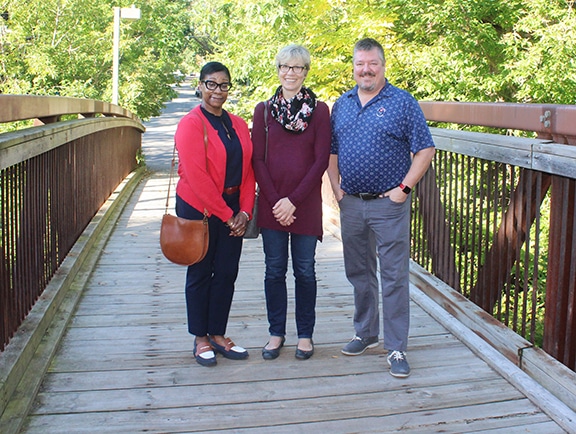
Beach Metro Community News recently spoke with Ingrid Graham, Director of Development and Acting Co-Executive Director of Nellie’s; and Jennifer Burns, Senior Development Officer of Nellie’s; in advance of the Oct. 24 Night Light Walk. (In our Sept. 17 edition, Beach Metro Community News profiled Red Door Family Shelter.)
Started in 1973, Nellie’s was one of the first women’s shelters opened in Toronto. It now serves a dual purpose as a shelter for women and children escaping family violence, and as a shelter for homeless women.
The shelter is named after Canadian feminist Nellie McClung, who was part of the Famous Five group that brought the Persons Case in 1928 and 1929 challenging the assertion that women were not “persons” according to the British North America Act and a ruling by the Supreme Court of Canada.
Vicki Trerise, a 23-year-old law student at the time who was involved with the YWCA’s Stop 158, was instrumental in getting the shelter started back in 1973 and she was a founding board member. At the time there were very few shelter options for women in Toronto.
“She got together with some women from the Y and some women from Interval House (that was the first shelter for women) that were victims of intimate partner violence and some other women in the community and they formed the Women’s Housing Committee in 1972. In May 1973 they applied for funding from Metro Toronto Social Services and Housing,” said Burns.
“It was to address a problem of young transient women in the city who had nowhere to go. The committee felt they were vulnerable and they needed somewhere to stay that was safe. They were coming to Toronto from all over.”
That was the motivation to start the shelter, and once it got going Nellie’s saw that it needed to adapt to meet the needs of the women it was actually seeing, said Burns. “It was not only young women but older women leaving abusive relationships. They had nowhere to go so they came to Nellie’s.”
When the shelter first opened in the early 1970s the policy was that it would not admit women with their children. But Nellie’s “very quickly realized they had to, we must, do this as there was such a big need. Nellie’s has always adapted itself to the needs of the community,” said Burns.
Providing space and support for both women and children became a pillar of what Nellie’s does, and the current 38-bed shelter is very family-friendly with many services and activities for children. The shelter is almost always at capacity, and there are presently 11 children staying at Nellie’s.
“We’re a crisis shelter, we work with women and children who are in emergency situations,” said Burns. “But there’s another part of our work which is empowerment to prevent those situations from happening in the first place. We’re trying to move beyond crisis. We can’t always be in this reactive mode, which is obviously not stopping violence from happening.”
“Every once in a while we’ll get this question as to whether we allow boys in the shelter and of course we do. We have teenage boys here,” said Graham. “One of the reasons we have such strong children’s programs is because when the kids, boys and girls, come here some of them are already presenting with issues you have to address if you want to stop the cycle of violence repeating. We have age-appropriate programming for toddlers all the way up to teens. We need them to stay in school, have as much support as possible and address the trauma.”
Graham said the children have often witnessed the violence and abuse taking place in the family before fleeing to the shelter with their mothers, and Nellie’s needs to make sure those boys and girls learn what “healthy relationships” look like.
“We find at Nellie’s that while shelter is our core, we have to do more to help the individuals and that’s why we have so many programs,” said Graham. “While the shelter is what we’re known for I don’t think enough people realize all the other things we do. Those are the other things that impact a woman’s ability to be successful when she leaves a shelter.
You still have to have active-care support. We call them wrap-around services and they are there because we hope you don’t come back.”
“It’s really about building the community of care and support around the residents,” said Burns.
When a woman fleeing violence in the home arrives at Nellie’s, they are assigned a worker to help them with housing, assistance at school for their children, court and other needs.
The housing situation in Toronto makes finding a safe and affordable place for the women and their children to move into once they are ready to leave the shelter a major challenge, said Graham, and that is resulting in long stays for some families.
“We’re a home and we’re becoming a home for families for a very long time. The average length of stay at Nellie’s is almost pushing four months, and we have families here past six months,” she said.
“Women and children should not be staying here past three months. But we live in the City of Toronto where housing is very difficult. If a woman comes in with two or three children, trying to find safe, affordable housing is very difficult,” said Graham.
“A lot of the women and children who come to Nellie’s are not only victims of domestic abuse, but it’s domestic abuse in all its forms such as financial abuse. Some of their partners have all of their documents. It takes time to get documentation and without documentation you can’t rent an apartment, you can’t apply for services. There are a lot of things that make finding a home very difficult. If you want subsidized housing, the wait list for that at times is more than 10 years. Our housing workers do work to help women gain housing in just the regular market. But a lot of our clients also qualify for special assistance. There’s lots of reasons why, but it’s Toronto and the GTA in general. It’s expensive.”
Nellie’s receives funding from the Ontario Ministry of Children and Community Social Services to run its shelter for women and children fleeing intimate partner violence. The homeless women’s shelter receives funding from the City of Toronto and clients are referred to it through the city’s shelter program. Nellie’s also receives some funding from the United Way of Greater Toronto, but that money goes towards its community programs and not the shelter specifically.
This year Nellie’s has a fundraising goal of $1,050,000, said Graham.
The Royal LePage Shelter Foundation Night Light Walk in the Beach is one of the ways to help not only with fundraising directly but in raising awareness about the work Nellie’s does, she said.
“As a small organization, and Nellie’s is a small organization, we could never mount anything like the walk ourselves. To have a national organization as well as their local team wrap themselves around this organization allows us to communicate our message to the community.”
Burns said working with Dunlop and the team of agents at Royal LePage Estate Realty on the walk has been inspiring.
“Royal LePage and especially Estate Realty and Chris Dunlop, they’ve been working with Nellie’s for so long. From a fundraising point, they are the easiest group to work with because they don’t ask, they just do. They are wonderful to work with and they want to better their community,” said Graham. “It’s great that they’ve chose to support east end Toronto organizations with the walk… They help put roofs over the heads of lots people but they also recognize that there’s a group of people who need some help.”
Burns said intimate partner violence happens in isolation and an event such as the walk brings it out into the open.
“It happens in our community, and the solution is community. Bringing us together as a community to raise awareness and hold a light to this is so important, and we could not do it alone.”
The walk will also help to break the stigma of intimate partner violence and abuse that many victims feel, said Graham. “The more people who talk about it and spread awareness, the less stigma there is if you yourself are dealing with it.”
The theme of Nellie’s 50th anniversary is Moving Forward, said Graham, and the walk fits into that philosophy of putting one foot in front of the other to keep on going to a better place. “This walk in a way moves forward. We certainly can’t go backwards, but we need a group of people to help move us forward and hopefully one day these type of events will be something of the past. But until that day we need organizations to help get the message out and also to help us fundraise.”
Graham and Burns said Nellie’s is appreciative of the support of the Night Light Walk by Beach residents.
“People in the Beaches know of all the issues that affect the city,” said Graham. “Violence doesn’t distinguish between socio-economics or education. It’s everywhere. It’s behind all those doors. People in the Beaches should know there are organizations within their own neighbourhoods that support women and children. Any support they give us will help their neighbours and make for a better city.”
“We’re part of the community and I’m sure, like us, you want to build a better community,” added Burns. “Let’s build that bridge from where we are now to where we all want to be; where women and children can live free from violence, homelessness and oppression.”
For more information on Nellie’s, please go to https://nellies.org