‘Snow angels’ show traces of wildlife
Of the many reasons to love winter, one of my top ones is finding footprints in freshly fallen snow. If you take the time to go for an early morning walk after a snowfall you can observe the extensive animal activity that is happening all the time and all around us. Animals that are nocturnal, or just really good at hide and seek, suddenly leave tracks for anyone to follow.
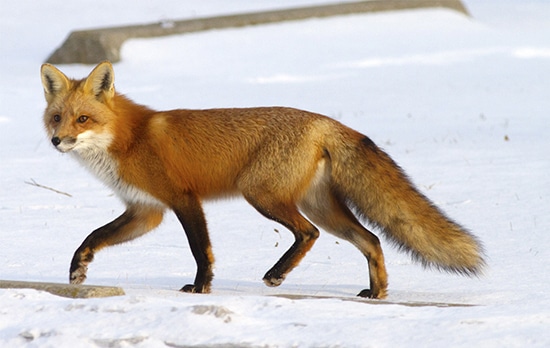
A fox is seen at Bluffer’s Park.
PHOTO: Ann Brokelman
Animal tracking makes me feel like a CSI agent examining evidence and deciphering clues. Discovering how big a print is, how deep it is in the snow, how many toes it has, whether or not there are claws, and how far apart the tracks are from each other can tell us what the animal is, what direction it’s travelling, whether it was running or walking, and how large or old the animal is. It really is the next best thing to seeing them with your own eyes.
Just a little bit of snow on the ground creates hours of entertainment as I follow fox tracks through the park, swan footprints near the water, and even mink tracks on the ice. One day I was with my friend Chris who was looking down at the snow when she found some unique prints on the ground. There was a large imprint in the snow with a trailing mark behind it. Further along were several other impacts and trails. We never found out for certain what made these odd marks, but a naturalist we contacted suggested it was a big owl or a good sized grouse hopping through the snow. No matter what it was it was an avian snow angel to me.
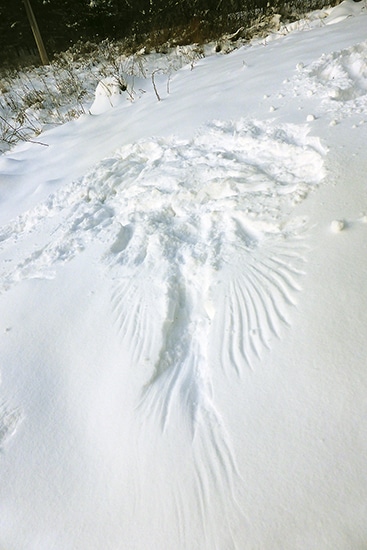
A ‘snow angel’ left by a bird.
PHOTO: Ann Brokelman
Many, many time I’ve come across the tracks of little mice running across a field … only to end suddenly at the same place where slight wing-prints are visible. Though I don’t wish any harm to come to the mouse, it is fascinating to see the evidence of survival of the fittest at work.
Tracking has become an important part of my volunteer work. In order to help an animal you often need to learn everything you can about it in order to catch it and rehabilitate it safely. What do its footprints look like? Does the animal follow the same path daily? Did it leave any scat in the area or did it leave behind any unusual smells (mange has a very distinct smell)? Knowing these details can help you determine how healthy or unhealthy an animal is.
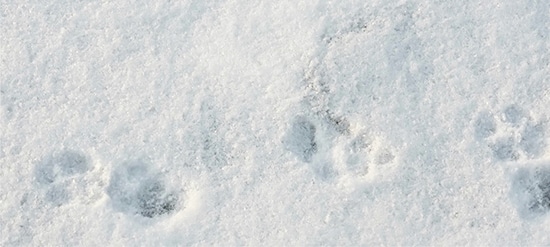
Questions about animal tracks? On the Wild Side author Ann Brokelman may be able to help.
PHOTO: Ann Brokelman
So I challenge you to go looking for prints in the snow. Feel free to send me pictures of prints you’ve found at abrokelman@gmail.com and I’ll do my best to help determine what the animal was. A couple of hints: Take a photo of the tracks, but make sure you put your foot, a ruler, or another common object beside it to give a sense of the size. Also, if you can, indicate the number of toes and whether there are claws. Hopefully that’ll be enough to tell you what you’ve got! Enjoy this great Canadian weather.
Ann Brokelman is an avid birder and nature photographer – naturephotosbyann.blogspot.ca