Gulls deserve more respect
Ahhhh yes! It’s finally a beautiful Saturday, and a great opportunity for me to get outside. Without a cloud in the sky, Donna, Pam and I headed to Ashbridges Bay to see if there were any wintering ducks around. On arrival we could hear a few ducks (the yodeling of the Long-tailed ducks is quite distinct), saw plenty of Buffleheads diving for food, and in the distance might even have spotted a Hooded Merganser.
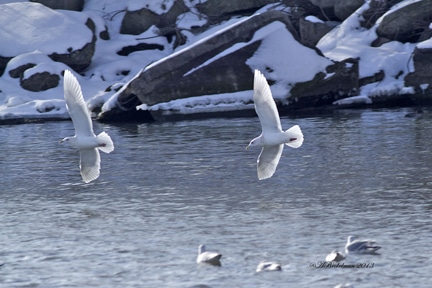
A pair of Kumlien’s gulls, a sub-species of Iceland gulls.
We noticed a person at the edge of the docks observing the birds through a scope. Wondering who it might be, we went to investigate and saw it was Jean Iron (a well known ornithologist). While many readers think gulls are merely garbage eaters, picnic disturbers and flying poop dispensers, keep in mind that gulls come in many shapes, sizes and other variations, and can be just as fascinating as our other avian friends.
Jean told us there were a pair of Kumlien’s gulls flying back and forth with the Ring-billed and Herring Gulls. I had seen an Iceland Gull a few years back but was thrilled to see the pair of Kumlien’s flying together. She pointed them out and for the next 20 minutes we watched them as they soared back and forth, while Jean helped us understand them better.
Jean told us they were called the white winged gulls and in the photo you will see where they got their name. Hundreds of gulls hang around Ashbridges Bay and when the ice comes in you can see them even closer. For more information on gulls see Jean Iron and Ron Pittaway’s article at ofo.ca/webapp/site/page/view/articles.gulls.
Iceland Gull (Larus glaucoides) is a pale gull that has white head, underparts, and wingtips in adult plumage. The back is a light gray, and the yellow bill has a red spot near its tip. The Kumlien’s Gull is classified as a subspecies of the Iceland Gull. It is a medium to large size gull with a length of 50 to 64 cm (20 to 25 in), wingspan 115 to 150 cm (45 to 59 in) and weight 480 to 1,100 g (1.1 to 2.4 lb). The gull breeds in the high Arctic regions of Canada and winters south in small numbers.
So the next time you go to Ashbridges Bay, look a bit closer and you may be rewarded by spotting a gull from the far north.