Development debate intensifies over Kingston Road condo
A number of people who attended a recent community meeting in the Beach came prepared to push back against the reason for the meeting: a proposed condo development at Kingston Road and Main Street.
The required community consultation meeting on Feb. 8 saw about 25 people turn out to the Beaches Recreation Centre to hear from city planners, staff, and project consultants and architects.
City planner Derrick Wong said the meeting, intended to provide information and gather community feedback, was the beginning of a long process and that the final decision would ultimately be made by city council.
In order to approve the seven-storey development as proposed for the northwest side of Kingston and Main, the city would need to amend several bylaws. Preliminary designs, prepared by Hunter and Associates and RAW architects, are for 75 units, 32 underground parking spots, 7,000 square feet of retail on the ground floor, and a laddered design that is scaled back as it gets taller, providing rooftop patios and units of varying sizes while reducing shadow and overlook.
An official plan amendment would also be necessary, as the Kingston-Main corner falls under the “neighbourhood” designation in the City of Toronto official plan. That designation means the building’s height is supposed to be capped at four storeys and retail space is limited.
But a number of mixed-use developments are under construction in the area and several other buildings along Kingston Road in the area are taller than four storeys.
“If you look at the other staff reports, it’s not a blank slate. It’s not meant to be every policy applicable to each site or each development proposal,” said Craig Hunter of Hunter and Associates. “But there is a pattern of six- to eight-storey buildings, some pure residential and some with retail.”
There are also detached homes, duplexes and low-density apartment buildings in the area.
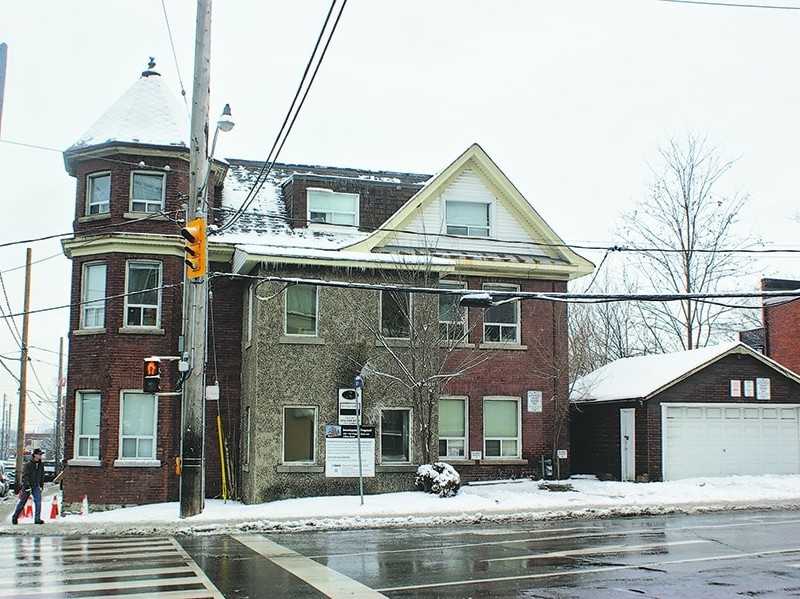
To build the development, the current two-and-a-half storey building on the corner of the site would need to be demolished, leaving a deficit of 11 affordable housing units. To that end, unlike other developments in the area, the proposed development would be required to include 11 units of affordable housing – the meeting heard those rents fall around $830 a month – and mitigate the effects on the current tenants.
“There are real constraints and real opportunities for including and creating affordable rental housing in the city,” said Hunter. “It’s the right thing to do and it’s a policy of the city. We’ll be respecting that and replacing those units.”
Architect Roland Colthoff detailed how the building would look in relation to the unusual topography of the corner which has a steep slope up Main Street.
“This corner of Kingston Road, we think, is a fairly important corner in the urban hierarchy of the city. We think it’s important to your community, we think it should be celebrated,” said Colthoff, noting that the visual emphasis of the building will be on the corner. “Brick will be a big feature of this building because that is a big feature of your area and it’s important that we reflect the context of the neighbourhood.”
Despite requests by Wong for the audience to wait until the presentation was finished before asking questions, residents raised concerns throughout the meeting.
Those concerns included parking – the development would host 32 parking spots for 75 units, nearly a third of the 92 currently required – and increased traffic in the area, with one resident noting that overflow street parking would end up on his street.
Another attendee noted the constant – and noisy – state of construction in the area, and wondered how long the development projects would go on for.
Broader concerns on the latter point and the changing neighbourhood were also raised.
“There’s no holistic approach to this whole neighbourhood,” said resident Charles Braive.
Several attendees lamented the fact that the area does not have an overall plan for development.
But Wong said that the city simply doesn’t have the resources to study each and every neighbourhood. He noted that while there is development taking place at Kingston and Main it is not specifically identified by the city as a “growth area.”
That point was echoed by an audience member, who quipped during the Q&A that the push towards densification is worse in other parts of the city.
Ward 32 councillor Mary Margaret McMahon, also in attendance, responded to a question about the Ontario Municipal Board appeals process, and what residents can do to keep fighting if the development is green-lit, by noting that she has been involved in lengthy pushes against certain developments, and that the OMB process can be expensive for individuals.
“I don’t want anyone to get in the hole because of this … I’m realistic that we live in a city and we can’t stand at the corner and stop development,” she said.
“So to get ahead of it and get a development that’s in character with the neighbourhood, to get parking and traffic concerns addressed, materiality of the site, bigger family units versus smaller family units, amenities, parking restrictions, things like that is more in keeping within the realm of possibilities.”