True Davidson Meals on Wheels volunteers help deliver food, independence and social connection to local residents
By JESSICA SHACKLETON
Since 1973, True Davidson Meals on Wheels has been delivering meals to people in East York six days a week.
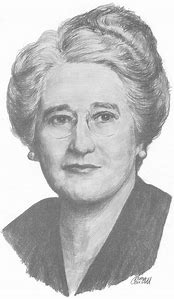
Named after Gertrude “True” Davidson, the reeve and then mayor of East York from 1961 to 1972, the program not only provides hot meals but also as a vital social connection for those who receive the deliveries. In 2014, the program merged with Neighbourhood Link Support Services (The Neighbourhood Group – TNG).
The important service provided by the Meals on Wheels program is done by a dedicated group of volunteers who dedicate their time each week to helping others.
Maureen Ballentine and Rosemary Vandierendonck have been volunteering with True Davidson Meals on Wheels since 2017. They work together as a team with Vandierendonck as the driver and Ballentine as the runner.
“You’ve got to eat, and we’re also the only program that delivers hot meals,” said Ballentine. “There’s lots of other services that are all frozen. A lot of our clients can’t even manage heating it up.”
True Davidson Meals on Wheels (MOW) does have a frozen option for the food it delivers, but fresh, hot meals remove another barrier for those being served. The hot meals costs less than $10 each, and subsidies are available for those who need them. The meals are prepared in an industrial kitchen and purchased by Meals on Wheels.
The hot meals are based on a four-week rotation menu and include meat or vegetarian options with potato, pasta, or rice; vegetables; dessert; and bread and butter. The choice of meat includes beef, chicken or fish. The program offers options for clients who have diabetes or food allergies, need puréed or minced food, or require lactose-free meals or meals with no added salt.
The volunteer commitment is once a week for a few hours around lunchtime. “It’s not a big ask,” said volunteer Ken Martin.
“If you’ve got a couple hours a week, you’re really helping out people that need food deliveries who are homebound,” said Ballentine. “I find people that volunteer have always been volunteers.”
The volunteers stressed the importance of social interaction with the clients receiving the meals.
“Sometimes we’re the only people that they see. We might be their contact for the day,” said Vandierendonck.
Some of the living situations can be grim, so volunteers are trained on what to do if they encounter any issues.
During COVID-19, everyone was isolated from usual activities, but Ballentine said lack of social interaction has always been a factor for some MOW clients
“There’s isolation in general; a lot of these people I deliver to, they don’t get outside so you might be the only person that they see. I always ask my clients, ‘Do you have family, kids?’ A lot of people have nobody,” she said. “I had a person burst into tears when I came because no one’s showing up.”
Some of the clients do have Personal Service Workers (PSWs) but not all, and the volunteers doing the deliveries are also often making a de facto wellness check.
“You do see people who are hidden right under the surface of society that otherwise you wouldn’t know they were there,” said Martin.
The routes for the delivery volunteers are subject to change but generally consistent so that they are checking in on the same people each week.
For some clients, a volunteer at the door means a hot lunch and their only conversation of the day. That regular visit helps them keep living in their own homes.
“It just gives some people independence. Us delivering some food (means) they get to stay in their houses,” said Vandierendonck.
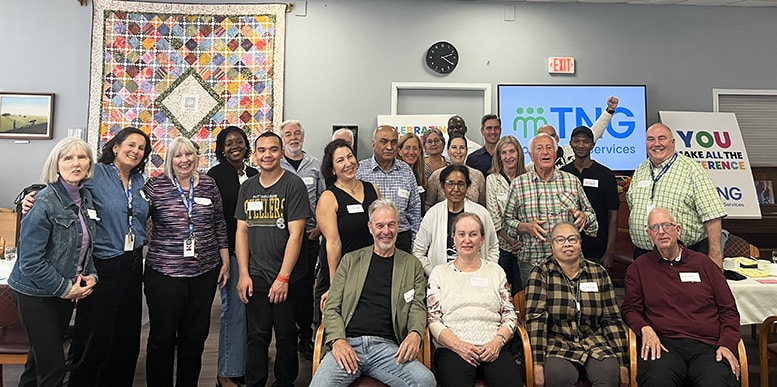
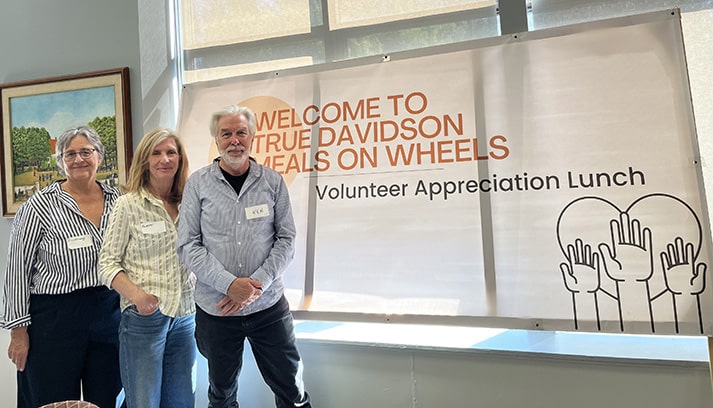
Both Ballentine and Vandierendonck were among the True Davidson Meals on Wheels volunteers honoured at a recent luncheon event at the St. Clair O’Connor Community.
The formal program of the luncheon included a reception with speakers and volunteer awards, hosted by Hasina Quader, who has been involved since 1989 and is now the Senior Manager for True Davidson MOW..
She said that when she started, there were a lot of seniors in East York but she’s seen a demographic shift recently.
“A lot of seniors are no longer here for various reasons. A lot of younger generations have moved here. We see that demand has reduced, but it’s coming back because more people are becoming seniors,” she said.
As mentioned, Meals on Wheels played a key role during COVID, and the program never stopped delivering during the pandemic.
“We were actually doing more meals than ever because we were getting calls from doctors’ offices, from neighbours; we were getting calls from out of the area because at that time we did not ensure they were from the area because we just wanted to deliver meals,” said Quader. “We were working more hours, doing more meals, but volunteering was not an issue at that time because a lot of people were out of work.”
Being available in the middle of the day is why a lot of the Meals on Wheels volunteers are retirees, but Amedee and James Kattianie are among a younger group of volunteers. They started last year when they were looking for something to do.
“We came here last year, and I was looking for places to volunteer, and I was looking online and saw TNG,” said Amedee. “It’s kind of the same thing as Uber, and I emailed Hasina; we met, and we started three months later.”
The few-hour commitment worked well for them, and the best part has been meeting residents. “Most of them, they are alone, and you are the only person they see,” said Amedee.
“The only connection,” added James.
The luncheon recognized volunteers who had served for one, five or 10 years. Amedee and James were among those recognized for one year of service.
She spoke about how her first exposure to the importance of volunteering was with Meals on Wheels when she was growing up in Collingwood.
“Where I am now, I blame it on Meals on Wheels. My parents were big volunteers, and one of the places they dragged us to was Meals on Wheels. Even though we fought it and wanted to be at home watching cartoons and whatnot, I realized at an early age, the more you give, the happier you are,” said McMahon.
“Volunteering makes the world go ‘round, and the world would be a much better place if everyone got up off their couches and got outside and gave up their time and energy.”
Bill Sinclair is the CEO of The Neighbourhood Group (TNG) and he talked at the luncheon about the core principles of the Meals on Wheels program.
“Cities are neighbourhoods, cities are people, and neighbours helping neighbours is what I think about when I think of Toronto. The people talk to their neighbours, help out their neighbours, and nothing really at TNG represents that better than Meals on Wheels, where volunteers come out and personally hand-deliver meals to their neighbours,” he said.
“It’s not digital, it’s not AI, it’s personally bringing the meals in, saying ‘Hi’, seeing how they are today. It’s what makes this a livable place; it’s how we make sure our neighbours stay in their homes as long as possible.”
A SHIFT WITH MEALS ON WHEELS VOLUNTEERS
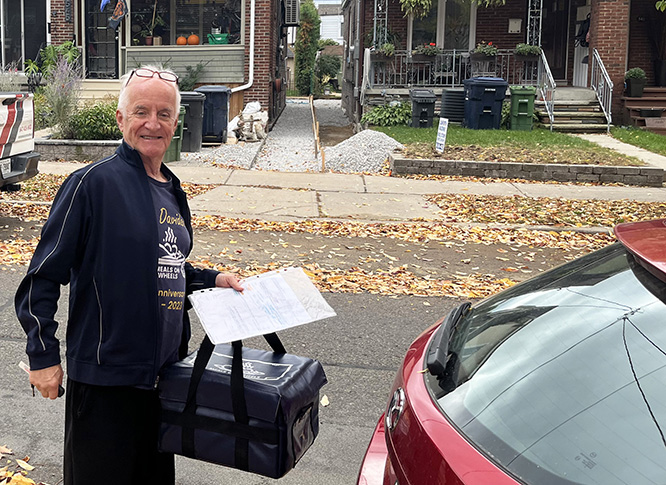
His shift didn’t start until 11 a.m., but Bill Sheehan arrived at Meals on Wheels headquarters in East York half an hour before. Wednesdays aren’t his usual day, but he was filling in for another route.
He was the first volunteer to arrive, and Anna Klukowicz, Kelley Marasigan, and Quader, the head office team, were still in the back getting the meals organized.
Sheehan has been volunteering since he retired in 2023. “I knew I was going to look for some volunteer work to keep busy and give back. This is relatively simple as volunteer work goes,” he said.
Slowly, more volunteers arrived for their shift, including Adrienne Scott, who is a fairly new volunteer.
“I live in the community, and it’s a small thing to do compared to the difference it makes for someone. To come for two hours is not much to ask. I love to meet other neighbours and deliver meals; really it’s not an imposition at all,” she said. “It’s the very least you can do for your community, and I feel lucky to be able to do it and just do something in the community that isn’t about you.”
When all the volunteers had arrived, there were a total of four teams of two. They chatted about the Thanksgiving long weekend and received their route sheet.
The sheet contains the addresses and names of clients, plus what they will receive. The hot meal comes with soup, bread, and dessert, and there are notes on dietary restrictions.
Into Sheehan’s car went a blue cooler with the hot meals and soups, a cooler bag with the desserts and bread, and a blue Meals on Wheels insulated bag for drop-offs. He puts frozen meals, an option some people select alongside the fresh meal, into the trunk.
He was the first to arrive at the distribution centre, and the first to head off on his route at 10:55 a.m. The driver is at the wheel with the cooler bag riding shotgun, and the runner sits in the back with the cooler.
When Meals on Wheels arrives at the address, Sheehan’s car has a Meals on Wheels sign on the dashboard; he reads the order form and the runner fills the insulated bag.
“Then we’ll go and deliver our meals,” he said, before getting out of the car.
Once the food is inside, the two walk to the door. There are detailed instructions explaining any special steps that need to be taken. When the client acknowledges the delivery, the meal is placed either where they’re sitting or in the kitchen for whenever they would like to eat it.
“You might be the only person they talk to live all day, so you’ve got to let them chat some,” said Sheehan. “Some might keep you there all day chatting.”
There are five stops on Sheehan’s route this particular day and it is organized in a way that doesn’t involve driving in circles. Since this wasn’t Sheehan’s usual route, he consulted the map on his phone for directions, but he said he has his regular stops memorized.
When the cooler is empty and all the meals have been served, it’s time to head back to the office. There, the coolers are returned, and Klukowicz and Marasigan are there to greet the volunteers. The whole route took less than an hour to complete.
There are 125 not-for-profit organizations receiving government funding from the Ontario Ministry of Health and Long-Term Care to provide Meals on Wheels programs across the province. This funding only covers part of the operational costs; the rest is made up by donations and client fees, which are kept as low as possible.
According to MOW Ontario website, in 2022–23, 125 publicly funded Ontario organizations reported delivering more than 3.3 million meals to more than 60,000 people across the province.
Meals on Wheels was founded in 1947 in Great Britain after many people lost their homes and ability to cook their own food during the Blitz of the Second World War. The Women’s Volunteer Service for Civil Defense began delivering food to those in need. This concept made its way around the world, and the first Meals on Wheels in Canada was delivered in Brampton in 1963.
Locally, True Davidson Meals on Wheels is always looking for more volunteers to help the operation and the residents who depend on the service.
As all current volunteers said, it’s a small commitment with a big payoff. Despite the name of the program, your own set of wheels is not required, since each two-person team needs only one driver. Volunteer Sheehan said he often drops off runners at the subway station on his way home, and the office is accessible by bus.
When volunteers have finished their deliveries, they head off to whatever plans they might have for the afternoon, knowing that lunch, and more, has been served to their neighbours.
Last year, True Davidson Meals on Wheels was helped by 71 volunteers, who delivered to 312 clients, put in 5,182 combined hours service and delivered more than 30,000 meals.
For more information on the program and how to become a volunteer, please visit https://tngcommunityto.org/programs-services/adults/true-davidson-meals-on-wheels