
Lest We Forget: East Toronto family of fallen Spitfire pilot John Newton Miller received letter from German flyer who fought against him
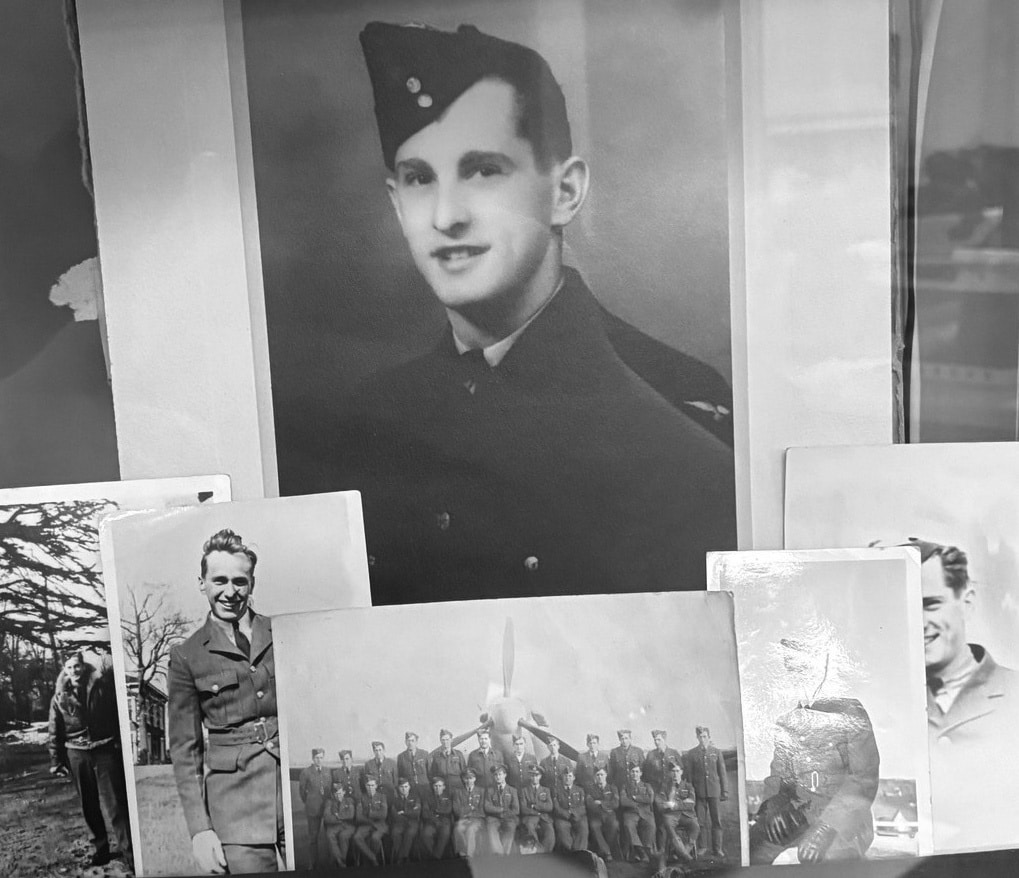
With Remembrance Day approaching, area resident Bruce Newton Miller reached out to Beach Metro Community News to share a remarkable, deeply moving piece of East End military history his family holds.
Bruce is the nephew of Pilot Officer John Newton Miller who grew up in the local area (Hampton Avenue in the Danforth and Logan avenues area) and attended Frankland Public School and Eastern High School of Commerce.
Shortly after the start of the Second World War, John enlisted in the Royal Canadian Air Force (RCAF).
John served with the 185 Squadron flying Spitfires over Malta, where he was lost in action on March 20, 1943, at just 22 years old. (His older brother, Pilot Officer Bruce Armstrong Miller, was also killed in the Second World War during air operations over Germany in 1942 at the age of 23 and is named on the permanent memorial at Danforth Collegiate and Technical Institute).
John is on the Malta Memorial which commemorates the more than 2,000 airmen from Commonwealth countries who lost their lives across the Mediterranean, northwest Africa and southern Europe and who have no known graves.
“What makes John’s story uniquely poignant is a letter written directly to the Miller family by the Axis/Austrian pilot who flew against him,” said Bruce in a note sent to Beach Metro Community News this week.
“In the letter, the enemy pilot took the time to contact John’s grieving family specifically to commend the ‘amazing courage’ and skill John displayed during his final dogfight. As a community newspaper that beautifully preserves local heritage, I wanted to offer a digital copy of this letter, alongside family photographs, if you would like to feature John and Bruce’s story for the community this November.”
Bruce sent Beach Metro a copy of the letter and a photo of John.
Beach Metro is honoured to share some of the contents of that letter with our readers on the day before Remembrance Day.
Here are some of the words from the Luftwaffe flyer named Heinz Schlechter, an Austrian who took part in the air battle in which John was killed after his plane was shot down and crashed into the Mediterranean. The letter was originally sent in German to an officer (Wing Commander Maurice A. Smith) with the Royal Air Force (R.A.F) Volunteer Reserve who was an editor with the R.A.F’s Flight publication in March of 1947. A translation of the letter into English was later sent to the Miller family.
“This letter comes from my heart and I can see no other way of sending you some information which will certainly be of interest to you and will also bring a little pleasure to the people it concerns,” reads the letter.
“On 20th March, 1943, between 1523 and 1545 hours I was engaged in air combat with an R.A.F fighter of the South coast of Sicily and I have never been able to forget it. My opponent was a remarkably brave man and I experienced no feeling of triumph afterwards, but as though I had slain a friend.”
Schlechter’s letter continued:
“I was reckoned an ‘old hand’ after I had taken part in the Africa Campaign and I always flew (in and Me 109 G) with a friend of my boyhood whom I had encountered in Africa. He too was a lieutenant and was 21 and I was 22. On the day in question (20th March, 1943) the alert was given. The weather was very bad. We both took off at 1523 hours and soon reached the coast and were glad to out of the bad weather. We climbed higher and after 5 minutes flying time we saw below us, at a height of about 500-300 metres a single Spitfire (probably IX) who paid no attention to us.
“We saw at once that the pilot was circling above an air-sea rescue post, two to three kilometres from the enemy coast at this low altitude. Apparently one of his formation had crashed in the sea. Bernd attacked at once but the Spitfire got away so quickly that the attack was fruitless.”
The letter explained that Bernd was considered an ace fighter pilot and the two German Luftwaffe planes and Miller’s Spitfire were engaged in long air battle.
“The remarkable manoeuverability of the Spitfire stood our unknown enemy in good stead. He dodged every attack cleverly, constantly remaining 50 to 100 metres below us following all our twists and dodges, and we put up a fine show. He did not think of drawing away and hiding himself in the clouds which hung like a thick curtain before the coast, only 1 to 2 km. away. 15 minutes passed and we had received a few hits, but we could not catch up with him…We were ready to break off the engagement as our fuel was getting short and we were wondering how we should get back to base; just at this moment, however, the Spitfire managed to get behind us and we realised what we were up against. This was no novice but a first rate man who meant to settle his fight one way or the other.”
Schlechter’s letter pointed out again that Miller could have hidden in the clouds but did not do so. “Suddenly he came towards us, with the evident intention of shooting one of us down. A clever dodge, I was so surprised that I forgot to fire, but Bernd fired a fraction of a second before the Spitfire pilot who flew clean into the hail of fire and was almost certainly hit at once, the Spitfire passed 50 metres away from me and I saw it breaking up; out of control it plunged into the sea without catching fire. The waves rose high, like a memorial which the unknown man himself erected as a token of parting with life, then they swirled together and closed the gap made by the aircraft.”
Schlechter said he never forgot that day and the unknown Spitfire pilot. “Years have passed and I never forgotten this man. Who mourned for him? What has become of Bernd? On the 2nd May of the same year, after 35 air victories he was shot down into the Mediterranean and his body lies in the same grave as that of his most valiant opponent. That was his hardest and greatest fight.”
In the letter, Schlechter said in other times they all might have flown together, not as enemies. “We should so much have liked to be friends with you and flown with you. Now to my request my dear Mr. Smith. Will you try to find who this man was and will you drop this belated wreath from his former opponent on his watery grave…Will you be so kind as to send on this letter to his parents or relations and friends; perhaps one of the men of the R.A.F. who was in his unit is still alive. I should be so glad if my wish could be fulfilled…
“I am not trying to curry favour and make myself important, my wish is prompted by my feelings…In conclusion I should be glad of an answer and I hope that those who loved this outstanding pilot have, by my letter, been freed from painful uncertainty. He was vanquished by no unworthy foe, for Bernd too was a wonderful person, there are few of his equals in this world. This however is poor comfort. The grief for our opponent will be none the less bitter.”
Tomorrow, Wednesday, Nov. 11, is Remembrance Day.



Comments (0)
There are no comments on this article.