
On The Wild Side: Look high into the sky as fall is raptor migration season
By ANN AND ERIK BROKELMAN
I know a lot of people look forward to autumn for the cooler weather, the beautiful trees, trick-or-treating, and the pumpkin spice everything, but this time of year is special to me for another reason: It is raptor watching season!
While I’m not sure if this is true, a few people have told me that on crisp, chilly days with a northwest wind, migrating raptors tend to fly lower, giving us some of our best opportunities for amazing pictures. What I can say with confidence: You never know what you’re going to see on any given day, which is why you’ll always find me out there with my camera at the ready.
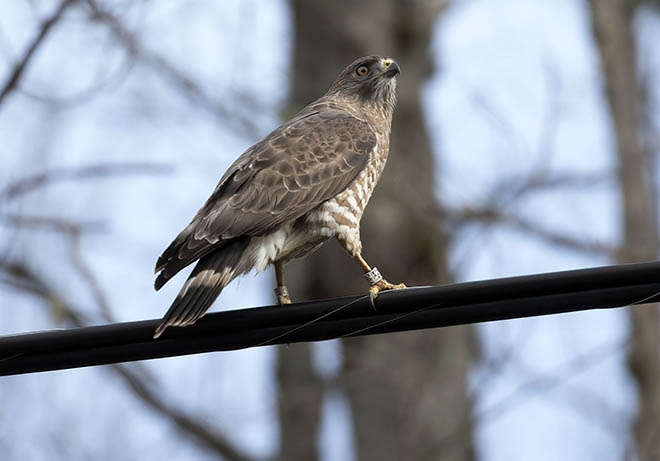
One incredible raptor that passes through the Greater Toronto Area this time of year is the Broad-winged Hawk (Buteo platypterus).
Up in Algonquin Park, I often spot them perched along the hydro lines. In Toronto, I like to watch along the Scarborough Bluffs as they tend to fly by closer to eye level. They thrive in our deciduous or mixed woodlands.
With their short, broad wings, they can fly and maneuver between trees with incredible speed and agility. If you catch sight of a raptor, but aren’t sure if you’re seeing a Cooper Hawk, Red-tailed Hawk, Bald Eagle or Sharp-shinned Hawk, look closely for the distinct, bold bands on the tail of the Broad-winged Hawk.
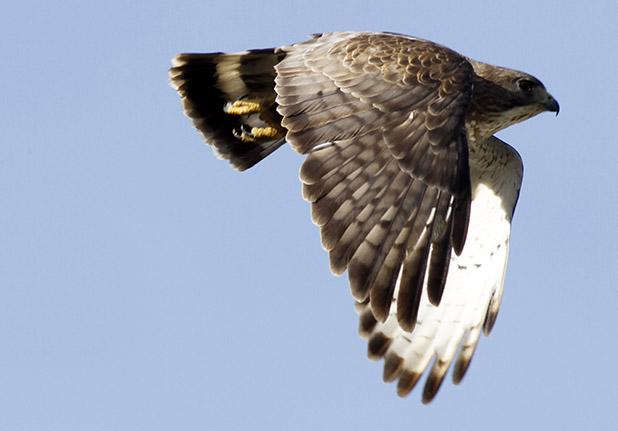
While we do see them, a few at a time overhead in Toronto, if you are willing to make the trip down to Port Stanley, and get your timing right, you might catch hundreds, or even tens of thousands of these hawks gathering and funneling through southern Ontario on their journey south.
I have stood at Hawk Cliff, just east of Port Stanley, and watched hundreds of them soaring together high in the sky over just a 10-minute period. They rely on rising warm air currents, called thermals, which allow them to gain altitude without even flapping their wings. I can promise you it is a breathtaking sight!
That said, I’ve since learned about the “River of Raptors” that takes place in Veracruz, Mexico, and I’ve got a new item for my bucket list.
Apparently, by the time these birds make it that far south, they form clouds that include hundreds of thousands, and sometimes millions, of hawks travelling together. I’ve looked up pictures, but this is something I need to see with my own eyes.
While doing a little reading on these birds, I was excited to learn about a wonderful project taking place right here in Ontario. Local Beach residents, Malcolm Wilson and Charlotte England, are leading a tracking project to gather vital information on Broad-winged Hawk behaviour.
This year alone, they have banded 45 of the birds and fitted three adults with state-of-the-art GPS-GSM transmitters. Last I heard, they had banded an astonishing 700 Broad-wings!
How fortunate we are to have dedicated researchers like Malcolm and Charlotte doing such interesting, and crucial, environmental work right in our backyard.
You can even follow their tracked birds’ incredible journeys online. Head over to the Hawk Mountain Sanctuary website under their Broadwing Movements page, where you can learn about the travels of tagged hawks like Minden, Raey, and Josh Allen.
It is absolutely fascinating to see where they head, and at the time of writing this article it looks like “Potts” has made it the furthest, all the way into central Brazil. A huge thank you to Malcolm and Charlotte for their amazing research and dedication to protecting these beautiful birds!
If you happen to see one, or even capture a picture of one, please feel free to reach out and let me know. I am always excited to hear about your animal sightings!
UPDATE: One of the Monarch Butterflies with transmitter has reached Mexico. It took 41 days and the butterfly travelled a total of 2,645 kilometres. Hopefully more will join Noor RMT26032.



Comments (0)
There are no comments on this article.