Picture book for adults with dementia released by author Helen Metella
By JULIA SAWICKI
Helen Metella never imagined that picture books would become one of the few ways she could still connect with her mother.
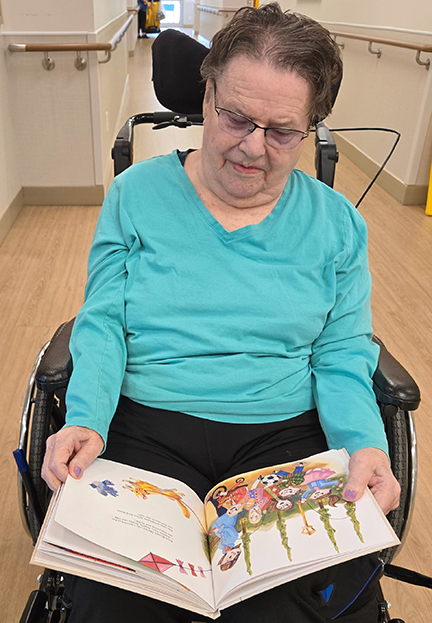
Three years after the former East Toronto resident’s mother was diagnosed with dementia, everyday forms of reading — newspapers, novels and long stories — slowly became too difficult to follow. So Metella turned to picture books.
The picture books worked. Metella’s mother absorbed the illustrations, drawn to the imagery and details that helped her focus, while Metella loved seeing her mother smile and connect.
But reading children’s books to her mother, even the classics, began to feel uncomfortable for Metella. The stories were simple, but also childish, filled with lessons about getting along with your baby brother, learning confidence as a little girl, or what happens when you give a mouse a cookie. The books were written for children, not for adults who had lived full and complex lives, even if they couldn’t always remember them.
“I thought to myself, ‘I can do better than this. I’m a writer,”’ said Matella.
This realization became the foundation of Marika and the Auction, a picture book written for adults with dementia. Illustrated by Hannah Kate Miller, the story centres around a woman dealing with her chaotic and rambunctious children at an auction.
For more than a year, Metella worked to create a story that captured the intelligence, identity and experiences of her readers. It incorporates captivating, colourful visuals without taking away from its substance.
“I’m not talking down to her. I’m not pretending that she’s a child. It’s actually about a capable adult,” said Metella.
Metella describes her mother as one of millions of women transformed by the social changes of the late 1960s and early ’70s: a feminist who balanced motherhood, career, family life and her own identity during an era where women’s roles were evolving in new and exciting ways. She drew on the vibrant energy of her mother as she remembers her, along with her own experiences, creating a story filled with details and emotional familiarity.
Marika and the Auction is set in the 1970s and pulls from memories of family life and visually significant period furniture, attitudes and fashion. This decade was strategically chosen for the book, said Metella.
According to the Mayo Clinic, the primary age demographic of those living with dementia is 65 and older, placing many in their late teens to early 30s during the 1970s. Adults with dementia most vividly recall memories from young adulthood, typically between 15 to 30, making this era extremely relevant for those with Alzheimer’s or dementia.
For Metella, those details are crucial. They allow memories to resurface naturally and provide some familiarity.
“I point to the furniture that we’ve created that looks like it’s dowdy or from the late ’60s, and I say ‘Oh mom, I remember when we had this icky old couch or this funny looking clock.’ And she doesn’t have to say anything,” said Metella. “I can say I remember, and I can spin a story, and she can listen to it, she can chime in if she’s capable on that day.”
The book helps open the door for recollection. Metella said her younger brother has a pivotal role in the book, and references the moment of frustration when two children act up and are sent to opposite sides. She also includes the image of a father’s legs sticking out from under a car as he tinkers around while Marika heads off to the auction.
“It’s a nice memory, even if it’s a subtle one,” said Metella.
The book also rejects what many experts refer to as “elderspeak,” a simplified, high-pitched style of talking often used with elderly people, or those with difficulty understanding. Elderspeak can feel demeaning and infantilizing. According to the National Institutes of Health, it can contribute to depression, resistance to care, and a loss of autonomy.
“Suddenly we’re talking to them in loud voices and going ‘Oh dearie how are you?’ That’s not the way I ever want to talk to my mom,” said Metella.
One of Metella’s main intentions with Marika and the Auction was to ease communication between people with dementia and their family members or friends.
“I chose to talk to her like an adult, the way I’ve always done. I bring her anecdotes, tell her stories. But what happens when you see someone twice a week or just once a week? You run out of anecdotes to tell them. Whereas this book, you can go in and it’s ready made. It’s got the story that you can read, and then you can point at some details and go on to a side story.”
Metella emphasized that the book is suitable for all ages, although it is written at an adult audience.
“It’s appropriate for an adult, but also for a grandchild. The books are not written at a level that is too advanced. If you want your child to have a relationship with their grandparent or great aunt or uncle who has dementia, it’s really hard to start a conversation,” she said. “You can have a young child read the book to them. That’s a beautiful way for them to visit and not feel depressed or bored. I think that when a person is in their 80s and has grandchildren or great grandchildren, they still want to connect with them, even if they don’t know what to say to them.”
The book was released on May 1. Although Metella now lives in Edmonton with her mother, many friends and family remain in the Beach and she wanted to share the story with them.
A book signing will take place on June 8 at Coles, 2169 Queen St. E., from 11 a.m. to 12:30 p.m., followed by a launch event at the nearby Beaches Branch library from 1 to 3 p.m.
Marika and the Auction is available online through Indigo, Amazon, Audreys and YNWP Publishing, and at the Coles book signing. For more info, please visit https://www.storybooksforseniors.com/