Readers ask for more Sir John A.
Since I wrote my last article on Sir John A. Macdonald, and whether we should reward his memory with a plaque or by naming a park after him, I have been told by many people that they think something along those lines would be appropriate. Others wanted more information about Sir John A., his life and times. So here in encapsulated prose is a biography of Sir John A., in my opinion.
Sir John Alexander Macdonald, Glaswegian, humanitarian, politician, businessman, lawyer, non-abstainer, family man, visionary, orator, prime minister, Canadian, was born in Glasgow on Jan. 10 or 11, 1815 – you can make your own choice on the date – and stayed in Scotland until he was 5. Macdonald’s parents decided to leave for the new world, thousands of miles across the sea, and arrived in Canada, or British Canada, as he was often to say. The family ended up in Kingston, and John spent his school years in that area.
John was a bright student (so they said), and made his way in Kingston to start his apprenticeship as a lawyer with a prominent firm. Macdonald proved his worth, sometimes in an orderly fashion, sometimes in a dynamic way, before he was 20. He had a few episodes before he was called to the Bar (pardon the pun).
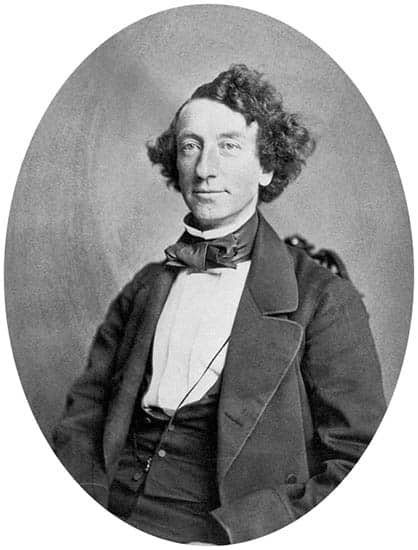
Sir John A. Macdonald in 1858
At this time the reader must know that John had many plans and dreams to choose between: to make money? To help his fellow man? Or to help himself, or his family? We will see that Macdonald tried all of these things, some more successfully than others.
Macdonald had a military career, although he wasn’t a general or an officer, but a private in the militia in Toronto, during the rebellion of 1837, started by people like William Lyon Mackenzie and other French rebels.
As a lawyer, John defended some rebels in court, and made enemies, but he did what he thought best for the underdog. His career was at this time beginning to grow, and he came to the attention of several prominent people. John kept his law practice right up to the time of his death, even throughout his political career. He practised law in Kingston, Toronto, and other small towns.
His political career began as an elected alderman in Kingston in 1843. John became a Conservative and at age 29 entered the legislative assembly of the Province of Canada.
He reached the post of Receiver General. I can write reams and reams about his political career and ambitions, but there is not enough time and paper.
He also was instrumental in starting a new alliance after the Liberals lost power: the Liberal Conservative Party. He worked his way up through the ranks again, using personality and ingenuity to become head of the Conservative party in 1856, and as co-premier of the province of Canada with Étienne-Paschal Taché of Quebec.
By now John began the tremendous task of nation building. However, many opposed him, including George Brown of the Globe and others in his own party. It looked bleak (and maybe in those times he started his drinking), but as time would show, he persevered.
Finally Macdonald accepted the coalition of George Brown and others in 1864. Then the Charlottetown conference was held, and the foundations of John’s dream were laid. On July 1, 1867, his Canadian dream came true and the country was born.
Macdonald’s life was filled with many personal tragedies which would have driven a lesser man to quit, and go off and get drunk – which he did, more than once. John married his cousin Isabella Clark, and they had two children, though one died and the other suffered chronic illness. Another child from a later marriage, Hugh, would become a well-known politician.
As you can see, there was a human side to Macdonald, but I will go into this another time.
Macdonald had many businesses over the years, was a director of numerous companies, and made and lost small fortunes more than once. This will also be covered at a later date.
Sir John A. Macdonald steered the good ship Canada through many rough seas. He lost friends and made enemies. In 1872, an election year, his government was brought down through the Pacific railway scandal. He was in political limbo, sometimes drinking to a point of ill health. Several times he was going to quit politics.
However, he again persevered, and in 1878 during an election campaign he made a four hour speech at Victoria Park in Toronto. The speech was made to several thousand people and sent out by telegraph, and Macdonald went on to win the election.
From that point on Macdonald was unbeatable, until late May of 1891 when he suffered a stroke. Sir John A. Macdonald, the father of Canada, died on June 6, 1891.
And the question remains: should we honour him here in the Beach?