Residents question city’s rules in connection with new house being built on Selwood Avenue
By MATTHEW STEPHENS
Residents living on a quiet street in the Beach are questioning the city’s building rules after they claim a residential development was fast tracked through the approval and demolition process.
“Late last week, we found a demolition notice posted (at a house on Selwood Avenue) and a fence going up. We were told the house was coming down and a three-storey duplex with a basement apartment going up,” said a local resident (who wished to remain anonymous) in an interview with Beach Metro Community News last month.
(Beach Metro Community News has decided not to name any of the residents involved in this story, including the building’s owner, as this story’s focus is on how City of Toronto and Province of Ontario rules have changed regarding development on properties in residential neighbourhoods.)
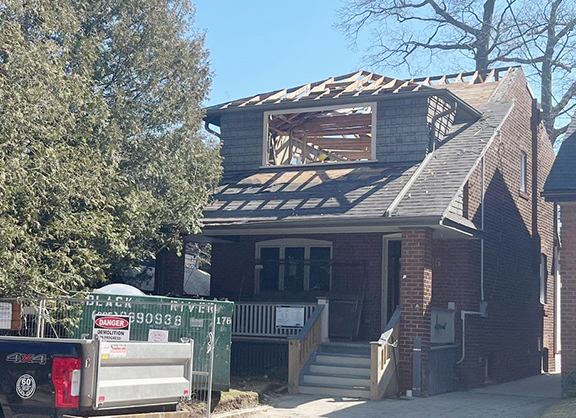
Several Selwood residents said they received little notice regarding the demolition of the house on the property, and said no Committee of Adjustment hearing had been held despite plans to increase the building’s height from two to three storeys.
“We were told the house was coming down and a three-storey duplex with a basement apartment going up. No consultation with neighbours and no Committee of Adjustment necessary. Apparently, this is supposed to give us time to lodge a complaint,” said the resident.
Despite what they described as a “fast-tracked” demolition process, the resident acknowledged that the builder/owner sent a note last December inviting the community to see their new plans for the property.
“He sent a note in December saying, ‘Come join us and we’ll show you the plans.’ And then last week, they said the demolition notice was up for two weeks, I only noticed it for about 10 days,” said the resident.
Beach Metro Community News has confirmed the owner did earlier offer to share the plans for the new house with other Selwood Avenue residents.
The City of Toronto said the building going up on the Selwood Avenue is allowed under “as-of-right” rules and conforms with all of the city zoning bylaws.
The Committee of Adjustment is authorized by the city under the Planning Act to evaluate applications for minor variances (including building setbacks, height, or lot coverage), land severances (consents), and legal non-conforming uses in order to ensure builds and renovations fit within the community’s official plan and zoning bylaws.
As with other three-storey buildings in the area, City of Toronto Communications Advisor Kate Lear said the Selwood Avenue building plan complies with the zoning bylaws under as-of-right, and that no Committee of Adjustment hearing was necessary.
“A Committee of Adjustment hearing is only required when a development needs either a minor variance from the zoning bylaw or consent to sever property,” said Lear in an email to Beach Metro Community News. “The proposed construction… complied with all existing zoning regulations including height, depth, setbacks, density, floor space index, and building envelope; therefore, Committee of Adjustment (CoA) approval was not required.”
Several Selwood residents also claimed the project was fast tracked by the province under the More Homes Built Faster Act, a 2022 bill intended to increase housing options for Ontarians.
When asked about that, Lear said provincial legislation had no impact on the plan not having to go through the Committee of Adjustment process.
“Bill 23 (the province’s More Homes Built Faster Act) did not remove or eliminate the Committee of Adjustment process. Variances are still required when a project exceeds zoning permissions,” said Lear.
However, provincial and municipal rules aren’t the only issues concerning residents on Selwood Avenue. They said they were concerned part of the residential space at the new house might be used as a business, and they are questioning how the city ensures residential properties are used for their intended purpose after approval.
Beach Metro Community News has been told that the owner does not plan to run a commercial business at the new house.
Lear said developers are required to show compliance with both zoning and building code regulations when applying for building permits, and that Municipal Licensing & Standards (MLS) may investigate if a property owner operates a commercial business in a residential property.
“In Toronto, all properties, including new construction must comply with zoning bylaws, the Ontario Building Code, and issued building permits. (Selwood Avenue) is zoned in a residential zone. When an applicant applies for a building permit, they must show compliance with both zoning and the Building Code,” said Lear.
“City staff review plans to ensure the proposed structure and its intended use are allowed. If a non-permitted use operates in a residential zone, Municipal Licensing & Standards may investigate and take enforcement actions.”
Other Selwood Avenue residents complained the developer posted an “insufficient” demolition notice just several days before work began.
The City of Toronto’s demolition permit process operates separately from broader planning approvals, which can limit public visibility. In many cases, permits are issued administratively by city staff without mandatory public notice, particularly if the property is not designated under the Ontario Heritage Act and the proposed redevelopment complies with existing zoning bylaws which was the case for the Selwood Avenue property.
Lear said, under Municipal Code Chapter 363, residential developers are required to post a demolition notice on the property “for at least 14 days,” before work begins, and inform the local city councillor.
However, one neighbour recalled seeing a demolition permit on the property on March 10, noting that demolition crews began gutting the property’s interior shortly after.
“I first met the new owner March 5, and the work started the start of the following week. I didn’t notice any notice, until this notice appeared March 10th. Work had started that day or the next day. Definitely not 14 days later,” said the resident.
Lear said demolition of a property is not permitted during the 14-day notice period, but that work to deconstruct the interior “may occur” during that time.
“Demolition of the building structure is not permitted during the 14-day notice period. During this time, some interior demolition work may occur, such as the removal of finishes and flooring provided that the work does not require a building permit,” said Lear.
As of April 1, demolition of the exterior of the existing house had not started. As of April 8, demolition work on the exterior was taking place but much of the house was still standing.
During the 14-day demolition posting period, Lear said residents can submit a concern or objection to the city’s Director and Deputy Chief Building Official.
According to Lear, written complaints or objection from a local city councillor can directly impact the progression of a residential development, sending it to community council for further consideration.
However, without specific directions on how to file a complaint, residents unhappy with the new build fear they may have missed the window to contest it.
One resident said a number of complaints had been made to a city building inspector, but the residents were told “there was nothing that could be done” because the demolition and new build had already been approved.
While it remains unclear if the complaints had any impact prior to the demolition process, some of the Selwood Avenue residents are continuing to argue against the new house due to its height and impact on the neighbourhood and the loss of a “perfectly beautiful” existing Beach home.