Great grandson of Nelson Mandela, Dr. Siyabulela Mandela, talks about peace and reconciliation during visit to local preschool
By MATTHEW STEPHENS
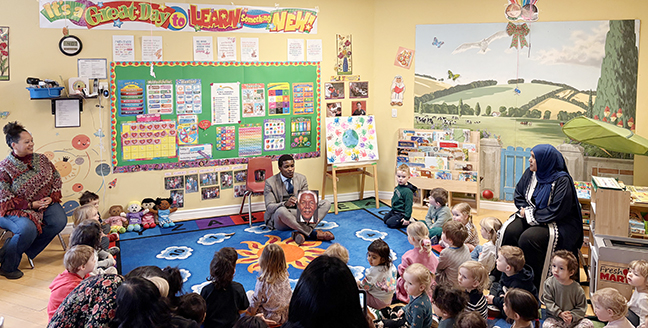
In honour of Nelson Mandela’s insurmountable legacy, his great grandson Dr. Siyabulela Mandela has embarked on a weeks long tour across Toronto to advocate for truth and reconciliation – bringing him to East Toronto’s Teach Me to Fly preschool in southwest Scarborough late last week.
“We’re talking about peace; we’re talking about reconciliation. This year, we came back to see how we can continue to remember the legacy of Nelson Mandela at a time when the world is becoming more divided,” said Siyabulela in an interview with Beach Metro Community News.
He visited the preschool at 2560 Gerrard St. E. on Thursday, Feb. 19, to read the kids a short story about Nelson Mandela’s onerous mission to fight for human rights in an apartheid (institutionalized segregation) South Africa in the mid to late 1900s.
Siyabulela will also be at Neil McNeil Catholic High School on Thursday, Feb, 26, to share a message similar to the one heard by young students at Teach Me to Fly.
“It’s important that we continue to build bridges between communities. So, we’re having talks at local schools on the importance of reconciliation and the protection of fundamental values that guide humanity,” said Siyabulela.
Following in his great grandfather’s footsteps, Siyabulela is a scholar and social justice activist for leadership and world peace. He has worked as the Regional Project Manager for east and southern Africa at Journalists for Human Rights, and recently finished his position as a lecturer for politics and international relations at the University of Kurdistan Hewlêr in Erbil, Iraq.
Now focused on his Toronto tour, he is holding his presentations at the layers of society where he believes truth and reconciliation awareness is needed most.
“During this tour that we’re doing, I’ll be engaging with schools, universities, government entities like police departments across Toronto. I’ll be speaking at Toronto Metropolitan University on the role that Nelson Mandela played as a lawyer fighting for justice, peace and freedom,” said Siyabulela.
Nelson Mandela (through the African National Congress Party) laid the groundwork for truth and reconciliation in 1995, when he established South Africa’s Truth and Reconciliation Commission just one year after being elected as the country’s first Black president.
In 2008, Canada introduced its own Truth and Reconciliation Commission, which was formed through a legal settlement between Residential School Survivors, the Assembly of First Nations, Inuit representatives and parties responsible for the creation and operation of residential schools, the federal government and the church bodies.
“Truth and Reconciliation was later adopted by Canada back in the early 2000s, when they realized that they also have to follow through the example that South Africa had presented to mend the injustices of the past,” said Siyabulela.
He said the goal of his presentations is to help break down underlying barriers prevalent amongst marginalized communities by talking about how members of society can come together and help build a better world.
“We are touching every layer in the sector of society,” said Siyabulela. “From the schools to the police; from the police to the universities; from the universities to the corporate companies – focusing on the role that they play in transforming societies.”
While minority groups across North America were still recovering from the lasting impacts of racial segregation throughout the 1900s, Nelson Mandela was leading the charge against South Africa’s apartheid laws.
Similar to America’s Jim Crow laws, which lasted from the 1870s to mid-1960s – South Africa’s apartheid laws (from 1948 to 1994 following the election of the white-only National Party) also enforced strict institutionalized racial segregation and white supremacy.
Throughout his life and political career, Nelson Mandela fought against segregation in South Africa as an African Nationalist. He studied law at the University of Fort Hare and the University of Witwatersrand before working as a lawyer in Johannesburg. He became a crusader for anti-colonial and African nationalist politics, joining The African National Congress (ANC) Party in 1943.
Following the National Party’s establishment of apartheid laws in 1948, Mandela and the ANC swore to overthrow South Africa’s governing party by appointing him as the president of the ANC’s Transvaal branch, which led to further anti-apartheid efforts such as the 1952 Defiance campaign and the 1955 Congress of the people.
Through his efforts to end apartheid laws, Mandela was repeatedly arrested by the South African government for seditious activities. In 1956, he was unsuccessfully prosecuted for treason in the Johannesburg treason trial, in which 156 people were arrested in a raid.
His career later saw him secretly join the banned South African Communist Party. Despite his initial commitment to non-violent protest, he co-founded the ANC’s paramilitary wing known as the uMkhonto we Sizwe in 1961, which would later become involved in a sabotage campaign against the apartheid government. This led to Mandela’s arrest in 1962, and following the Rivonia Trial two years later, he was sentenced to life imprisonment for conspiring to overthrow the state.
He served 27 years of his life sentence. However, amongst growing international pressure and civil unrest, President F. W. de Klerk released him in 1990. Following his release, Mandela and de Klerk worked to negotiate an end to apartheid laws, which resulted in the 1994 multiracial general election and Mandela’s victory as South Africa’s first Black president.
He declined a second term and would later go on to become an elder statesman focused on addressing poverty and the HIV/AIDS crisis through his charitable Nelson Mandela Foundation. He is now widely recognized as a historic icon for world peace and social justice, receiving more than 250 honours and winning the Nobel Peace Prize in 1993 for his work with de Klerk to end the apartheid regime in South Africa.
And now, 13 years after his passing, Siyabulela continues to share his great grandfather’s idea of world peace and harmony, hoping that his story will help shape future generations to come.
“We’re looking at the philosophy of Madiba (Nelson Mandela’s clan name), talking about the role that the community should play in building peace and creating a better world – not only for this generation, but for generations to come,” said Siyabulela.