
Community members’ concerns over proposed 11-storey building north of Main Street Library include size of building, lack of parking
By MATTHEW STEPHENS
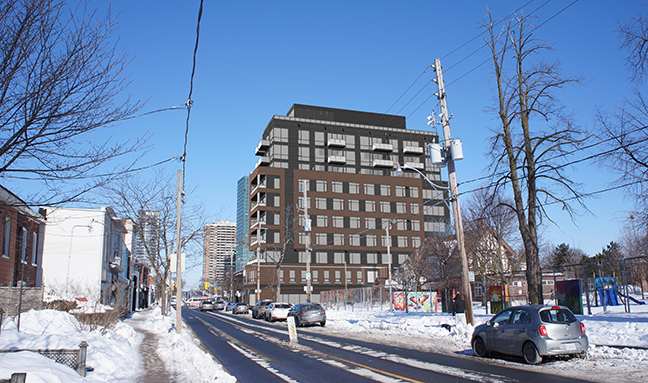
Residents expressed disappointment at last week’s virtual community meeting for a proposed 11-storey mixed-use building just south of the Main and Gerrard Street intersection.
“Replacing a two-storey building with an 11-storey building is just greedy, going so far over the limits,” said local resident David Kendall at the Thursday, Feb. 12 virtual meeting.
Submitted for city approval in December 2025 by urban planning consulting firm Batory Planning, the proposed mixed-use residential development at 143-147 Main St. – south of Gerrard Street East and north of the library – includes 56 units (seven of which are rental replacement units), four visitor vehicle parking spaces, 62 bicycle parking spaces, and a retail unit on the ground floor.
A portion of the existing building, which is listed on the City of Toronto Heritage Register, will be incorporated into the proposed development.
During last week’s virtual public meeting, Batory Planning met with residents, Beaches-East York Councillor Brad Bradford and Toronto city staff to discuss details of the proposal and provide context for future development in the area.
According to the city’s Main Street Planning Study, the mixed-use area surrounding the Main and Gerrard intersection has been designated for mid-rise development. The city generally defines a mid-rise building as any structure that is five to 14 storeys in height.
The area has also been designated by the city and Provincial Ministry of Municipal Affairs and Housing as one of Toronto’s Protected Major Transit Station Areas (PMTSAs), identified to support future growth and density.
“This is a site that’s in a major transit station area. It’s intended to experience some degree of intensification that’s different than areas that are not within walkable distance of transit and services,” said Greg Uens, a member of Batory Planning’s management team.
He said the site’s proximity to transit is just one of several reasons behind the developer’s decision to include just four visitor parking spaces at the site – a decision that annoyed existing tenants of the two-storey building who currently have access to parking.
“Currently, out of the seven tenants, four of us have parking spots,” said the tenant. “So, we were just wondering what would happen to those parking spots. Would we be assigned another parking spot somewhere else?”
Uens said parking replacement for existing tenants would be part of an exclusive tenant meeting to discuss rental replacement, and that the developer’s decision to not incorporate vehicular parking is meant to attract tenants who don’t drive.
However, with transit serving as the most viable option for those seeking affordability, many residents have argued that new developments near PMTSAs require a significant portion of affordable housing.
Although Uens said determining rental costs is “ultimately up to the owner,” it remains unclear whether the development proposal includes any affordable housing units.
In recent months, changes to provincial and city policy has left many local residents and councillors concerned about a lack of accommodations incorporated into new residential developments – with new buildings within transit areas no-longer required to provide any parking, and Ontario’s latest legislation to temporarily ban the city from requiring any affordable units in developments near transit hubs (Inclusionary Zoning).
With fewer regulations, many residents at the Feb. 12 meeting worried that the proposal could be the beginning of a new context for buildings the area, where the current “character” only consists of “two-storey commercial buildings,” according to Uens.
He said Batory’s proposal responds to the “city’s priorities,” and told residents the area has been “designated for growth” in the coming years.
However, with the area’s surrounding buildings only two storeys in height, East Toronto resident and meeting attendee Adam Smith said a building five times larger will stand out for years until new developments are approved.
“As there is no guarantee the other developments directly to the north will ever actually happen, if this gets built alone, it will stick out like a sore thumb for the foreseeable future,” said Smith at the meeting. “I feel it’s a little too big for this site and does not integrate with the existing streetscape.”
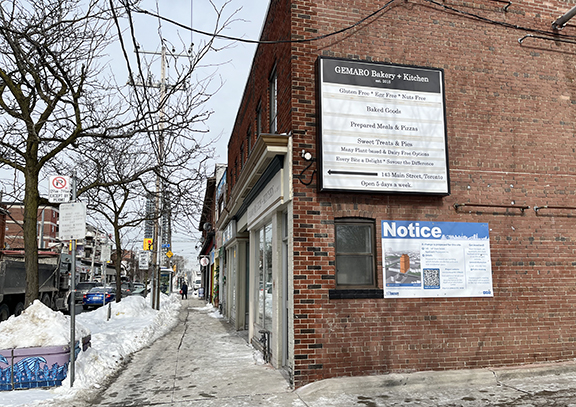
Rental costs for the existing tenants caused significant contention at the meeting, with several residents questioning whether their monthly cost for rental replacement units would remain unchanged following construction.
City staff said the tenant meeting to discuss rental replacement will be held later in the application process, and that rental costs for the existing seven tenants would be “similar to what the current tenants are paying” when they return.
“The overview of that formula is that it’s the rent that tenants are paying when they move out of the unit, plus the provincial guideline increases,” said city planner Kate Macmillan during the meeting. “So, it’s intended to be a similar rent as if they had stayed in the building and their rent continues to increase in a regular way.”
Many also argued that, due to the current state of the retail rental market, the proposed building’s ground floor retail space will only be affordable for big-name franchise stores.
“One of the reasons why I actually moved to the Main and Gerrard area, is because I loved some of those businesses that are surrounding us,” said resident Oliver Wickham at the meeting. “Obviously, there’s a lot of talk about rent for the tenants in the building, but I also want to draw the discussion to talking about rent for the retail spaces or what we can do to maintain some of the neighbourhood community integrity.”
Uens said the property owner is currently “exploring” the opportunity for the existing commercial tenants to occupy the new retail space following construction, and that due to modern building design, developers are often required to build larger, more expensive retail rental spaces.
“The city generally requires 4.5 metres of floor to ceiling height. And even if you have a loading space on the ground floor, it goes up to six metres. And what I find is that’s a very problematic space for smaller businesses,” said Uens. “It’s an expensive space, it’s costly, and it doesn’t have the same compact, street-oriented nature that some of the older Main Street buildings do.”
Building impact also caused significant unease from residents at the meeting, with some worried about construction-related congestion on the one-lane portion of Main Street south of Gerrard, and others expressing fear that the area’s infrastructure can’t keep up with increased density.
“Kids in the area are learning in a box (portable classrooms) outside of the local schools because there’s not enough classrooms. Is the infrastructure going to keep up with the rate of growth?” said Garry Mathieu during the meeting.
Toronto community planner Sarah Henstock said every development application submitted for approval is also circulated through all the school boards, who have their own set of planners and analysts to determine how increased density will be mitigated.
In their closing remarks, city staff said the applicant will be reviewing the materials and continue to work with city staff to prepare a decision report for Toronto and East York Community Council.
For more information regarding the proposal, head to https://www.toronto.ca/city-government/planning-development/application-details/?id=5714308&pid=270598&title=143-147-MAIN-ST.



Absolutely ridiculous – this project is way too big for the immediate neighbourhood. The City continues to show they have no interest in proper neighbourhood design – only in generating more tax revenues!