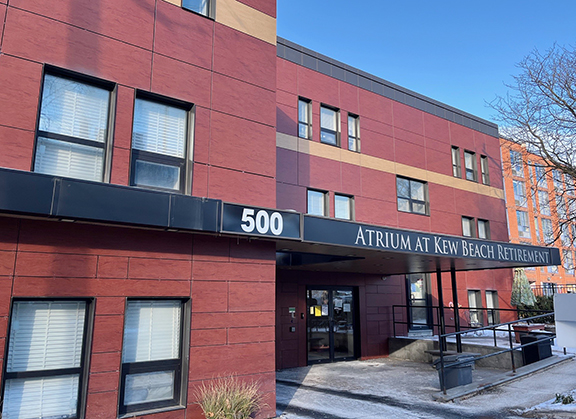
Kew Beach Unit on Kingston Road marks five years of providing integrated care for patients transitioning from hospital
By KAT BERGERON
During the first year of the COVID-19 pandemic in 2020, VHA Home HealthCare and East Toronto’s Michael Garron Hospital partnered to create what was supposed to be a three-month program for off-campus alternative integrated care to bed-bound patients called the Kew Beach Unit.
Five years later, the Kew Beach Unit off-campus integrated care program continues to serve the community as an adaptive measure to support the increased need for hospital beds even since the pandemic.
Based on Kingston Road, just west of Main Street, the program now hosts upwards of 80 patients (up from 20 beds since it started) which supports about 400,000 people in East Toronto.
The program is “just really demonstrating the need and the support that this sort of collaboration provides to the patients we serve,” said Jennifer Sampson, Director of Seniors & Aging and Transitional Care at Michael Garron Hospital.
For patients who are entirely bed-bound, VHA Home HealthCare provides assistance with basic needs such as bathing, rotating laying position to avoid pressure ulcers and eating. For patients with some or limited mobility, the program focuses on healing, mobility and rebuilding strength gradually.
The work to accommodate and rehabilitate patients typically involves multiple specialists, working within the program. The unit began with mostly nurses and PSWs (Personal Support Workers), but has expanded to include physiotherapists, occupational therapists, and memory supports, with the help of the OHA (Ontario Hospital Association).
“The ALC (alternative care unit) patients are bound to be transitioned to the LTC [long-term care] or go back to their homes,” said Oliva Mabborang, Manager – Community Programs and Partnerships for VHA Home HealthCare.
She added that when those patients “are in the hospital, there’s a lot of deconditioning. So although they don’t need a lot of acute care in the hospital, they still need some basic care. And then this is where they transition. And then we do help them to get better, or, I would say, to re-acclimate them.”
As of May, the Kew Beach Unit was working to relieve the stress on hospital bed capacity limitations with 14 of the original 18 staff providing off-campus hospital bed support as the demand continued to grow. For comparison, when it opened in 2020, the program housed 82 patients in off-campus extended care, showing that it was working to increase the number of available hospital beds. By this year, in 2025, the Kew Beach Unit saw an increase in usage to 343 beds off-campus.
According to Health Quality Ontario data from this fall, the average wait to receive hospital emergency room care was two hours, while admitted patients spent an average of 18.9 hours. The OHA data reports show Ontario’s average available beds per 1,000 people, was 2.28 in 2023.
To expand the alternative care program over a larger network would require more staff, facilities and funding.
“It would be nice to have it expanded, if we are able to, and, of course, VHA will always be there to support in terms of supplying the nurses, the PSW and the allied health workers,” said Mabborang.
Sampson said the Kew Beach Unit’s success has shown that alternative integrated care can help both the patients it treats while relieving pressures on hospitals.
“In reflection, what was a short-term, innovative idea born out of a pressure, has really turned into a sustainable model and exemplifies what integrated care and cross sector collaboration looks like,” said Sampson.
For more information, please go to https://www.vha.ca/integrated-solutions/transitional-care-units/ and/or https://ethp.ca/from-off-site-hospital-wing-to-comprehensive-transitional-care-centre-ethps-kew-beach-experiences-remarkable-growth-to-become-model-of-integrated-care-delivery/