
In My Opinion: Idea of ‘gentle density’ in East Toronto is slipping away
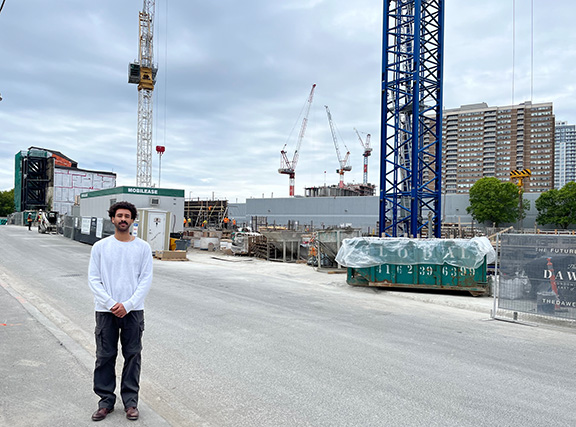
By MATTHEW STEPHENS
During my time as a reporter at Beach Metro Community News, I’ve experienced first-hand how proud members of this community are; how families (including my own) have established a livelihood in this area for generations; and how the “small town in a big city” feeling has been a driving force behind people’s decision to start a life here.
I’ve also had the pleasure (or rather, displeasure) of covering many stories involving new high-rise development proposals in parts of the community that were once regarded as quiet and quaint.
It’s been heartbreaking to see longtime residents watch their neighbourhood become an unrecognizable fragment of what it once was. To hear concerns regarding safety, traffic congestion, and lack of infrastructure – all of which are completely valid points.
For far too long, it seemed like many parts of East Toronto had astonishingly escaped the mass population growth that had been happening in other parts of the city.
However, in recent months, I’ve learned to accept that nothing lasts forever – and in that realization, I’ve also learned to accept that the idea of having “gentle density” in our community is straying further and further from being a reality in this generation. The sooner we accept it, the sooner we can learn to appreciate local population growth with optimism instead of dread.
The truth is that population density is going to increase whether we like it or not – and after all, why shouldn’t it? Canada is a great place to live, and while it may be my personal bias, our area is one of the best places to live in the city.
After attending several community meetings regarding residential developments, it’s become more and more clear to me that developers aren’t really concerned with what this community stands for. For them, building as much housing as possible is at the forefront of their priorities.
According to a representative of an urban planning firm at a recent meeting, changes in City of Toronto building policies are actually encouraging developers to build larger (high-rise) structures across the city to increase housing. The new towers in the Main Street and Danforth/Dawes area are a prime example.
Although developers don’t necessarily represent the values of this neighbourhood, or even know what it means to be a member of this community, I’d like to believe they will ultimately serve as part of the solution to the many housing issues affecting both this area and Toronto as a whole.
By now, it should be clear our country is in a housing crisis. According to the city’s Housing Update Report from September 2024, nearly 11,000 individuals were experiencing homelessness in Toronto. But homelessness is only one part of the housing crisis.
During a recent electoral candidates meeting I attended, I listened to a mother express disappointment in knowing her children may not be able to find an affordable place to live locally and carry on their family legacy of living in the Beach. Her sentiment hit home for me, as I know that I may share the same fate as her children.
In a previous statement I received from President of the Balmy Beach Residents’ Association John Cameron, many Beach residents expressed “worry regarding options for their neighbours, their children, or themselves to live in the coming years.”
To put it simply, gentle density is an unrealistic expectation in light of Canada’s ongoing housing crisis. We need all the housing we can get at this time, and it doesn’t feel right to think that we shouldn’t have more density across the city just so we can prevent the inevitable and preserve the idea of what our neighbourhood once was.
While I must admit that providing “affordable” housing doesn’t seem to be a top priority for many developers, the fact is we need all the housing we can get.
And with the recently elected federal Liberal Party saying they plan to work harder to get back into the business of building affordable housing and ensuring more rental units are government owned and rent controlled – it gives me hope that future deals between developers and the city will be focused on addressing the affordable housing crisis. If more density in our area is required for more Torontonians to have an affordable place to live, I’m all for it.
During many of the meetings I’ve attended, the issue of infrastructure has also been a prominent topic of discussion. While it may be true that our neighbourhoods don’t have adequate infrastructure to support the rise in population and traffic, I would argue the infrastructure of downtown Toronto isn’t built for the population it sustains either – yet they (somehow) make it work.
Although it may be a difficult pill to swallow, we need to have faith that our city will make the necessary adjustments to infrastructure to ensure our neighbourhoods remain safe and comfortable. Again, optimism is super important.
Considering population growth and density is going to happen whether we like it or not, we need to learn to embrace the change and look at the many benefits density provides. It welcomes cultural diversity and contributes unique perspectives to local community events.
Density also provides immense support to our local businesses and economy. It creates more housing availability for our children in the community who are looking to start a family and carry on traditions and generational legacies; and it gives local seniors an opportunity to downsize while staying in the community and selling their homes to those looking to start families here.
Having lived in the Beach my entire life, I’ll admit I’m skeptical and worried about what population density means for the future of our beloved community.
However, I’m also optimistic about all the ways population density could strengthen this proud community that I will forever call home.


“The sooner we accept it, the sooner we can learn to appreciate local population growth with optimism instead of dread.”
The author, while well-intentioned and perhaps trying to be diplomatic, is still suggesting that somehow growth and development are going to be inevitably imposed, as if residents just need to accept that and find a way to live with it.
Hooey.
Density and development and the emissions they create are choking our city, and it’s high time we started pushing back. Collectively as a species on this planet we have hit the limits to growth, it’s time to focus on a sustainable circular economy that ebbs and flows as nature does, not keep bowing to the corporate lust for profits in an economic system that is incompatible with nature because it requires infinite exponential growth in a finite system. It’s time to protect what we have before we lose it.
We need to stop capitulating to the dictates of the politicians in service to the wealthy elite and their corporations and start doing things for people.
The Murphy Law project went through lengthy process including community consultation and a deal to preserve the heritage value of the Murphy Law project. Deign changes were added. And it confirmed to the official plan guidelines for 6 stories. It was approved. A hood building . They quickly demolished the old hotel which was being used as a woman’s shelter. Then they just left the brown filed vacant for 7 years as an eyesore and blight on the area. Now they want to “upzone” to maximize their greedy profits and totally disregard the rules and the process that had been agreed upon. It’s really shameful! No thanks. They shouldn’t be rewarded for this kind of behaviour.
Gentle density is slipping away. The question is why accept quantity over quality? If density is the only solution to housing, that by definition means future generations are subjected to smaller and smaller units of housing, with no end in sight. Why not ask the tough questions; why is the housing of the past, no longer affordable? Density will happen over time, but that doesn’t mean it should be implemented with a complete lack of transparency. Main & Danforth underwent a planning study recently, 30 storeys is what the community was told. Developers immediately appealed, they now seek to build 50+ storeys. Politicians tell us that we can participate in these studies, they use words like “gentle density” and “incremental change” but the reality is these decisions are made behind closed doors and the community is left with rough density instead.