Marsupial moves into heart of Beach
Why did the opossum cross Wineva Avenue?
Rick Wyszynski didn’t ask, but he did snap a photo of the one that slowly crossed his street a few weeks ago.
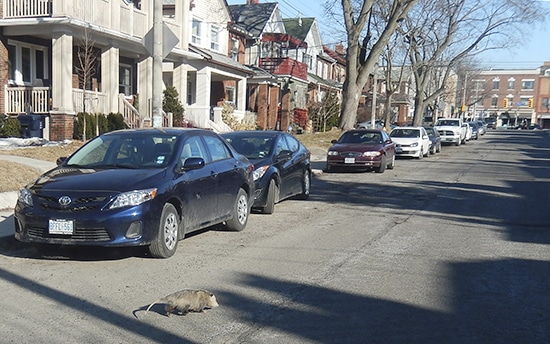
Beach Metro News reader Rick Wyszynski caught a photo of this brave – or oblivious – opossum heading north on Wineva Avenue.
PHOTO: Rick Wyszynsk
Wyszynski said it was the first opossum he has seen in the Beach after 30 years here.
“It didn’t look like the usual raccoon, so I slowed down,” said Wyszynski, who was driving on Wineva at about 9 a.m.
“It was moving so slowly, I thought it was hurt at first. But I think it may have just woken up, I don’t know.”
In nearby Birch Cliff, three more residents said they have recently had opossums under their porches, according to the Birch Cliff News.
Nathalie Karvonen, the executive director of Toronto Wildlife Centre, said it’s hard to pinpoint what year opossums first moved north to Toronto, but sightings go back at least as far as the 1980s.
“We’ve been open for 21 years, and from our perspective, without doing a scientific survey, I could say that their numbers have been slowly increasing across Toronto,” she said.
Karvonen said Toronto Wildlife Centre receives more than 100 sick or injured opossums each year.
“Mother opossums tend to have 10, 12, 14 babies at a time,” she said, noting that they sometimes receive a whole pouch of young opossums when a mother opossum is killed by a car.
“The numbers can go up pretty fast because of that,” she said.
Opossums are North America’s only marsupials, meaning their young develop in a pouch, like kangaroos.
According to Ontario’s Ministry of Natural Resources, opossums give birth 13 days after mating, at which time their young are blind, furless, and so tiny that a whole litter can fit on a teaspoon.
Karvonen said opossum young can recover outside a pouch, but their chances are much better if they already have fur and sight. And unlike other mammals, opossum young must be fed milk by tube, rather than by bottle or syringe.
“They’re different than other baby mammals we get in, in that they don’t really have a suckling reflex,” she explained.
Native to the southeastern U.S., the Virginia opossum seen here has since expanded its range across southern Ontario, says the Ministry of Natural Resources, which some scientists attribute to the warming climate.
But with its bare tail, toes, and ears, the opossum is ill prepared for cold winters like the one from which Toronto is finally thawing.
“If you think about the mammals that have evolved in this area for a long time, like a red fox, they’re very, very furry,” said Karvonen, noting that the wildlife centre treats some frost-bitten opossums with antibiotics and, in extreme cases, surgery.
Karvonen said anyone who sees an opossum should know they are not dangerous.
Confronted by a person or a dog, opossums will usually stand their ground and drop their mouths open to show all their 50 teeth.
“And that’s often all they’ll do,” Karvonen said. “You could stand there sometimes for 20 minutes, and they won’t do anything other than that.”
Karvonen also said people should know that opossums rarely “play possum,” or lay down and pretend to be dead.
“It actually might be sick or injured, and it would be better to call our hotline to talk about it,” she said.
Residents can phone the Toronto Wildlife Centre at 416-631-0662.