On The Wild Side: A freezing cold day and red-breasted mergansers
By ANN AND ERIK BROKELMAN
Today’s story began on one of those perfect winter days. Well, perfect for those of us who enjoy the winter. It was minus 25, the sky was a crisp blue, and the lake frozen over except for a few open patches of water.
As I made my way around the park, I realized I had the whole place to myself. This is usually a good sign, and maybe I’d get to see some ducks up close.
Sure enough, on one side of a bridge, a pair of mute swans were searching for food in the open water. I watched them dip their heads beneath the surface with the calm determination they always seem to have. Along the icy edge of the water, I spotted two ducks. I paused and wondered: would they stay put, or would they take off before I could get a better look?
I slowly crossed to the other side of the bridge and settled in to wait, hoping they might swim closer my way. I was sitting quietly, bundled up against the cold, when suddenly—there they were.
They had spiky hairdos, glittering black with water droplets, and long, pointy beaks. These were female, red-breasted mergansers, and were following the swans in the hunt for food. I was glued to them through my camera lens, inching along the edge of the water and trying to get a better angle.
What I was really hoping for was a glimpse of them going under the water. Well, the best picture would have been of them literally under the water, but that’s not the sort of camera I had. Oh, and I don’t go swimming in the summer, let alone the cold days of winter!
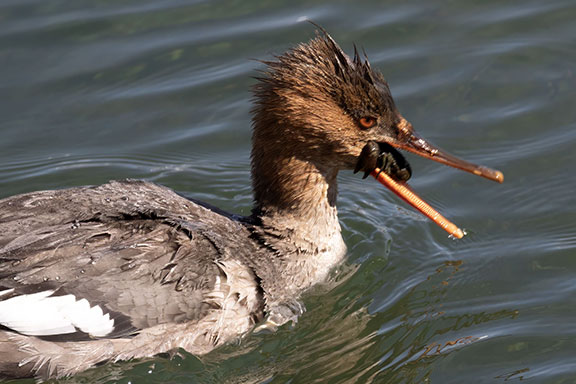
With a bit of luck (and a lot of patience), I saw them diving beneath the edge of the ice and surfacing again, each time with a wriggling, brown crayfish in their beaks. Over and over, they did it, clearly finding a buffet down there. Surprise, surprise: I snapped way too many photos of it all. It was cold, it was quiet, and it was magical. I’m so glad I got to witness it.
Did you know that the red-breasted merganser is the fastest duck there is? They can fly up to 161 km/h (100 mph). When I was learning about them, for a second, I thought I read that they could swim that fast! (That would make them the fastest duck ever recorded.)
Red-breasted mergansers have a wonderfully odd, streamlined shape: long necks, narrow beaks, and powerful webbed feet that make them excellent divers. Their beaks are long and thin, almost like darts, and if you look closely, you’ll see tiny serrations lining the sides, like little teeth! These help them grip slippery prey like fish and, as I got to witness, crayfish.
While many duck species will eat a fish or two if they can catch them, red-breasted mergansers are unusual in that they feed primarily on fish. Check out my photo of the one with a crayfish in its mouth.
My second-favourite sighting, from recent days, was an incredible gathering of swans: over a hundred trumpeter swans, one lone tundra swan, and a family of mute swans, floating peacefully together down on Lake Ontario.
It was a breathtaking sight, to see so many in one place. I won’t forget that soon. As of writing this, most of our northern guests have already moved on—ducks, gulls, and even the swans are making their way back to summer grounds farther north.
I know many of you are celebrating the return of warm weather and sunshine, but I’m quietly hoping for just a few more cold mornings. With any luck, there’ll be another wave of ducks passing through before spring fully settles in.
Below are more photos by Ann Brokelman of her recent encounter with a pair of red-breasted mergansers: