Affordability, crowding at Main Street Subway Station among community concerns raised at meeting on proposed 56-storey building on Dawes Road
By MATTHEW STEPHENS
Lack of affordability and increased pressure on what is already an extremely busy Main Street Subway Station were among the concerns raised at a community consultation meeting for a proposed 56-storey rental residential building in the Danforth Avenue and Dawes Road area.
The virtual meeting on the evening of Monday, March 31, was held to give community members a chance to learn more and ask questions about the proposed 56-storey residential building that will be located at 6 Dawes Rd., south of Danforth Avenue and just north of the railway tracks and the Danforth GO Station.
Representatives of the City of Toronto’s planning department, developers Fitzrovia Inc., and Bousfields Inc. (an urban planning company working with the developer) were at the meeting to talk about the proposal and answer questions from members of the public.
The main concerns expressed by community members at the meeting involved the small number of affordable rental units in the project and the impact it would have on subway passengers using the nearby Main Street subway station.
“There’s only going to be a commitment of six affordable units – that’s pretty embarrassing,” said a community member during the meeting’s question-and-answer session.
“I would strongly suggest that, given that you want to go up 56 floors, increasing the density, increasing your take-home in terms of money, that they need to have way more affordable units in these developments.”
The application for this particular development is part of an overall project approved in August 2022 as part of a settlement at the Ontario Land Tribunal, which included four towers with heights of 29, 39, 37, and 17 storeys. Three of those buildings are already under construction on the strip of land directly north of the Danforth GO station and east of Main Street.
The settlement also included the development of a public park, a public road, and a privately owned but publicly available space in the area.
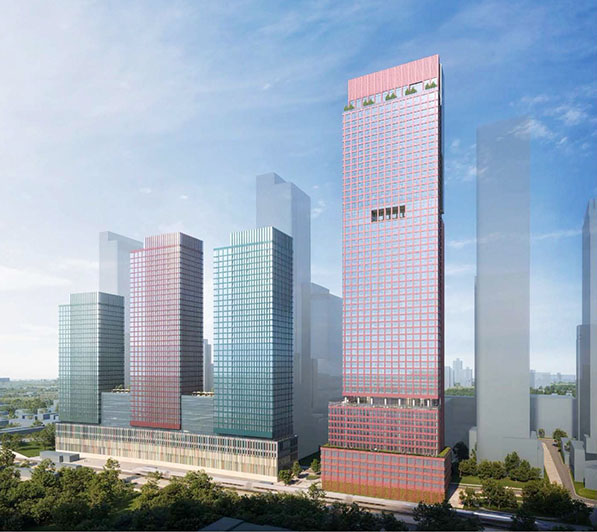
The March 31 meeting focussed specifically on what was a previously approved 17-storey building at the east end (East Block) of the site closest to Dawes Road. The proposal is now being re-submitted to the city as a 56-storey project by Fitzrovia. The new development application is seeking to “right-size” the building to 56 storeys to ensure consistency with surrounding developments in the area, said Fitzrovia in its new proposal.
This “right sizing” drew speculation from Donna, a local resident, who questioned if the new development was keeping in line with Fitzrovia’s other developments in the area.
“Someone mentioned that the 56 storeys that we’re talking about here, that it fits in with the already planned buildings, but those buildings are, correct me if I’m wrong, but they are 30 to 40 stories,” said Donna.
Sheliza Rajan, Senior Planner with Bousfields Inc., said that changes in city building policy to encourage more density, coupled with the site’s close proximity to a “transit hub,” has influenced the move to higher towers amongst all developers within the Main Street-Danforth Avenue-Dawes Road area. She referenced other high-rise developments in the area, such as 8 Dawes Rd., a 52-storey development located directly next to the Fitzrovia site.
According to the new proposal for 6 Dawes Rd., the East Block residential tower will be an “elegant” 56-storey structure with an 854-square-metre tower floorplate and 11-storey podium comprised of approximately 533 dwellings. The updated project will also include four levels of above-grade parking with 65 parking spaces, six visitor parking spaces, and 587 bike parking spaces.
At the meeting, members of the public were quick to question unit affordability. Currently, the overarching development proposal for all buildings will secure just six units designated as affordable housing – a number which left some attendees strongly discouraged.
“There’s an estimated 533 living units, and only six of them are slated to be affordable. That makes it barely one per cent of the units will be affordable,” said East Toronto resident Adam Smith. “Will the rental units be calculated based on what is affordable according to the average Toronto income, or is it simply going to be the currently unaffordable market rates?”
Gregory Gilbert, Vice President of Planning at Fitzrovia,. clarified that the six affordable rental units in question are slated to be established at an existing project already under construction and will become available by 2027.
According to Gilbert, the proposal for the 56-storey building has “No kind of affordable housing proposed beyond the market rental units at this time.”
However, he said securing affordable housing at the site could potentially be investigated at a later stage.
“It’s something we can look at, but generally, just the feasibility of rental apartments right now cannot withhold the additional constraints to deliver rental apartment units as part of the greater project,” said Gilbert.
According to Fitzrovia’s research, Gilbert said 30 per cent of Toronto’s population would be able to consider rental costs at the site affordable.
“When we look at these types of projects, we do consider incomes in Toronto. When you look at average rents between $2,500 and $5,000 for say, a large three-bedroom, these units are affordable for around 30 per cent of the Toronto population,” he said.
“When you look at earning incomes, which is how you calculate affordability, is basically 30 per cent of your income, that’s kind of how we look at it. This project would fall within 30 per cent of those folks that can afford it and meet the affordability threshold.”
He mentioned that changes to Section 37 agreements (in which developers provide money to a municipality for community improvements) has put more responsibility on the city to provide benefits such as affordable housing.
“The entire proposal for the whole master plan included over $7 million of Section 37 contributions, and it’s essentially us writing a cheque and giving it to the city in exchange for the density that was proposed on site. That has not changed and that can be spent in any sort of capital cost that the councillor sees fit. That could go towards things like affordable housing,” said Gilbert.
City of Toronto Senior Planner Seanna Kerr clarified that community benefits provided as a result of Section 37 funding will be a topic of discussion later in the application process.
“We do have a Section 37 agreement on the site, so once we come to a built form that everybody can agree on, at that point we’ll start to discuss community benefits that could be provided on the site,” said Kerr.
Smith followed up on his question regarding affordability by saying the proposed building will only cater to those within a high-earning income bracket, and that those within that bracket would most likely be looking to buy and not rent property.
“It sounds like you’re aiming for rental rates that will only be affordable to the top 30 per cent of incomes in Toronto. And I’m just curious if you’ve also explored the fact that the people who are in that bracket aren’t typically looking to rent,” said Smith. “Those are the people looking to buy, if they can. So, I just don’t know who this building is catering to in terms of who’s going to be able to afford and want to live there.”
Gilbert responded by saying the building’s units would be marketed to the “general public” despite rental prices only being applicable to 30 per cent of Torontonians. He also said the developer’s recent projects often catered to what they believed are “underserved demographics, such as young families, empty nesters and downsizers, as well as young professionals that appreciate the enhanced amenity offering, community events and dynamic high-rise living with low maintenance.”
He emphasized that some of the developer’s other projects in the city cater to those living within a lower-income bracket.
“We do have a number of vintage apartment projects across the city which have the same level of property management and event planning that are strictly rent-controlled. We have about 1,000 rent-controlled apartments across Toronto that do cater to a more affordable bracket with a larger floor plan and cost per square foot than some of our newer projects,” said Gilbert.
Above all other beneficial factors, including bringing more rental homes to the city and meeting the demand for more rental apartments, Bousfield’s Rajan said the proposed building’s proximity to both the Main Street TTC station and Danforth GO station played a key role in the developer’s decision to call for a high-rise residential building at the location.
However, Smith said he believes that most residents who will be living in these new buildings will have little use for the GO trains for travel. He said he fears the increased population density will put more strain on what is an already extremely busy Main Street Subway Station during rush hours.
“I don’t think anyone has really considered the on the ground transit situation here in that the GO station isn’t terribly useful for people who live in the area and want to travel through Toronto,” said Smith.
“Main Street station at rush hour, it’s full to bursting at the platform. People are practically falling off it onto the tracks, so I don’t really understand if anyone here is really taking account of how crushing transit already is at Main Street, and then you’re going to have thousands upon thousands more people to what is already inadequate transit.”
Kerr mentioned that both the TTC and Metrolinx (the operator of GO Transit) are made aware of developments within their transit hub space, and that it is up to them to accommodate the rise in population density at their respective stations.
“I just wanted to note that the TTC does get circulated on all development applications in the city, so they are aware of the development applications in the area and the increase in population,” said Kerr.
Following the Q&A segment of the March 31 meeting, Kerr said city staff will take the feedback they received into consideration as they continue their technical review of the proposal. She also mentioned that members of the public will have another opportunity to provide feedback directly to herself and city staff.
The application will then be considered by city councillors for a final decision.
Residents who couldn’t attend the March 31 meeting and would like to provide feedback can do so by sending an email to Kerr at Seanna.kerr@Toronto.ca