Taking the ‘cold’ plunge: Lake dippers create goodness and build community spirit

By SAM HEFFER
One day in mid-December, 2016, there was snow on the ground and the air temperature was minus 14 degrees Celsius. Before sunrise that morning, a woman named Martina and her adult son left their home and began their 15 minute walk to the lake.
There’s nothing unusual about early risers heading to the beach in our neighbourhood, but Martina was wearing sandals, a fluffy white bathrobe, and her swimsuit. Her 25-year-old son was bundled up against the cold. He had his phone ready to film his Mom’s very first cold plunge into Lake Ontario.
As they approached the Leuty Lifeguard Station, Martina did not hesitate. She was going into the lake, and no one was going to stop her. Meanwhile, no one was going in with her either.
Nearby, an early shift of city employees stopped and stared in awe as Martina smiled at them, shed her bathrobe and sandals, and walked steadily out from the snowy shore in her swimsuit, until she was chest deep in the lake.
“They were smiling, watching me,” she recalls, “so I had to keep smiling, even though the cold water against my skin felt like I was moving through tiny pieces of razor-sharp glass.”
It was so cold that her son’s phone “froze” and no video proof exists of that inaugural cold plunge. But it was a much needed game changer in Martina’s life.
A few months before, she had witnessed the painful decline of a close friend diagnosed with Alzheimer’s.
“It absolutely terrified me,” Martina said, “I felt I had to make a change in my life to be more fully present and alive. After that first dip, I felt incredible for the rest of the day. It was easy to get hooked on feeling that good, and so I started going into the lake once a week.”
Martina hoped that her son would also take up her new “dipping” hobby.
After all, he was the one who introduced her to Wim Hoff, a Dutch man who promotes the benefits of cold water therapy, specific breathing techniques, and a positive, meditative mindset. He has shared his methods and outlook with millions of people worldwide. But as she began her new endeavour, it seemed that Martina was destined to brave the icy waters of the lake alone.
Within three years, Martina had settled into a routine of daily dips at sunrise. Then a few women in the neighbourhood noticed her posts on Facebook, and began meeting her on the beach. They were a small group who met each day to dip, exploring the possible health benefits, and developing a unique camaraderie.
And, dear reader, you are not alone if you’re wondering “Why? What on earth would possess anyone to voluntarily wade into a freezing lake at sunrise in the middle of the winter?”
That’s an excellent question.
Cold water therapy advocates believe that individuals who dip may experience a variety of health benefits, including reduced inflammation, boosts to the immune system, as well as heightened levels of dopamine and endorphins in the brain, that result in feelings of joy, and increased energy.
As a cold water enthusiast myself, I know that dippers vary in how, and to what extent, we experience these benefits. In addition, most dippers have important reasons and powerful personal stories that brought them to the edge of our frigid lake in the first place.
Entering the water takes your breath away on so many levels. It forces you to stay in the moment, and surrender completely to the cold.
But beyond possible health benefits, what draws us back to dip day after day, in the harshest winter conditions?
For many, there is a reverent aspect to gathering on the shore at sunrise, even when the wind chill plummets and white-capped waves pound the icy edges of the beach.
Always, there is a sacred feeling of drawing closer to the elements, and to each other.
Another lover of nature and community, Christina, began going into the lake during the pandemic. This was not long after her 42 year old brother, out for an early morning run on a country road, was killed by a drunk driver. Her cold water therapy became an essential part of her healing journey.
Christina says that she didn’t know what she was missing before she began dipping.
At first the uncomfortable, numbing pain of entering the lake at sunrise in winter matched her own deep heartache at the loss of her brother.
Over time, the lake also grounded her, helping her to reconnect with all that is beautiful in her life, even while coping with unspeakable tragedy.
“During the pandemic the lake welcomed me with open arms when so many things were closed,” she said.
Dipping at sunrise brought her closer to nature, and made her aware of like-minded individuals who were “focused on living, rather than fearful of dying.”
Each day at the lake Christina found healing, wisdom, and resilience.
She also received a micro-dose of community; precious moments of connection with fellow “cold water warriors, who warm my heart.”
Over time, those brief conversations turned strangers into friends.
Christina feels that dipping is a way for us to prioritize our own self-care. “It’s a special kind of one-on-one health care that’s free and accessible” to all who choose to explore it.
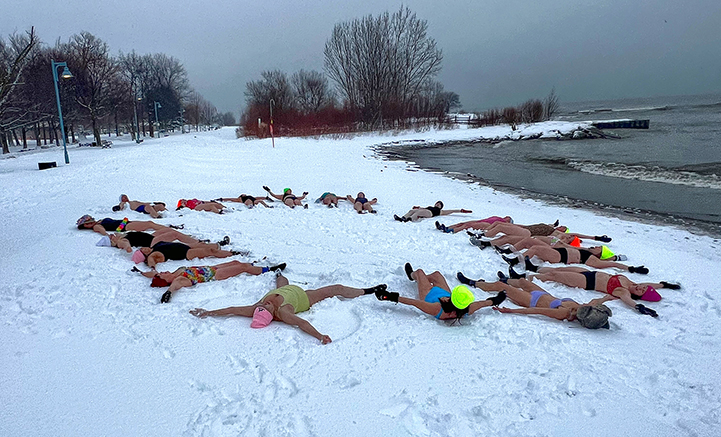
So these days, if you’re walking along the beach or the Boardwalk at sunrise, you’ll likely see groups gathering, figures clad in long swimmers’ coats (dry robes), wearing colourful toques and cozy mittens. It may be some of the LOLOs (Ladies of Lake Ontario) or the EndorFINs.
You may hear their chatter, singing and laughter.
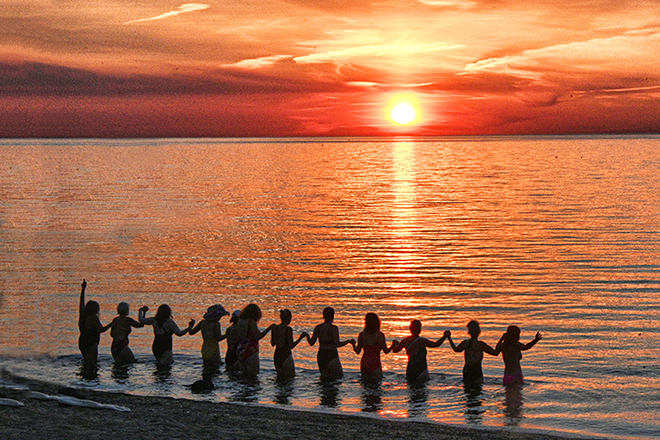
And you may notice a circle of dippers forming in the lake, holding each other’s mitten’d hands above the water. This Circle of Caring reflects a remarkable community spirit that continues to grow and welcome new dippers.
Martina describes sunrise at the lake as: “My home. Somebody is always going to be there to dip, and I can’t wait to see them. My mood is pure joy. Something as simple as embracing the cold for health reasons has turned into something very special. We embrace longevity by being fully engaged, and with the playfulness of little kids.”
You’ll see us greeting each other with hugs, and then holding hands as we enter the water.
And yes, it does look good in photos, but the real meaning is that we support each other – as we enter the lake, of course, – but we also know that we’ll step up to help each other in life.
Earlier this winter the EndorFINs were filmed and interviewed at the lake for CTV news, and last year in the middle of January (air temp -24C), a group photo of their joyous circle in the lake became Reuters “Photo of the Week.” Other news agencies took note, and the cold plunge pic appeared as a good news story in 28 countries around the world.
As Martina says, “We are creating goodness, and you never know where it will go.”
And these days more than ever, isn’t that exactly what the world needs.