Beacher Winona Gallop’s advocacy for cyclists helped lead to the creation of the Martin Goodman Trail along the waterfront
By MATTHEW STEPHENS
Bike lanes in Toronto have been a heated topic of discussion in recent years. Since the COVID-19 pandemic, major roads across the city including Danforth Avenue have been reworked to provide cyclists with their own lanes to commute in.
Now, as the Ontario government moves forward with a plan to remove bike lanes from Bloor West, Yonge and University, city residents can fondly reminisce about one of Toronto’s oldest bike lanes and the Beach area activist who fought for its creation.
The year was 1969 , Toronto’s infrastructure was changing, and with that change came a revitalized mode of transportation as bicycles were making a resurgence as an effective means to travel across the bustling city.
As the main contributor to the Waterfront Bike Trail’s creation, Beacher Winona Gallop and her team laid the groundwork for the trail that has become a staple in the East Toronto community. From the late 1960s to early 1970s, Gallop (who recently turned 90) acted as one of the first advocates for the establishment of safe bike routes in the city.
“The motivation was simply to have a safer designated means for recreational travel.” Gallop’s daughter Virginia told Beach Metro Community News recently.
In a 2018 interview with The Globe and Mail, Gallop described her motivation to fight for the Waterfront Trail as a “Duty to contribute; to try to make things better.”
Before the existence of the Waterfront Bike Trail, Virginia mentioned that cyclists would ride along the “uneven” wooden planks of the Boardwalk in the Beach. However, this was against the rules of the city, and it wasn’t long before Winona and her daughter were stopped by a park warden and issued a warning for cycling in a prohibited area.
Frustrated by a lack of accessible bicycle routes, Winona got to work and devised a proposal for Toronto Council’s parks and recreation committee to consider a small bike path to be constructed adjacent to the Boardwalk. In March 1970, the proposal for a two-kilometre path from Balmy Beach to Ashbridges Bay was approved on an “experimental” basis.
As the trail quickly gained traction amongst cyclists in the community, Winona soon expanded on her plans for the trail and proposed a five-kilometre westward extension all the way to Cherry Beach.
The proposal for the extension proved to be more challenging among government officials with jurisdiction over the area. However, after eventually being granted approval from the city, Gallop and the Harbour Bikeway group – along with her son Paul and summer students –grabbed their tools and got to work mapping out and extending the trail.
According to the Globe and Mail story, Gallop was shocked to find that “no one complained” about the work she and her team were doing.
Between planning trail routes, fighting for approval from the Toronto Harbour Commission, and establishing a construction crew, Virginia believes that her mother’s biggest challenge along the way was raising four children as a single mother.
“My mom was a single mom, so I think that the adversity that she dealt with was being a single parent raising her four children by herself and taking on projects that were unheard of.” said Virginia.
By August 1978, after years of planning, judicial barriers and construction, Gallop’s efforts to establish the Waterfront Bike Trail from Balmy Beach to the Humber River was finally complete – all except for a 740-metre gap at the bottom of Leslie Street by Tommy Thompson Park.
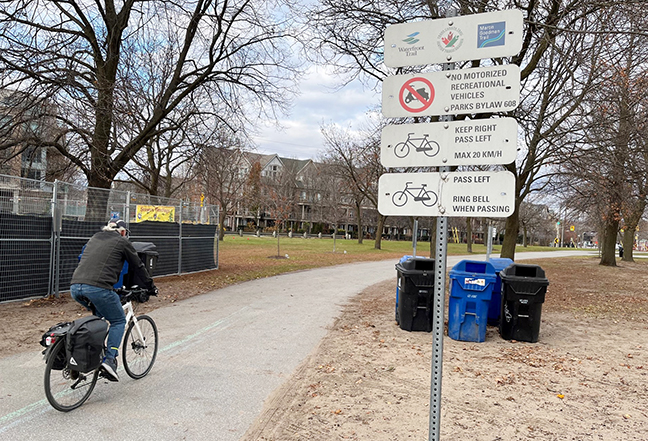
Over the late 1970s, other sections of the waterfront cycling path started to develop. And by 1984, the completed trail – now renamed in the memory of former Toronto Star president and editor-in-chief Martin Goodman – stretched approximately 19 kilometres.
In recent years, construction has bridged the gaps along the downtown harbourfront; extended the trail west of the Humber River and along the foot of Leslie Street.
What was once a disjointed cycling experience with inconsistencies and the occasional intersection with motor traffic, has now become the cohesive paved trail that many cyclists now know and love today. All thanks to the efforts of Winona Gallop’s team and their persistence in establishing safe and centralized bicycle routes in the city.
In addition to being a pivotal advocate for the Toronto Martin Goodman Trail, Gallop also stands as an honorary member of the Beach Guild of Fine Art as she was one of the group’s founding members.
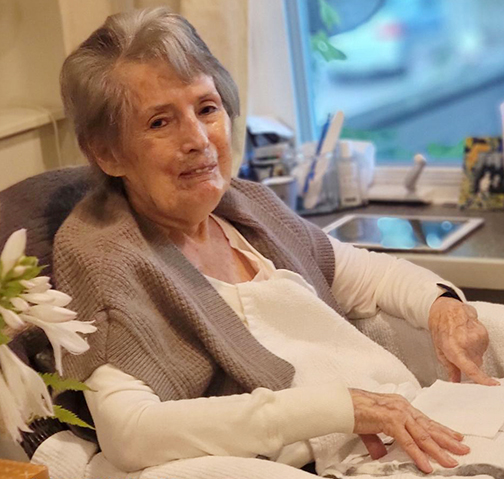
Although she may be unaware of the present issues surrounding bike lanes in the city, Virginia believes her mother is aware of the rippling impact the Waterfront bike trail has made for bike lane advocacy in the city.
“The start that she made was impactful. I think she would say she knows that was the start.” said Virginia.