On The Wild Side: ‘Super Generation’ of monarch butterfly eggs hatching at the end of summer

By ANN BROKELMAN
Building on previous summers, I’ve been really enjoying working with bugs, specifically butterflies and moths. I’ve invested a lot of time in finding eggs and caterpillars, giving them a safe place and plenty of food to grow, enter the chrysalis stage, and then watching in awe as they emerge in their final form.
Mind you, my husband isn’t always thrilled when we have a jailbreak, and butterflies begin circulating the house… oops?
This year, for the first time, I was able to watch, and photograph, a female monarch laying her eggs on a Marsh Milkweed. I wish I could have been on the ground a little more under the plant to catch the moment the eggs attached to the leaf, but, as I didn’t want to risk disturbing such a rare moment, I kept my space.
This monarch caught my attention as it was flittering from plant to plant, but not from flower to flower. I wondered why it wasn’t going through the usual pollinating pattern, so I pulled out my camera to get a zoomed in view.
It was also a windy day, so I thought she was just trying to find a place to ride out the weather, but once I got the camera on her, I saw her legs latch onto the leaf and her abdomen begin to stretch in an ‘unusual’ way. I was quite sure I had caught on to what she was doing at this point. After only about 10 seconds, the monarch flew away. I went over to check the leaf; sure enough: there was a brand-new egg. This will be one of the last eggs of the season, which makes it incredibly special: it is part of the “Super Generation.”
If you’ve never heard of the super generation, don’t feel bad, you know what I’m talking about, you just didn’t know that these butterflies were different or that they had a special name.
Have you ever seen the amazing images/videos of the monarchs migrating to Mexico? The ones that gather by the tens of thousands to cover entire trees in their beautiful orange. Well, those are the ones from the super generation. While most monarchs hatch in the spring and early summer, and live for about two-to-six weeks, the super generation emerges from their chrysalises at the end of the summer, or early fall, and will often live for eight months.

A monarch emerges from its chrysalis and eats the egg shell. Photo by Ann Brokelman.
I had always thought that all monarchs made the trek south, not just a rare few. What makes this even more incredible is that it’s just the ‘magic’ of nature’s timing that the last generation born is the one that can live so long and ‘knows’ to fly to migrate south. The idea that several generations of monarchs will emerge and lay eggs over a spring/summer in Toronto, but somehow, something inside them, knows that only the last group is the special one… it’s just marvellous to me!
I’m also excited because my granddaughter Lara (Grade 6) and I will be talking to a kindergarten class at her school about monarch butterflies. Lara has been helping me hatch, take care of, and release monarchs for many years and I can’t wait to hear her share her knowledge and experiences. If we were lucky with timing, the class would have been able to see a butterfly emerge in the second week of the school year. If so, we’ll have tagged it, released it, and will find out if it made it all the way to Mexico.
The second notable butterfly moment I had this summer was with a Giant Swallowtail. I don’t have enough room to draft another short story, so I’ll just say that these beautiful butterflies appear far less often, which makes a sighting that much more special!
Giant Swallowtails come by their name honestly, as they are quite large compared to most other butterflies. Unlike the orange of a monarch, swallowtails are a lovely mix of black and yellow.
I can count the number of times I’ve seen one in the wild on a single hand, so when I noticed one enjoying some nectar from a Pie Weed bush, I must have taken over one hundred photos in just a few minutes.
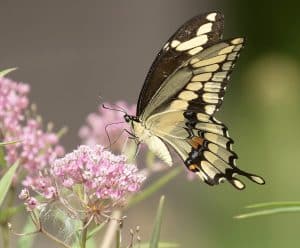
A Gian Swallowtail butterfly photographed by Ann Brokelman in Scarborough. Photo by Ann Brokelman.
If you have any time in the next days, head to any nearby flower gardens and look for butterflies, dragonflies, bees and more, before they are gone for another season.
Enjoy these final few days of summer and remember to email me and share any of your own interesting wildlife stories or photographs.