
East Toronto buildings added to Heritage Register as concerns grow about possible changes to city’s rules
By AMARACHI AMADIKE, Local Journalism Initiative Reporter
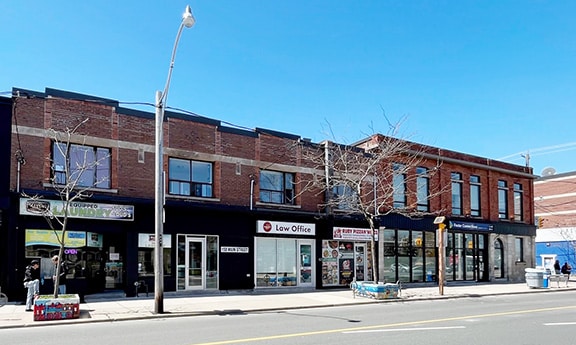
The City of Toronto has added several East Toronto buildings on the south side of the Gerrard Street East and Main Street intersection to the Heritage Register as properties of cultural heritage value or interest.
The latest additions include properties at 143 Main St.; 154 Main St.; 155, 161, 167 Main St. and 2201-2207 Gerrard St. E. and 164 Main St.
With most of these buildings dating back to the late 1800s when East Toronto was a village, and then a town, advocates of heritage building preservation, such as Barbara Myrvold of The Beach and East Toronto Historical Society (TBETHS), have placed significance on the protection of these sites.
“I think it’s good for people to have reminders of buildings that were constructed during the period when East Toronto was its own separate municipality,” said Myrvold. “Main Street doesn’t have its name for nothing. It was the main street of the town and the village.”
Prior to East Toronto being annexed by the City of Toronto in 1908, the Main and Gerrard intersection was a hub that attracted business from all parts of the city.
One notable figure that found a home in the village was William Snell who moved to Main Street in 1897, first establishing a bakery and residence before he and his family solidified themselves as historically-significant community members in the early development of the Town of East Toronto.
Born and raised in Croydon, England, Snell was the eldest son of 11 children born to William Snell, a baker, and Ruth Hynard. He worked in his father’s bakery before immigrating to Canada
The property at 154 Main St. which once housed his bakery, also known as Snell’s Hall, is part of the group of buildings being added to the Heritage Register due to the design value that represents the “early-twentieth century Main Street Commercial Block type building”, according to the notice presented by the City Clerk’s office.
Originally constructed in 1909 before being partially reconstructed in 1920 due to a fire two years prior, it features two-storey massing, brick cladding with decorative stone details, and an irregular roof line.
“The subject property is also physically, visually, and historically linked to its surroundings, where it displays a high level of architectural consistency with the neighbouring properties at 164 Main Street, 143 Main Street and 155-167 Main Street and 2201-2207 Gerrard Street East,” stated the City Clerk’s Notice.
Like the rest of the sites included in the document, Snell’s Hall meets the City of Toronto’s criteria for heritage status.
However, Myrvold is concerned about many of East Toronto’s buildings’ ability to be granted heritage status due to the Province of Ontario’s Bill 23 (More Homes Built Faster Act) which TBETHS believes is detrimental to preserving Toronto’s heritage buildings.
“Bill 23 has mandated that any building that is listed on the Heritage Register as of the date of the bill will only continue to be listed until the end of this year,” said Myrvold. “There’s all sorts of significant buildings in our East Toronto area that are listed and not yet designated.”
Myrvold told Beach Metro Community News that this could lead to the loss of a lot of heritage properties.
Although the buildings that are already designated as heritage are not affected by Bill 23, the “listed” properties in the heritage status pipeline will lose their chance to reach heritage status if the process isn’t completed by the year’s end. Once this happens, the properties cannot be relisted for another five years.
This, said Myrvold, is not enough time to secure status for the more than 4,000 listed properties (more than 100 in East Toronto) as only about 50 properties receive heritage status each year.
“It’s a huge workload for the City of Toronto to get these designated within the timeframe,” she said.
Myrvold acknowledged that Ontario is in desperate need of housing, but believes that the province’s approach to building more homes is flawed when it comes to heritage buildings.
“I think that there are all sorts of buildings that could be repurposed without having to touch heritage buildings,” said Myrvold.
With the province cracking down on the designation of heritage buildings, it appears the City of Toronto is following suit with a recent proposal to amend the criteria for buildings to receive heritage status.
On May 9, the city’s Planning and Housing Committee is hosting a public meeting to discuss amendments to heritage building application requirements.
According to the Notice of Public Meeting, one of the purposes of the amendment is to “reflect new requirements due to changes in legislation or policy.”
The amendment also serves to add a policy to support the addition of a Cultural Heritage Evaluation Report requirement.
As the city looks to streamline housing developments in Toronto, some have criticized heritage buildings as a barrier that has halted construction on prime locations.
At the Planning and Housing Committee meeting, residents will have the opportunity to voice their opinions on the proposal.
Anyone who would like to participate in the May 9 meeting is encouraged to register by email to phc@toronto.ca or by calling 416-397-4579 before the May 8 deadline.

— Amarachi Amadike is a Local Journalism Initiative Reporter for Beach Metro Community News. His reporting is funded by the Government of Canada through its Local Journalism Initiative.