In My Opinion: Community Land Trusts are the answer to local development tensions
By DEREK SCHMUCKER
In the Beach, where I’ve lived for 22 years, the tension between development and anti-development sentiments remains strong.
On one side are those arguing that more supply through private development is needed for housing affordability, and on the other side are those arguing that allowing developers free-reign will negatively impact the neighbourhood character.
This is a false dichotomy, and I suggest that a change in perspective can resolve these tensions for many Beach residents.
In urban planning, the term growth is everywhere. Many urban planners help manage and facilitate growth, while so-called common sense planning dictates that “growth pays for growth”.
Many consider growth to be inherently positive and the only way cities can improve. Yet there are different kinds of growth that are strongly linked, and which influence our neighbourhoods – such as economic growth. It is worth looking closely at whether the search for economic growth is truly improving our city.
Infinite economic growth manifests itself visibly in how we treat the earth, and Toronto is no exception.
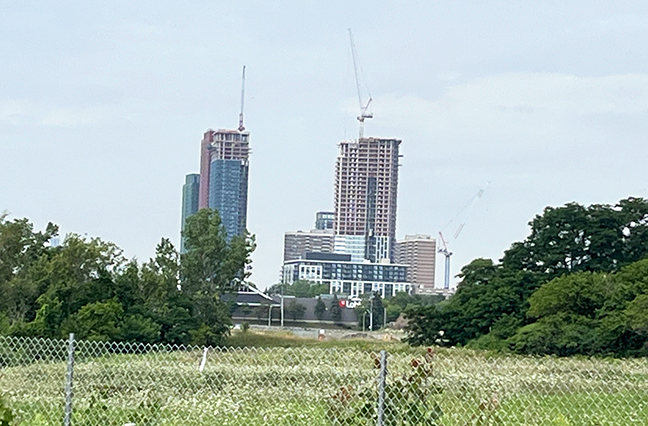
Downtown is awash with skyscrapers that were built either for offices or as profit generating condos for people needing somewhere to live. The current condo market crash is a direct result of profit maximization in development. No landlord wants to lose money on their investment, yet not many people want to live in shoeboxes built for investment instead of homes.
Current developments not yet financed are switching their ownership model from condos to long-term rentals to ensure their profits. This will result in for-profit corporations owning more housing in the long run, and the increase of housing unaffordability.
These are just some examples of how Toronto’s housing realities are shaped by the quest for infinite economic growth.
The affordable housing crisis is real and a clear sign that change is needed. But the change many politicians and developer lobbyists fight for – for example, “Building Canada Strong,” HST rebates, cutting development charges – is not the change we need, as these plans have mostly worked as corporate welfare.
So how do we reconcile needing more affordable housing with a development system that prioritises private profits over affordable outcomes and community voices? What can communities do when they see that developers only build housing with profit motives and housing strategies that address housing affordability through supply alone are not working?
I believe the answer lies in Community Land Trusts. CLTs work as grassroots, member-led and owned, not-for-profit alternatives to for-profit development and housing.
Due to having no profit incentives, CLTs are able to prioritise affordability for community members through frameworks such as rent-geared-to-income. Many CLTs add affordable housing supply by retrofitting existing properties instead of tearing down, leading to more environmentally friendly builds and more liveable units.
One extended benefit of CLTs is that they reduce market rents in the area by providing an affordable baseline. By acting as an anchor to the rental market, they bring prices down, and make housing more affordable. This could also be achieved if the provincial and federal levels of government built more non-profit housing; unfortunately they have often shown to be more interested in helping developers and investors profit than in housing people.
Toronto has several CLTs. One example is Parkdale Neighbourhood Land Trust.
Since 2014, this CLT has been acquiring land to ensure it remains in community hands, while creating and supporting affordable housing, urban agriculture, and non-profit organizations and small businesses. Today, Parkdale Neighbourhood Land Trust has around 300 affordable units that supports community-owned housing and local services and programs – protecting the best parts of living in Toronto.
Toronto’s east end also has a CLT – Circle Community Land Trust, with 600 units – providing long term affordable housing within our community.
Not all growth is positive growth. When land use decisions depend on infinite economic growth, other considerations such as affordability, environmental impact are choked out. We see this in how a financialised housing strategy adds unwanted condos, big box chain stores, and continued unaffordability.
Yet by retrofitting existing buildings for climate resilience and higher density along with implementing democratic, community-led governance, Community Land Trusts build sustainable long-term community, not short-term private profits.
Residents in the Beach – and perhaps in all of Toronto – who are concerned about development should reject the false dichotomy of development as either the solution for or the destruction of Toronto’s neighbourhoods and focus on supporting Community Land Trusts. The Beach could use their growth.
- Derek Schmucker is a recent graduate of TMU’s Master of Planning program who most recently worked in an urban planning consulting firm. He is interested in housing justice, land use economics, and environmental action.