Upper Beaches Scale Solar System puts space and the planets on display
By JESSICA SHACKLETON
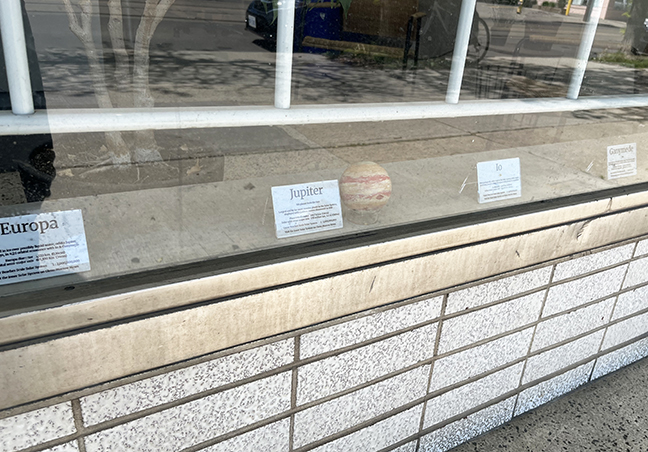
The front window of the Beach Metro Community News office is often home to many posters advertising local festivals, plays and services. But if you look down, you’ll see its newest addition: a model of Jupiter on the windowsill.
It’s part of a scale model solar system coming to the neighbourhood.
The Upper Beaches Scale Solar System project was created by local resident Derrick Dodgson, Beach Metro Community News recently joined him on a walk in the Main Street and Gerrard Street East area to see how the project is coming along so far.
Dodgson said he’s always been interested in space and space exploration.
“I now have a couple of young kids, so I’ve been able to teach them some things and get them interested in the subject. I thought this was a cool way to get, not only kids, but grown-ups in the area, too, to understand and appreciate the scale of our universe and space,” he said.
The Upper Beaches Scale Solar System is being presented at a 1:2 billion scale, and even then there is only local space enough to keep the display to the inner solar system.
“It’s a delicate balance to have a big enough scale that you can actually see the planets but not so big that you can’t even walk between them,” explained Dodgson.
“I thought about what I could display on my street, and I came to the conclusion that I couldn’t do all the planets there at a reasonable scale, so I decided to do the inner Solar System in that stretch. It’s made for the size of sun I could acquire.”
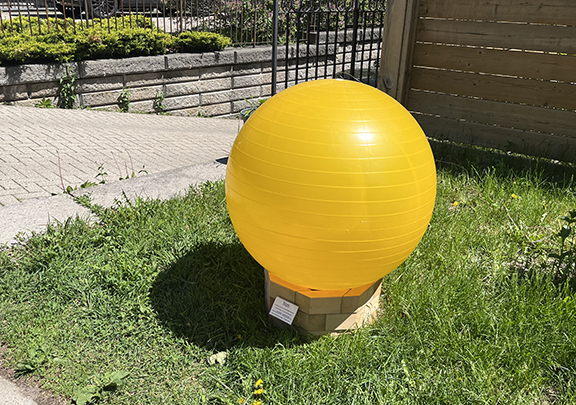
The Sun in question is a yellow yoga ball on Glen Morrow Mews (which is just south of the railway and west of Main Street) and every planet must revolve around it and be in relation to it, he said.
The inner planets of Mercury, Venus, Earth, and Mars are also located on Glen Morrow Mews, and the outer planets of Jupiter, Uranus, Saturn, and Neptune will be spread even further east into the Upper Beach neighbourhood.
The inner planets are made of ball bearings and sit along a fence, while Mars is located just past the intersection of Glen Morrow and Woodlee Road.
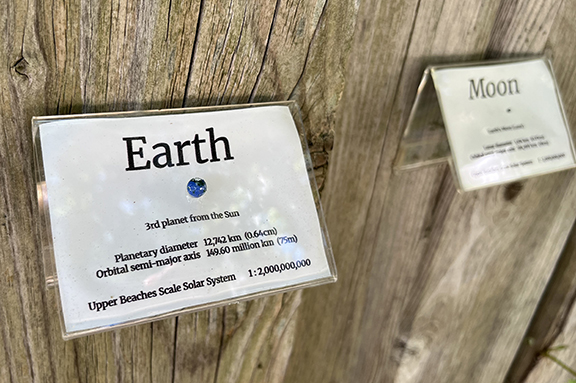
Aside from the Moon, Mars is top of mind for space agencies around the world, said Dodgson.
“The thing about the moon, obviously, it’s much closer, but it doesn’t really have any natural resources, as was discovered when people went there. It’s just a bunch of dust and rock, and there’s not a lot of useful metals or minerals or water-based compounds that you could use to sustain life or grow things, and it doesn’t have an atmosphere,” he said. “Mars does have a very weak atmosphere, so there’s theoretically more potential to grow and sustain a population.”
Dodgson doesn’t think we’ll be seeing development on Mars anytime soon, but he pointed to shows such as The Expanse and For All Mankind for those interested in futuristic and alternate universe stories about space colonization.
For those planning on a trek across the Upper Beaches Scale Solar System, make sure to stop in at Kildonan Park (north end of Norwood Road just south of the railway tracks) for a look at Ceres, the only dwarf planet in the inner solar system. Along with the five dwarf planets in the Milky Way, there are 1.4 million asteroids and 4,000 comets roaming around the solar system.
As Dodgson works on the outer planets, he said he also plans to add fan favourite Pluto to the model.
The world’s largest scale model solar system is in Sweden, with Stockholm’s Avicii Arena, also known as “the Globe”, representing the Sun. Avicii Arena is the largest spherical building in the world. The Swedish model is at a scale of 1:20 million and stretches across the entire country. Each planet has little informational plaques that tell you what you’re looking at, and the scale to the Sun.
After the Artemis II Mission captured the world’s attention earlier this year, space has been on people’s minds. Dodgson wants people to stay interested.
“I hope that I spark some curiosity, I hope that if someone finds Jupiter or one of the other planets, they’ll be curious about it and see the suggestion to come visit the inner solar system on our street, and they may do so,” he said.
“In particular, it helps kids get an idea of the scale of the solar system, which would be great; if not, it’s something a little bit interesting and fun to have in the community.”
Beach Metro’s walk with Dodgson from the Sun to Jupiter took about 20 minutes, including stopping to read the plaques and learn additional information.
“I’ve observed people walking on our street, and often people will see the Sun and read the plaque, and then continue walking for days or weeks before realizing where the planets are,” he said.
“That’s part of the whole idea of the scale of this thing; stars are very bright, and you can see them from very far away. Planets are so small and insignificant in comparison, you have to do a lot of work to find them. That’s part of the concept. People don’t appreciate the scale and how distant things are.”
Jupiter’s display in the window of Beach Metro Community News at 2196 Gerrard St. E., also includes its four largest Galilean moons: Ganymede, Callisto, Io, and Europa.