
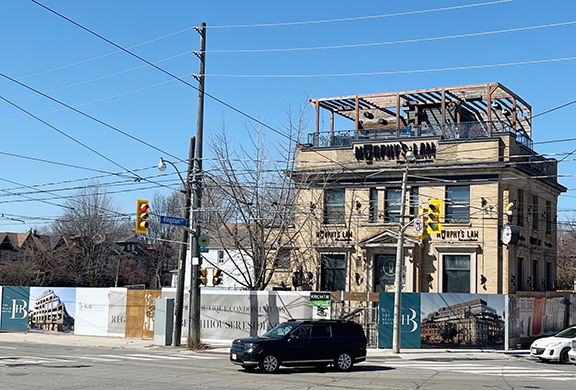
Final approval for 10-storey building at Murphy’s Law site given by Toronto Council
By MATTHEW STEPHENS
Toronto Council gave the final stamp of approval for the contentious Murphy’s Law development proposal at its meeting last night.
A final motion moved by Beaches-East York Councillor Brad Bradford sought to refuse the developer’s 10-storey application for the site at the northwest corner of Queen Street East and Kingston Road on the grounds that he was “not personally satisfied” with the outcome.
“It’s been a long and difficult journey on this one. It goes back to my first term when council actually approved what was a six-storey building on this site,” Bradford told members of Toronto Council prior to the vote on the evening of Thursday, March 26.
“Unfortunately, after lots of work with both the applicant and the community, I am personally not satisfied with the outcome here, which is why I will be voting to refuse this application.”
Parkdale-High Park Councillor Gord Perks warned that council’s failure to approve the application would result in a hearing at the Ontario Land Tribunal, where developer Sud Group would likely be approved to build the proposed 10-storey building.
“What Councillor Bradford is moving will send us to the Ontario Land Tribunal (OLT), where we will lose,” said Perks. “We have a staff report that recommends accepting this application. And you all know what happens when we turn down staff recommendations.”
City staff told councillors the applicant planned to appeal to the OLT “immediately” if the proposal was not approved by council.
Perks said that when appealing to the OLT, developers can call on city staff to testify as witnesses at the hearings, even if councillors refused the application.
“The applicant can actually call city staff as witnesses, hostile to whatever position we take. It’s a mug’s game; it’s not a winning game,” said Perks.
Bradford’s motion to refuse the application lost on a vote of 19-5. The councillors voting with Bradford were Shelley Carroll (Don Valley North), Lily Cheng (Willowdale), Rachel Chernos Lin (Don Valley West), and Stephen Holyday (Etobicoke Centre).
The Murphy’s Law application, which was initially approved for a six-storey building in 2022, has a long history in the community. However, the application faced controversy two years later, when the developer backed out of their initial plan, proposing an 11-storey building in its place.
Following a community consultation meeting last October, the final proposal brought before Toronto and East York Community Council on Feb. 19 called for a 10-storey mixed-use residential building with 168 residential rental dwelling units, 56 vehicular parking spaces and 186 bicycle parking spaces.
In addition to lowering the building’s height by one storey and removing 48 units from the previous 11-storey proposal, the updated application also removed balconies on the north facade of the building to prevent overlook impacts, and increased the percentage of two and three-bedroom units to 42 per cent two-bedroom and 21 per-cent three bedroom units.
During the application process, many local residents expressed confusion over how the city balances its all-encompassing 2024 Mid-Rise Building Design Guidelines in conjunction with the local 2012 Queen Street East Urban Design Guidelines (UDG).
The Queen Street East UDG limits building heights along Queen Street East in the Beach to six storeys between Coxwell and Neville Park avenues, and also set design standards to preserve the area’s character. In contrast to the Queen Street East UDG, the city’s guidelines define a mid-rise building as a residential structure between five to 14-storeys in height.
During yesterday’s council meeting, Bradford reiterated a final query into the Queen Street East UDG and its relevance when city staff reviewed the Murphy’s Law application, given it exceeded the height restrictions of the UDG.
“City-wide guidelines generally take precedent. They reflect the city’s current direction, and they are the primary basis on which the city reviews new mid-rise buildings,” said city staff in answer to Bradford’s question.
“However, local guidelines continue to be relevant in supporting local special character that they are often specifically designed to consider. Specific examples of how the local Queen Street guidelines continue to be impactful in our review of this proposal are with respect to the Queen Street streetscape and setbacks, and the street wall height along Queen Street.”
In a “rhetorical” line of questioning, Bradford asked whether city staff have recognized a pattern of developers across the city applying for taller buildings in light of changes to the mid-rise guidelines, and asked if any regulations exist to prevent that from happening.
“We have no ability to compel a developer to build what was already approved, and they do have the ability to make new applications,” city staff told Bradford.
Despite his disapproval of the application, Bradford said he was thankful for the opportunity to work with the developer to provide “in-kind affordable housing” on the site, as well as “exploring additional parking,” to prevent an overflow of vehicles on local roads.
Comments (0)
There are no comments on this article.