
William Kurelek’s paintings bring memories of heavy snow, Balsam Avenue, Glen Stewart Ravine and more
By ALAN SHACKLETON
Some recent articles in Beach Metro Community News have brought memories of Canadian artist William Kurelek to the forefront.
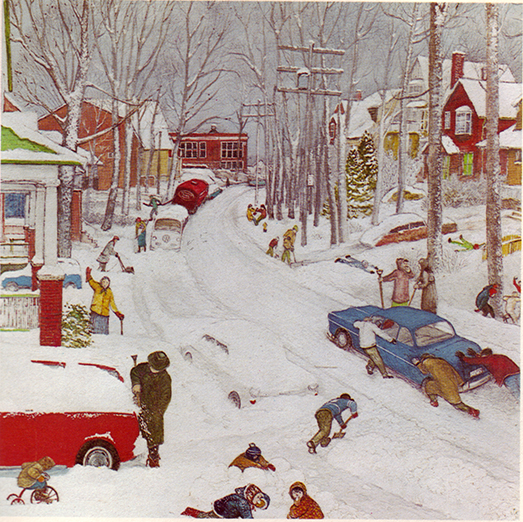
For those who don’t know, Kurelek lived on Balsam Avenue in the Beach for many years and one of his most famous and well-known paintings features a view of the street while residents deal with a heavy snowfall in a variety of ways.
The painting from 1972 is titled Balsam Avenue after a Heavy Snowfall. The view is looking south from approximately Kurelek’s driveway towards what was the old Balmy Beach Public School.
Whenever we get a heavy snowfall, I try to see if we can recreate the scene in a photo. I’ve come to accept we’ll never be able to get it quite right for a number of reasons including that the school building no longer exists. And, of course, a painting is not a photograph and artists have enormous freedom to interpret and put into paintings whatever they wish. News photographers can’t do that, which is as it should be.
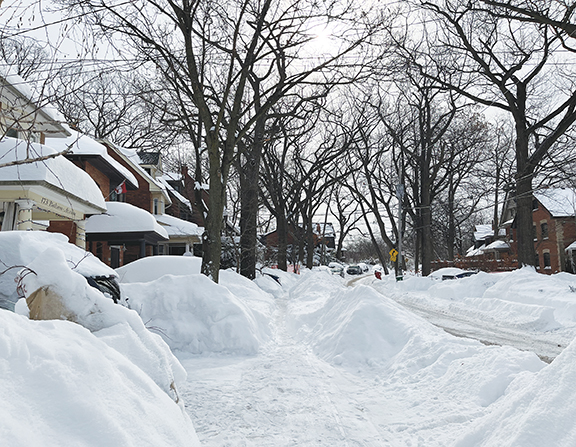
So why am I talking about William Kurelek and a painting that is more than 50 years old?
Well, it’s not just because we had a heavy snowfall on Jan. 26 of this year.
In our Jan. 20 edition of Beach Metro Community News, many readers would have seen local historian Gene Domagala’s Beach Memories column on some of the community’s most famous residents through the years.
The very first person Gene mentioned in the column was Kurelek. Which, of course, prompted someone to write us a letter complaining that Kurelek wasn’t mentioned in the column. (Welcome to the world of the editor — which is most definitely not a dog’s life though I digress.)
When I put Gene’s column up on our website, I thought it would be fun to include Kurelek’s Balsam Avenue painting to go with it. So I did, because I am all about fun.
I also put a link at the bottom of the column to a story Sheila Blinoff (general manager here at Ward 9/Beach Metro Community News for 40 years) wrote about Kurelek in 2017. What’s especially interesting about Sheila’s story is not only did she live on Balsam Avenue on the other side of the street from Kurelek but she is also in the painting – holding a snow shovel and chatting with a neighbour.
“One day around 1972 I was clearing snow, when I saw Bill Kurelek on his steps photographing the street. The result was one of his most recognized and pleasing pieces, a commissioned work entitled ‘Balsam Avenue after a Heavy Snowfall’. This could be almost anywhere in Toronto, but the streetscape and people in the foreground are instantly recognizable to anyone living there at the time,” wrote Blinoff in her article marking the 40th anniversary of Kurelek’s death in 1977.
“The old Balmy Beach School, razed around 1974, is in the distance. Bill Kurelek is brushing off his car and his four young children are playing in the snow. Three men are pushing a stalled car. And on the pavement outside my house are two women, shovels in hand talking – my neighbour and myself, I like to think.”
Which brings me to conversations I’ve been having for more than a year with Randy Walker who also grew up on Balsam Avenue at the same time as the Kurelek family and near their home as well.
Randy now lives in Oshawa and has been taken by the connections with Kurelek and some of his own father’s experiences. Randy also says he is in the Balsam Avenue painting and is probably one of the boys/men either pushing the car or shovelling.
“The southern view of Balsam Avenue in the 1972 Balsam Avenue painting always resonated with me because it was the same view I would see on my way to Balmy Beach School, where I spent a lot of time in my youth,” wrote Walker in a note he sent me.
Walker’s house also appears in the painting. “It’s the side of the porch, the dormer near the top which was my brother’s bedroom at the time, and the old oak tree are in the painting.”
Walker believes he is either the person on the “back left” pushing the car or “the guy on his left shovelling snow”.
In 2008, Walker asked Kurelek’s wife Jean if she could identify all the people in the famous Balsam Avenue painting. Her answer was basically that she had asked William before he died the same question due to inquiries from others as well, and that William had said: “It’s all in the eye of the painter.”
But Walker’s connections go beyond his house and his possible/probable appearance in the painting. Like Kurelek, Walker’s father had also lived in Winnipeg, gone to art school and did a number of paintings of his own; but being an artist was not his career.
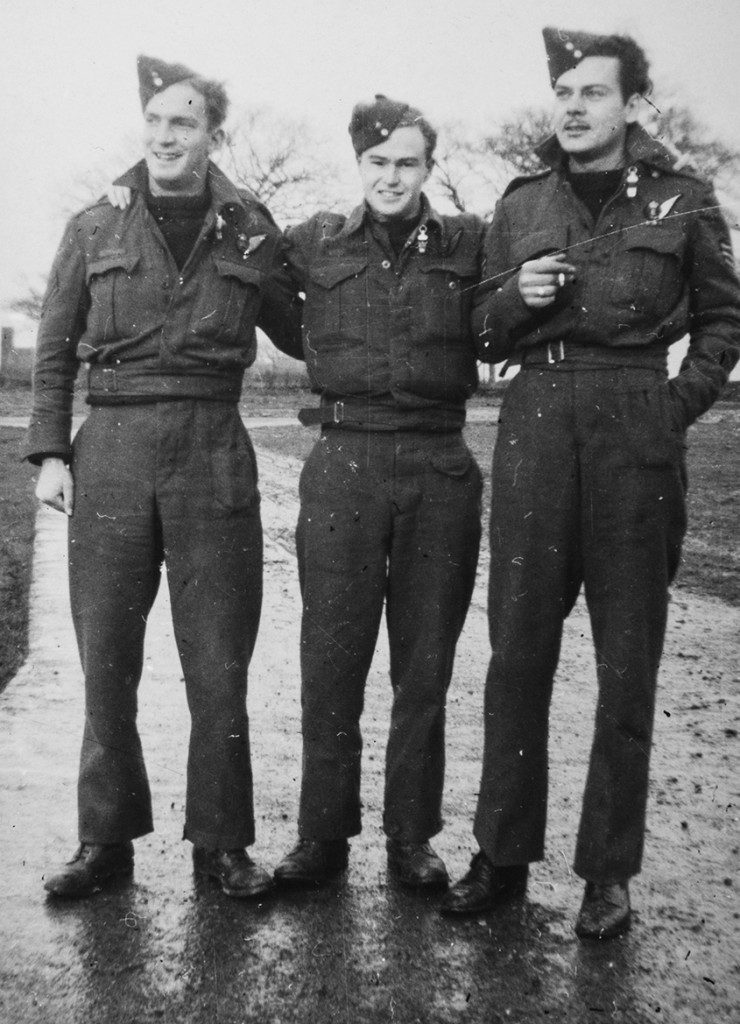
Walker’s father Wilfred J. Walker served in the Royal Canadian Air Force during the Second World War. As a flight engineer with the rank of sergeant, Wilfred flew 17 operational missions from air bases in England including one close to the town of Newton-on-Ouse.
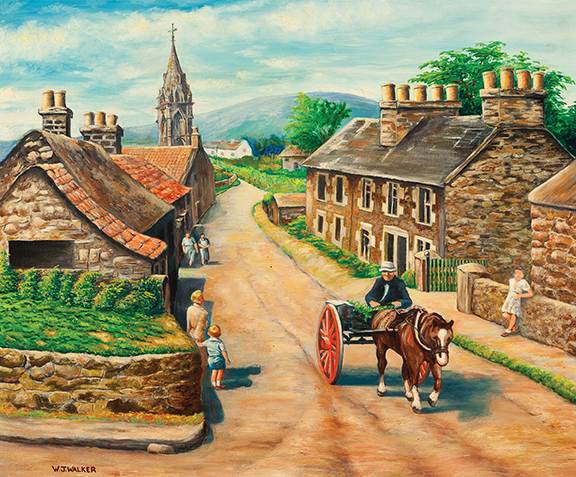
And it was in that North Yorkshire town, with a distinctive and ancient tower and steeple from the All Saints Church that air crews used as a navigational aid when trying to locate their landing field, that Wilfred was inspired to create a painting of his own featuring Newton-on-Ouse. Walker has shared an image of his father’s painting with me.
Newton-on-Ouse is also known as being where an RCAF Halifax bomber crashed after returning from a mission in June of 1944, taking the lives of six of the men on board, four Canadian and two British. The Canadian airmen are buried in the nearby Harrogate Stonefall Cemetery in Yorkshire. The two British airmen were buried in cemeteries closer to their hometowns.
Walker also shared photos of his father with fellow airmen at that base. (While looking at one of the photos I was taken by how much he resembled Toronto Maple Leafs captain Auston Matthews. Let me know if you think so too.)
I’m happy to have been able to share this information with our readers, especially those who remember the Walker family from Balsam Avenue in the 1960s and 1970s.
But I’m not done with the paintings of William Kurelek quite yet.
You see, there’s this place called the Glen Stewart Ravine in the Beach — I’m sure you’ve heard of it. It’s been in the pages and on the website of Beach Metro Community News a lot lately due to a 13-storey residential building planned for Kingston Road on the ravine’s north side.
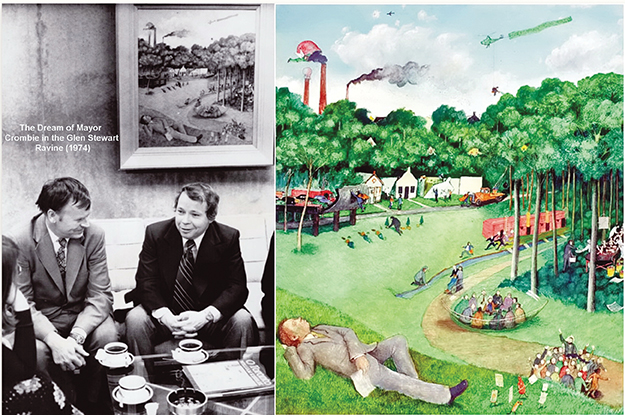
Thanks to Sheila Blinoff’s 2017 article, I knew that Kurelek had done a painting called The Dream of Mayor Crombie in the Glen Stewart Ravine.
I also know from Sheila’s article that getting Glen Stewart and Glen Manor confused is a great and long-lasting Beach tradition.
Here’s what she wrote in her article:
“One day I started walking back to the newspaper office after lunch when Bill Kurelek came across the road and asked: ‘What is the name of the ravine behind your garden?’
‘Glen Stewart Ravine.’
‘Not Glen Manor?’
‘No, Glen Stewart.’
‘I hope you’re sure because I’m giving a painting to the mayor this afternoon, and I have to have the right name.’”
And later on that day in 1974, Kurelek indeed went down to Toronto City Hall to meet with Crombie, have a cup of black coffee and present him with the painting.
I know this thanks to a photo of the presentation sent to me by former Beacher, and now Vancouver Island resident, John Hillis who still keeps up with the news from his old neighbourhood by reading Beach Metro Community News online.
Now I have to say that if you thought there was a lot going on in Balsam Avenue after a Heavy Snowfall, that painting is child’s play compared to The Dream of Mayor Crombie in the Glen Stewart Ravine.
I leave it to others to describe the painting since in my case (and this is a rare moment), words fail me.
“The Dream of Mayor Crombie in the Glen Stewart Ravine (1974). Kurelek’s social criticism becomes more explicit. The reclining Toronto mayor dreams of little supermen halting excessive urban development and putting caps on gushing smokestacks, while at the same time the city collects money from a man working at a conveyor belt where doctors are carving up small infant figures,” reads one description of the painting.
See what I mean about a lot going on.
Hillis sent me information on the painting as a reaction both to Gene’s Beach Memories column mentioning Kurelek (thanks again for reading and understanding the first paragraph before sending me a letter) and in response to our reporting on the development proposal near the Glen Stewart Ravine and the community opposition to it. More than 50 years on, and the painting is as timely as ever.
Here’s another description of The Dream of Mayor Crombie in the Glen Stewart Ravine:
“It’s ironic Mayor Crombie should have invited artist Bill Kurelek to his office to discuss the very painting that’s satirical and skeptical of government intervention to protect the environment. Indeed, the planned Gardiner Expressway ‘extension’ is halted in the upper left of the painting, yet the seemingly irreverent Mayor appears oblivious to city bureaucrats chasing after the developer clutching his bag of loot, the biologist taking water samples from Ames creek before disappearing into a culvert to be conveyed under Glen Manor Park and a person’s vain attempt at reforestation by planting a few seedlings neatly aligned in a straight row. Equally ironic is that this artwork resides in the archived City of Toronto Artifacts Collection but not surprising that it’s not hanging up somewhere on a wall at City Hall.”
According to Sheila’s article the painting could be seen at the Market Gallery on Front Street East in 2017. I was going to check recently to see if the painting was still on display there, but the gallery’s main exhibition area (located in the council chamber of what was Toronto’s first city hall) was closed while a display was being set up. However, The Dream of Mayor Crombie in the Glen Stewart Ravine is still listed as being in the City of Toronto’s Art and Artifact Collection.
While I will never claim to understand even a quarter of what is going on in that painting, I must note that what is referred to as the stopping of the Gardiner Expressway extension is in actuality the proposed Scarborough Expressway and that was indeed stopped by local residents from literally plowing through the area between Coxwell and Victoria Park avenues, destroying more than 700 homes and paving over parkland.
I will also note the fight to stop the Scarborough Expressway in 1972 was one of the defining causes leading to the creation of your beloved Ward 9 Community News (now Beach Metro Community News).
Our April 5, 1972 edition featured a story calling for a public review of the Scarborough Expressway plans, and that was just the beginning of the fight to stop it and this newspaper’s coverage of the issue.
And the more things change…


W.J. Walker does look like Auston Matthews and they were both winners.
Thanks for this wonderful piece. As a fan of Kurelek I’d love to see the crombie dream painting someday.
I love the painting by Bill Kurelek. Such talent!