
Are the Queen Street East development guidelines for the Beach now a relic from the past?
By MATTHEW STEPHENS
The apparent dismissal of the Queen Street East Urban Development Guidelines (UDG) by the City of Toronto has raised concerns among some of the people who helped create the planning document for the Beach community more than a decade ago.
Discussion about new building regulations in the Beach, and questions about the relevance of the 2012 Queen Street East UDG, were raised at the Jan. 22 meeting of the city’s Planning and Housing Committee. (See our story linked below.)
“When we have individuals that come down and make deputations, it’s almost misleading like these guidelines from 14 years ago are the law – completely ignoring the planning paradigm and the provincial planning statutes the city is statutorily required to comply with,” said Beaches-East York Councillor Brad Bradford at the Jan. 22 meeting.
Adopted by the city in 2012, the Queen Street East UDG was the result of a collaborative effort between local residents, including members of the Greater Beach Neighbourhood Association (GBNA), and current Beaches-East York MPP Mary-Margaret McMahon (who was Ward 32 Beaches-East York city councillor from 2010 to 2018), and the city’s planning department.
The guidelines limited building heights along Queen Street East in the Beach to six storeys between Coxwell and Neville Park avenues, and also set design standards to preserve the area’s character.
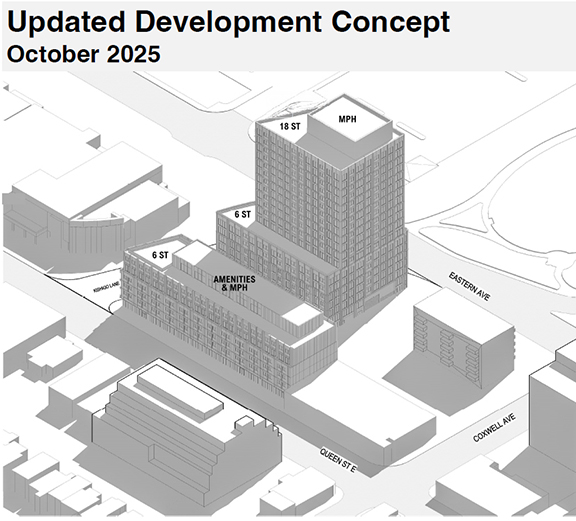
At the Jan. 22 Planning and Housing Committee meeting, members of the public and councillors discussed a development proposal at 1631 and 1641 Queen St. E. and a portion of 1080 and 1090 Eastern Ave., where an 18-storey residential building facing Eastern Avenue and a seven-storey residential building facing Queen Street East have now been approved for consideration at Toronto Council.
Mark Richardson, a local resident and Technical-Lead of the HousingNowTO group (which is an affordable housing tracking and transparency project), said the Queen Street East UDG was from a “past” era at the Jan. 22 meeting.
“It’s important that we contextualize that the rules that were passed in the past are from the past, and that things like the Beaches (Queen Street East) Urban Design Guidelines are only guidelines. They are not the Beach bible, as some people refer to them,” said Richardson.
The comments by Richardson and Bradford drew a response from GBNA members who helped establish the Queen Street East guidelines in 2012.
“These guidelines should not be so easily dismissed. They’re not just guidelines, they were adopted by city council and created by the city planning department with considerable community input,” said Uwe Sehmrau, board director of GBNA.
Sehmrau said the comments at the meeting were “irresponsible” sentiments of “personal opinion” that could set a precedent for future developers in the Beach to disregard height and density constraints established by the 2012 guidelines.
“It kind of implies to the development community that these guidelines are no longer valid. There’s every possibility to apply and get approval to build whatever you want. It’s creating this situation of the wild west of development again, where there are no guidelines,” he said.
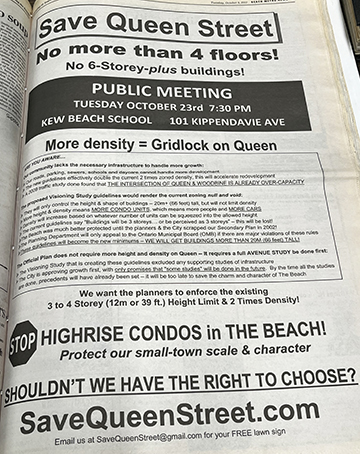
Jeffrey Levitt, another member of the GBNA who worked on the guidelines, said the city’s ineffective communication of the building regulation changes has created confusion amongst residents with each new development proposal.
“There’s nothing posted on the city’s website to indicate that the guidelines have been superseded by other city and provincial policies, and should therefore not be relied upon by Beach residents,” said Levitt. “Otherwise, confusion reigns, which is one of the reasons why we’re still talking about this.”
During a community meeting about the proposed 11-storey (now 10-storey) residential building at the Murphy’s Law site in the Beach, City Planner Sean Guenther said developers now adhere to the city’s 2024 Mid-Rise Guidelines which define a mid-rise property as five to 14 storeys in height.
The Murphy’s Law site proposal, at Queen Street East and Kingston Road and firmly in the area covered by the Queen Street East UDG, will be discussed again at a public meeting at Toronto and East York Community Council on Thursday, Feb. 19.
Sehmrau said building context and housing needs vary widely across the city, and that making site-specific exemptions would have been more effective than applying an all-encompassing Toronto-wide set of mid-rise guidelines to every project.
“It’s really something that could be dealt with as a site-specific amendment,” said Sehmrau, specifically referencing the Queen Street East and Eastern Avenue proposal that received unanimous approval from councillors at the Planning and Housing Committee meeting. “It didn’t have to require the dismissal of the (Queen Street East) guidelines for the entire area.”
For that specific proposal, which is expected to include “notable plusses” such as an expanded childcare centre and a “large affordable housing” component, Sehmrau said he believes residents would have been in favour of increased density and height if the project had been accepted as a one-time exception to the Queen Street East UDG.
“I think this community would be quite accepting to the needs for the city to address housing issues,” said Sehmrau. “With justification of addressing these city needs, there wouldn’t be this community concern and fear that we’re entering a period where anybody can apply for anything.”
Levitt said a site-specific exception could have been “easily addressed,” given that the development will be built on city owned land.
McMahon, who also stressed the importance of building more affordable housing, said it should be “up to the community and municipal politician” to revisit building regulations in the Queen Street East area.
“If they want to revisit it, revisit it with everyone again. Bring everyone into the tent and do the proper due diligence and ensure everyone is at the table and their voices are heard,” said McMahon.
While some have pointed to the age of the guidelines, Sehmrau said the Queen Street East UDG was implemented to serve as a “guide” for future generations of residential development in the area.
“Mark Richardson and Brad Bradford said that these things are in the past and that we live in the past. The tool was developed by the city planning department that would guide development into the future going forward,” said Sehmrau.
“It’s not a relic that it exists only in 2012. It was created to guide the future; where we are now.”



Thanks @Matthew.. Moving to Toronto in the `70’s w.living Parkdale.. East York.. Scarborough.. “My best”/fav neighbourhood was near Decade on >>> Algonquin and Wards Islands. <<<Friends and Neighbours Life< pulsed around regular ferry schedules w/brief conversations "routinely".. So in 2025 here's one wishing for a return to more local businesses promoting less travel distances for the rest of the neighbourhood where barter rocks. [wink] cheers L