
Housing committee approves plan for 18-storey and seven-storey residential buildings in Queen/Coxwell/Eastern area
By MATTHEW STEPHENS
After years of controversy, a residential project just southeast of Coxwell Avenue and Queen Street East received unanimous approval from the City of Toronto’s Planning and Housing Committee at a meeting last week.
The committee heard deputations from three speakers, two of whom spoke in favour of the project.
“I live 350 metres north of the subject site. I am in favour of the proposal. I’ve been following the application since its announcement as part of Housing Now phase two, and I am encouraged to see it in front of the committee today,” said local resident James Gray during his deputation to the committee on Thursday, Jan. 22.
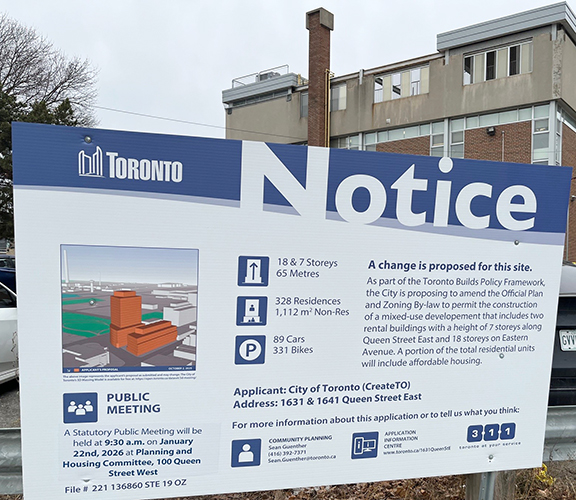
The development proposal, which encompasses the area of 1631 and 1641 Queen St. E., and a portion of 1080 and 1090 Eastern Ave., calls for an 18-storey residential building facing Eastern Avenue at the south end of the site, and a seven-storey residential building facing Queen Street East at the site’s north end. The site will include 328 new rental units, 20-30 per cent of which will be affordable.
Its scale and potential impact on the neighbourhood have made the proposal a contentious topic among local residents for half a decade.
During a consultation meeting held in October last year by CreateTO, an agency tasked with managing the city’s real estate assets, and City of Toronto staff, residents reiterated numerous concerns about the project since it was first announced back in 2020. Those concerns included building height, lack of “truly affordable housing,” and worries that the 18-storey building facing Eastern Avenue could compromise the “character” of Queen Street East.
“When you look at what’s actually affordable for the average person, the affordable rent is what regular rent should be,” said local resident Adam Smith during last year’s community consultation meeting to discuss the proposal.
Deputant Mark Richardson said the time for increased density and higher buildings in the Beach has come, despite past planning rules limiting building heights in the area.
“It’s important that we contextualize that the rules that were passed in the past are from the past, and that things like the Beaches Urban Design Guidelines are only guidelines. They are not the Beach bible, as some people refer to them,” said Richardson, a local resident and Technical-Lead of the HousingNowTO.com affordable-housing tracking and transparency project.
Richardson championed the project for taking the necessary time to acquire the adjacent Harvey’s restaurant at 1641 Queen St. E., and adhering to the city’s latest iteration of the Toronto Builds (formerly HousingNow) initiative, which aims to improve affordable housing ratios and durations across Toronto.
Smith, however, who also gave a deputation at the Jan. 22 meeting, reaffirmed his disapproval of the proposal for its disregard of the Queen Street East Urban Design Guidelines (UDG), which were established in 2012 to limit building heights along Queen Street East in the Beach to six storeys between Coxwell and Neville Park avenues.
“It seems Toronto has completely discarded what used to be good planning principles,” said Smith in his deputation. “While the Queen Street building only gets an extra storey, putting an 18-storey tower directly behind it completely negates the purpose of the guidelines in keeping building heights in line with the character of the neighbourhood.”
During his deputation, Smith presented mock-up photos of what the 18-storey building facing Eastern Avenue will look like when construction is complete.
In response, Beaches-East York Councillor Brad Bradford said the mock-up photos used by Smith were taken before the Don Summerville Community buildings at 1555 – 1575 Queen St. E. and 1070 Eastern Ave. were constructed, which has since changed the existing context around the proposal site.
“When you made a comment that it sets a precedent and that there’s nothing like this in the area, would you acknowledge that actually just a few hundred metres from the site, there is affordable housing, same size and scope?” said Bradford in response to Smith’s deputation.
Smith argued that the Don Summerville project “is not entirely affordable housing,” despite Bradford’s assertion that the photos used in Smith’s deputation were not “representative of the view” that can be seen today.
Beyond the exchange between Bradford and Smith, other members of council also raised questions about the scope of the proposal.
Toronto-Danforth Councillor Paula Fletcher questioned why the adjacent Toronto Community Housing Corporation (TCHC) building at 1080 Queen St. E. was not part of the development.
City staff said they assessed the existing six-storey building and its “difficult number of residents” before determining that it “had a long life ahead of it” and would not be considered for any kind of rezoning or expansion.
Fletcher also mentioned that she and Bradford received letters from the chair of city-funded agency Applegrove Community Complex, questioning why considering them for relocation to the development site once it was built had been revoked without any formal notice.
Currently, Applegrove Community Complex is located inside TDSB’s Duke of Connaught Junior and Senior Public School at 60 Woodfield Rd.
Although they were not mentioned in the report headed for consideration at the next Toronto City Council meeting, city staff confirmed the opportunity for the agency to be incorporated into the project still remains.
When asked why Applegrove had been left out from the latest report, Deputy City Manager of Development and Growth Services Jag Sharma told Bradford he was “not sure that we could answer as clearly as we would like at this point and time,” and that there was still a “funding decision to be made.”
Bradford ensured city staff remain committed to working with councillors and Applegrove to help “identify prospective options for their relocation.”
In his closing remarks, prior to the proposal’s unanimous vote of support from the committee, Bradford said that the Queen Street East UDG no longer aligns with the current provincial planning framework to build new housing, or the city’s increased housing challenges.
“When we have individuals that come down and make deputations, it’s almost misleading like these guidelines from 14 years ago are the law – completely ignoring the planning paradigm and the provincial planning statutes the city is statutorily required to comply with,” said Bradford.
Bradford said at the meeting that it was important for municipal politicians to acknowledge how both the provincial planning framework has changed, as has the city’s needs for more housing. “How the context of the city has changed. How the challenges and the demands and the pressures that we’re facing have changed,” he said.
“References were made to the 2012 Queen Street East Urban Design Guidelines, I think Mark Richardson called them the Bible or a tablet – Old Testament, New Testament. Here’s what it is: it’s a document from 14 years ago that were just guidelines at the time. So, Adam Smith likes to come down here from time to time with good intentions, but I feel like whenever I listen to his deputations it’s always like opening up a time capsule. You know, we talk about the Lick’s development from so many years ago where there was a lot of ink spilled at the time about that, but I go down to Queen Street all the time, and I think it looks fabulous,” said Bradford.
“Whether we like it or not, we’re not living in 2012 anymore. I think that comes across as misinformed at best, or maybe even misleading at worst. And I don’t think that’s how we build cities, I don’t think that’s how we build community, and I don’t think it’s particularly helpful in the Beaches. So, a position like that would likely come at the expense of affordable units for families, for seniors, for workers that our community so desperately needs. A position like that would probably come at the expense of the enhanced childcare spaces from the work that we’re doing in the public realm.”
“And again I remind folks, these positions and decisions that we make are difficult, but we have to consider all of the factors in front of us, try and come up with a balanced position, and one that moves this city forward, not one that’s handcuffed to a world that we were living in 15 years ago.”


Comments (0)
There are no comments on this article.