In My Opinion: Get to know and understand the people who are being helped by local food banks
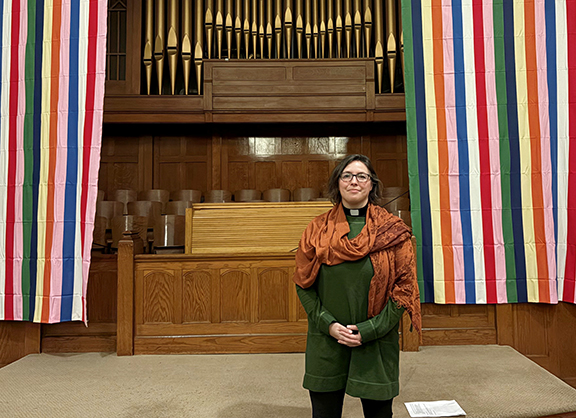
By REV. BRI-ANNE SWAN
When you hang out at a food bank, you soon realize that behind every bag of groceries there is a story of someone trying to hold their life together.
I had thought that was obvious. However, a recent opinion piece in the National Post argued that food banks have allowed themselves to become too “exploitable.” The writer suggested that, in the past, shame acted as a gatekeeper — and that today, especially because newcomers to Canada haven’t been taught to feel that shame, food banks are feeding people who may not truly deserve help.
I serve as a minister with the United Church of Canada at East End United Regional Ministry. We work out of two locations: Eastminster Campus at the Danforth Multifaith Commons, and Glen Rhodes Campus at the East End Food Hub on Gerrard Street East.
From the Food Hub, we run Nourish East End, our food justice ministry, which includes monthly community meals and a weekly, market-style food bank. Nourish (formerly the Glen Rhodes Food Bank) has been serving the Gerrard–Coxwell neighbourhood for decades.
We are deeply grateful for the generosity of residents across Toronto’s East End. Your donations allow us to purchase culturally and dietary-specific items, and to augment the amount of food we can offer our clients.
As food bank use rises (now more than one in 10 Torontonians) our shipments from Daily Bread have decreased. Your support allows us to continue to help those who need it.
Because of that generosity, I want you to know who your care is reaching. Each week, Nourish supports about 600 people, which represents over 300 households.
Roughly 20 per cent of the people we feed are children. That number is lower than many food banks, largely because a significant portion of our clients live in rooming houses or other forms of shared accommodation. Nearly half of the people we serve identify as members of visible minority communities.
More than half live in private rental housing. This matters. Hunger isn’t confined to people already “in the system.” It turns up wherever rent is high and housing stability is precarious.
The income data of those accessing the Nourish food bank is distressing. Around 25 per cent of our clients rely on social assistance. Another 28 per cent receive disability-related benefits. And one in four report having no income at all.
These figures certainly don’t describe folks who are trying to “game the system.” They describe people trying to stay afloat.
Less than 10 per cent of our clients are post-secondary students. This is significantly lower than the citywide average of 31 per cent. Across Toronto, many food banks are seeing a rise in international students seeking assistance. This has, at times, prompted public criticism: Why allow students to come here if they can’t support themselves?
But that question misses a key point. Public funding for post-secondary education has steadily declined, pushing colleges and universities to rely on international students who pay far more for the same education. After covering rent and utilities, many are left with almost nothing — on average, just $3.30 per day. That’s not even enough for TTC fare, let alone a meal.
Many of the people who volunteer at Nourish are also receiving support from it. This model is community care in action.
While there may be some who feel we should be doing more (Providing more food? Requiring more screening?) food banks did not create this crisis of food insecurity. We are responding to a system that has left people with few other options.
And we were never meant to be permanent. Food banks were introduced as stopgaps during the economic crisis of the early 1980s. They were only ever meant to be temporary, carrying people through a particular moment of widespread hardship. But those stopgaps became permanent. Now food banks are woven into our social safety net in ways that were never intended.
Instead of asking why so many are being forced to make impossible choices between food and shelter, some are asking whether food banks should sort the “deserving” from the “undeserving.” That is not a question food banks are equipped — or ethically positioned — to answer. Because hunger is a policy outcome. It’s also a societal failure.
When benefits don’t keep up with inflation, and shelter is treated as a commodity rather than a basic human right, financial insecurity follows. All the time. Every time. And people become hungry.
We are committed to what we do. But our ultimate goal is to find ourselves out of a job. No one should be without food in a country as resource-rich as Canada.
Meanwhile, we’ll keep showing up on food banks days with gratitude to everyone whose generosity helps us care for our neighbours.