Local resident’s milk bag mats help make a difference for Street Health Toronto clients
By JULIA SAWICKI
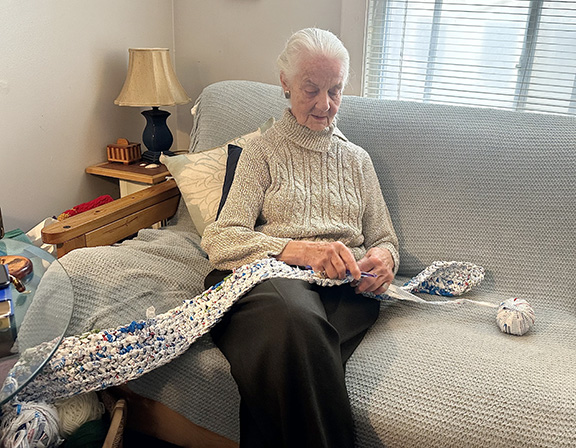
Loretta Mcdonald is a lifelong crocheter whose home is filled with hooks, yarn, wool and, for the last 15 years, milk bags.
She first encountered plastic yarn while donating clothes at Canadian Food for Children. The charity showed her how they turned the plastic material into mats, sending them to countries in need. The material was surprisingly durable, easy to clean, comfortable to sit or sleep on, and ideal for reusing.
Mcdonald took a box home that day and began making mats for the organization, a practice she continued for years before realizing she could make an impact closer to home.
“I thought, ‘Oh my goodness, we need to do something for the people in Toronto,” she said.
The 2024 Street Needs Assessment Survey reports that the number of unhoused individuals in Toronto has more than doubled since 2021, estimating approximately 15,400 people. Many experts describe the situation as a crisis, and Mcdonald saw the effects daily.
She connected with Street Health Toronto, and learned she could create mats using regular milk bags, the colourful outer ones commonly thrown away. Through eliminating plastic waste she transforms the bags into something to help keep people warm.
She began cutting the bags into strips and rolling the material with friends, later reaching out to schools and churches, asking them to collect milk bags for her when supplies ran low. One bag cuts into an eight-foot strip that crochets into roughly one to one-and-a-half feet. Depending on the size of the mat, Mcdonald uses between 250 and 300 bags.
Apart from crochet, there are various techniques used when making the mats, including weaving them on a frame. Mcdonald says she finds crochet the simplest, but it depends on what people are comfortable with.
Each mat Mcdonald makes is roughly the size of a yoga mat and tied to make it easier for people to carry. She also gives each mat a distinct look. If a milk bag has red packaging, she keeps all the red strips together or incorporates them into a pattern. She said this helps prevent theft, which she has learned is an unfortunate reality for many unhoused people.
When she has extra time, she also crochets yarn hats and gloves to accompany the mats. “The clients were really needing them. Because you can put them down, and they do not absorb the water, and it does not get dirty like other fabric would. You can wash it easily, the bugs do not like it, and it gives insulation. Some people put them in their sleeping bags,” explained Mcdonald.
In recent years, Mcdonald has turned to the community for help. She posts in the Beach Facebook Group whenever she runs out of milk bags and asks residents to message her for drop-off information. She said the response has been wonderful and often finds neat stacks of cleaned milk bags left at her door.
She added that once a church group dropped off the bags already cut into strips, and rolled them into makeshift yarn balls before delivery, which is a tremendous help and allows her to focus on the stitching.
She encourages others to learn to crochet the bags themselves, even if the process is not glamorous. Tutorials are available online and she has offered to teach people in the past when residents have reached out.
Mcdonald is not the only person to make milk bag mats; there are various organizations and charities that have implemented the project, but there are still far more milk bags than there are hands to crochet them.
“It’s not sexy. It’s boring plastic, nobody wants to do it. Not my family. ‘Oh mom, you and your milk bags.’ They’re so sick of me. But it’s useful and so to me, it’s magic,” she said.
For Mcdonald, the bags are not only a way to give back to her community. They are a way for her to use her time productively, keeping her hands moving, teaching her patience and mindfulness. She works to make sure she can offer a little more comfort to the people who need it most, while taking care of herself in the process.
“It is something so simple. To me, it has been a lifesaver since retiring and losing my husband. And it helps you focus. Once you get going, it is mindless, but you do have to focus. There are all kinds of life lessons in it. But this is true of any hobby, I think. And if you have a hobby, then you can learn so much,” said Mcdonald.
For a tutorial on cutting and crocheting your own milk bags, please visit https://www.instructables.com/Making-Milk-Bag-Mats-Mats-4-Haiti/
For information on milk bag matt drop offs, please visit https://milkbagsunlimited.ca/networks/
To reach out to Mcdonald directly, please visit https://www.facebook.com/profile.php?id=100086602634383