The Afro-Metis Nation’s album Anthem celebrates Black, Indigenous and Nova Scotian legacy
By MATTHEW STEPHENS
In 17th and 18th century Canada, European settlers would frequently enter relationships with Indigenous women as a social and economic strategy to secure trade routes, enhance regional access, and foster alliances between European and Indigenous peoples.
From this distinct union, a mixed-ancestry community emerged with its own unique culture, traditions, and language – forming what is now known as the Métis Nation of Canada.
During that same time, African slavery was still ongoing in Canada, particularly amongst the fur trade community in the Great Lakes region.
Slaves who had escaped bondage at the time also found themselves forming relationships with Indigenous women, resulting in what Leonard “Sugar Plum” Woodworth Croxen calls the Afro-Métis. The term also serves as the name for an ensemble of multicultural Canadian musicians who celebrate the legacy of people with mixed Black, Indigenous, and Nova Scotian ancestry; of which Croxen is a part of.
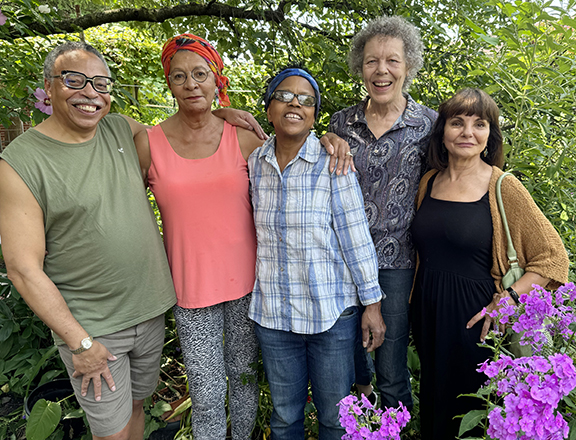
Alongside Croxen, Canadian poet, playwright, musician, literary critic and East Toronto resident George Elliott Clarke is another member of the harmonious ensemble known as The Afro-Métis Nation. Other members of the group include Linda Carvery, Karen Ashton, Sheila White and Shelley Hamilton.
Earlier this year, the group released their second full-length album, titled Anthem – a project Clarke described as a follow-up to their 2019 album Constitution. The 2019 album saw members Croxen, Hamilton, and Clarke nominated for Indigenous Songwriter of the Year honours at the 2020 Canadian Folk Music Awards.
Through descriptive and heartfelt lyrics, Anthem is a 16-track album that puts storytelling on full display with songs that invite listeners to reflect on the group’s Black and Indigenous lineage.
“It is important to be able to verify exactly what your roots are,” said Clarke. “In my case, my matrilineal great grandmother was a woman by the name of Emma Gibson. She lived in a place called Gibson Woods, where there was a lot of interconnections between Indigenous and Black in that part of Nova Scotia.”
Clarke said it was vital for the group to cohesively blend the differences and similarities between the Black and Indigenous experience in North America throughout history.
“The balance struck is reflective of who we are: Most folks see us as Black – and we grew up in Black communities, mainly. So, the poems and songs reflect our experience as visibly Black, but less visibly Indigenous,” said Clarke.
“On Anthem, we decided to just do the songs and poems that interested us, knowing that our very voices and instrumentation embody or project our mixed-race experience.”
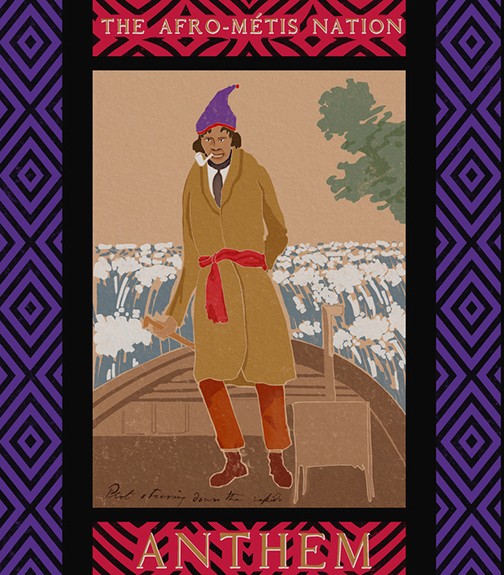
With songs like Raised in The Lost and Found and Surviving the Storm, the album utilizes themes of oppression, struggle, and perseverance to encapsulate the Back and Indigenous experience across North America throughout history.
Clarke puts his poetic mastery on full display when he’s front and centre on songs such as Homecomin’ Roam-No-Mo’ Blues and Letter from Department of Indian Affairs Ottawa 1921, which evoke sounds reminiscent of spoken-word poetry.
Clarke developed an affinity for lyricism and music at an early age, which later translated into an amalgamation of passions.
“On July 1, 1975, at the age of 15, I decided I should be a pop song lyricist, following in the footsteps of Elton John’s lyricist, Bernie Taupin. I began to write four song lyrics a day. However, in reading books about being a lyricist, I kept receiving the advice that the best lyricists are poets,” he said.
“So, I switched from writing song lyrics to writing four poems (usually ‘free verse’) per day. I began to mix Allen Ginsberg with Bob Dylan; that is to say, I began to understand that a good poem is always close to being a good song.”
The next step in Clarke’s journey took him to University of Waterloo, where he focused on British literature and began honing his craft as a poet.
Following studies at several universities, including University of Waterloo, Dalhousie, and Queen’s University, as well as writing several poetry books – Clarke turned his attention to music in 2016 and co-founded The Afro Métis Nation, which originally went by the name Can (Canadian) Roots.
Clarke was the Poet Laureate of Toronto from 2012 to 2015 and the Canadian Parliamentary Poet Laureate from 2016 to 2017.
For those longing to experience Clarke’s spoken word poetry in its purest form, on Anthem he delivers track 15 titled Everything Is Free #1 in the spoken word format.
For Clarke and The Afro-Métis Nation, Anthem is the group’s way of emphasizing their continued fight to establish those with Black and Indigenous roots as members of the Métis Indigenous community.
“Our historical connections are very deep, but have also been strongly repressed in Canada for various reasons,” said Clarke. “According to the Government of Canada, the official definition of Métis is that you have to be descendant of European and Indigenous people involved in the fur trade, only as prosecuted between Ontario and British Columbia, which is completely ludicrous.”
“The best way to oppose governmental injustice is by satire and ART,” he added.
For more information about The Afro-Métis Nation, please visit https://afrometis.ca/