
In My Opinion: Ontario’s ban on speed cameras is bad for drivers, worse for public safety
By MATTHEW STEPHENS
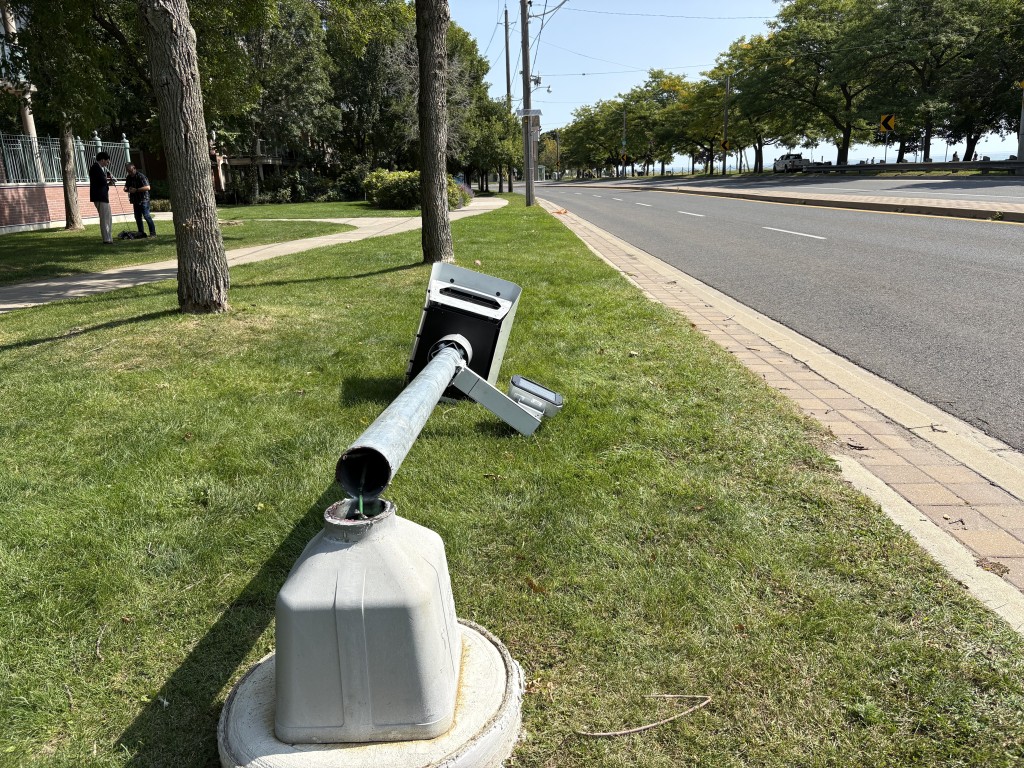
In recent years, speed camera vandalism has become common place in the City of Toronto, with the camera along Lake Shore Boulevard East being cut down twice since it was installed back in April, and another on Parkside Drive near High Park cut down seven times.
The situation reached a tipping point earlier this year, after 16 Automated Speed Enforcement cameras were vandalized across the city overnight on Tuesday, Sept. 9. (including the Lake Shore and Parkside cameras), an incident which seemed to have caught the attention of the provincial government.
Later that month, Premier Doug Ford announced he would be introducing legislation to ban speed cameras across the province, stating that they were “gouging” taxpayers.
While an argument could be made that speed cameras “gouge” taxpayers, I question whether Ford’s stance is rooted in logic or emotion.
During a press conference to unveil the Lake Shore Boulevard East speed camera in the spring, General Manager for Toronto’s Transportation Department Barbara Grey said speed cameras collected a whopping $40 million in revenue for the city in 2024.
As much as my blood boils whenever I receive a picture of my car’s rear-end attached with a hefty fine in the mail, I’ve always felt like the situation would have been significantly worse if I’d been pulled over by a police officer for driving a few kilometres over the speed limit.
It might sound evasive and somewhat devious, but the ironic beauty of speed cameras was that they couldn’t actually determine who was driving the vehicle at the time, which meant no police pullovers, and no subsequent demerit points, insurance hikes, and risk of license suspension.
However, despite not being able to put a name – or rather, a car – to a face, there’s no doubt speed cameras could catch reckless drivers and minimize speeding far more efficiently than Toronto police ever will, regardless of how much revenue the city collects in the process.
Considering the police simply cannot be at every school, daycare, and pedestrian-dense area across the city, I will also fear for the safety of children and pedestrians in light of Ford’s new legislation.
In place of speed cameras, he said municipalities will be increasing speed bumps, roundabouts, and flashing signs to indicate when a driver is going too fast.
While these new (or old) measures may help to mitigate reckless driving in certain areas, there’s a reason why the City of Toronto transitioned to speed cameras in the first place.
Speed bumps are only effective on residential roads. And on busy arterial roads, flashing signs that come with no repercussions can be easily ignored by reckless drivers.
I understand where Premier Ford is coming from in trying to protect our wallets with this new legislation, but his response to ban speed cameras altogether is going to end up doing more harm than good – for everyone.
A study published by Injury Prevention to monitor the impact of mobile ASE cameras across 250 Toronto school zones between 2020 and 2022 showed a 10.7 km/hr decrease in maximum speed travelled by 85 per cent of vehicles. And for drivers travelling at higher speeds, the study showed even greater reductions, with an 88 per cent drop in vehicles travelling faster than the speed limit by 20 km/h or more.
There’s no doubt that speed cameras work, and if the city has to “gouge” taxpayers to ensure safety in areas where outdated speed mitigation measures are ineffective, it’s a worthy sacrifice in my opinion.
I think another misleading narrative is what the city is actually doing with the millions of dollars collected from speed camera fines. And the truth is that only a portion of the revenue earned actually goes back into the city’s pocket.
To break it down: according to the City of Toronto’s ASE Program Inquiry from 2025, the city’s Gross ASE fine revenue in 2024 was $37.3 million. Of the fine revenue received, roughly 35 per cent is expected to fund the city’s administrative costs, and approximately 24 per cent of fine revenues are remitted annually to the province.
The document further states that the remaining 41 per cent ($15.293 million) is used for the Vision Zero Road Safety Plan, a city initiative focused on reducing traffic-related fatalities and serious injuries on Toronto’s streets. This initiative includes the speed camera program.
So, if the money “gouged” from reckless drivers is going right back into the system to ensure reckless driving is mitigated, how can Ford justify that it’s a waste of taxpayers’ money? Especially considering only a portion of taxpayers drive, and an even lesser portion drive recklessly.
I do believe, however, that maybe the province should have revisited the cost of speed camera fines, considering many Ontarians are navigating a cost-of-living crisis.
I understand the goal is to deter people from driving recklessly, but perhaps if fines had been lowered, vandals may have never cut down the cameras, Ford may have never caught on and banned speed cameras, and the program would have continued to operate smoothly, albeit with smaller profit margins.
As much as I share Premier Ford’s concerns about costly fines, banning speed cameras across Ontario will cost us far more — in safety, accountability, and lives.


Comments (0)
There are no comments on this article.